Friday, 15 July 2022

A new Breyerfest Celebration Horse

With Breyerfest 2022 going on right now, there couldn't be a better time to introduce my latest arrival, 2019's Celebration Horse.

For those of you who don't know Breyer well, each July for the last thirty-something years they've held a big themed event in Kentucky, with model shows and contests, raffles and auctions and sales rooms, real horse guest performances, hobby clinics and talks, and special run model horses. Most of these models you have to pay for, of course, but the entry ticket includes one free model for everyone to take home : this is known as the Celebration Horse.

A lot of people who go will then sell on their free horse afterwards - maybe it's not a breed they care about, or a mould they like, or it's just the wrong scale to keep for their collection. So those of us who can't possibly afford to actually take part in Breyerfest, can often get a chance to get hold of these special runs on the second-hand market afterwards - I've been lucky enough to catch quite a few over the years. 
Some pop up more often than others - in a year where the mould/colour combination's not been very popular with fans, you'll naturally find a lot more of them being sold on! 2019's must have been a much-loved edition, very few have yet made their way to UK Ebay.

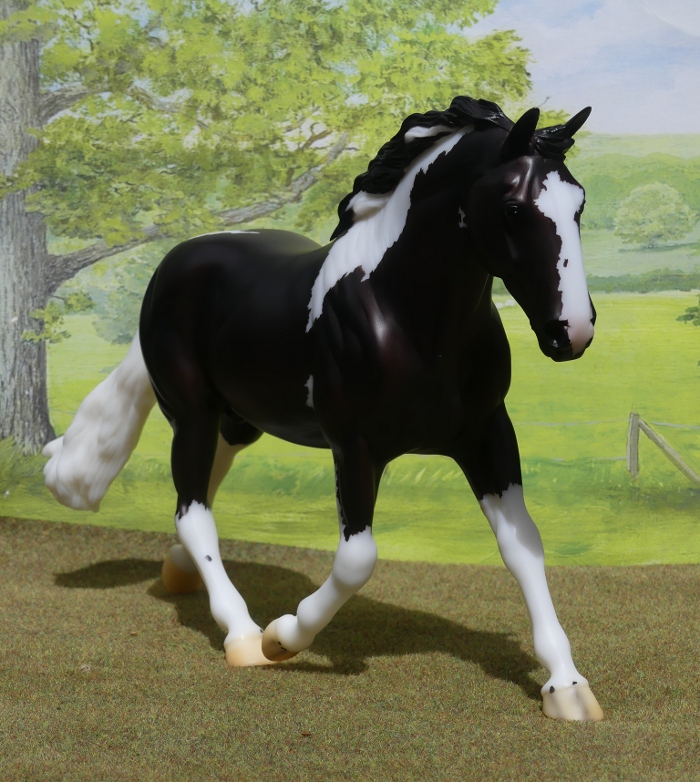
Here he is!


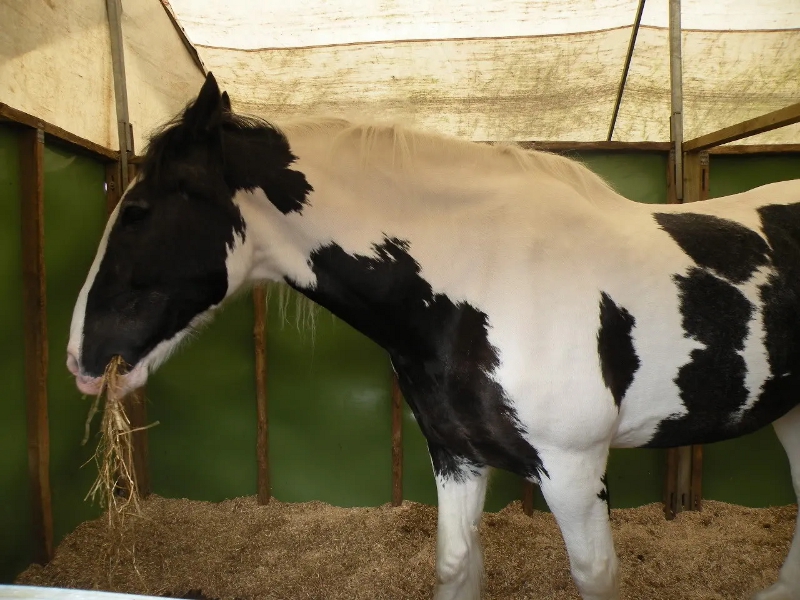
His official name is Oliver, and he's a portrait of a real horse with a long connection to Breyerfest - he's one of the mounted police horses who lives and works at Kentucky Horse Park, where it's held every year. So a lot of people who've been to the event will have seen or met the real Oliver, making him a very popular choice for the Celebration model. He's also a really big handsome chunk of a horse, a Shire cross with big bold markings which must make him very eye-catching when he's on duty.


This mould was sculpted as a Cleveland Bay, a hefty carriage horse breed from northern England, but has been released as other breeds too, from Irish Drafts to heavy crossbreds, and he does look pretty similar in build to the real Oliver. I'm used to seeing Shire crosses with the leg feather left on when they're shown in the UK, but it seems US draft crosses are more commonly trimmed to have neat heels.


At first glance he looks black and white, but there's a really pleasant hint of brown in his paint - and I also find Breyer's jet black paint tends to be glossy and not match the matte white areas, where this tinted dark dark brown isn't any shinier than his white bits.
The striped hoof detailing is a nice touch, this is the sort of thing which crops up when they're copying a real horse, added markings which they probably wouldn't have invented off-hand but need to be there to keep a portrait paintjob accurate.


Although he's posed trotting, which can be a bit of a worry making models tippy and prone to wobbling, he's very very steady on his feet - the sheer weight of so much solid plastic in his chunky limbs seems to ground him better than the light breeds which have a scarily fine balancing point!


Lovely big ears and a very kind face - the pink shading inside his nose marking is so sweet! I've named him Harecroft Wizard, which has no link to his official name or anything, just a personal tribute to the gentle old horse who lived next door to my pony field, who died recently at a grand old age.

This time last summer, I posted a summary of all my Breyerfest models here, but since then I've also added Dani, a Mountie's horse, and this beautiful buckskin to my collection. I'll need to do a new updated post in time for next year's Breyerfest!

Saturday, 25 June 2022

Two Breyer Traditionals

Two second-hand Traditional scale Breyer models to introduce this time! 

First here's Jasper, a special run only sold in Tractor Supply Company stores in the USA.


These special run models aren't tiny limited editions like some, but they are hard to get hold of in the UK where we don't have TSC - your only option if you really, really want one is to buy from a US-based seller who's found the models in-store and listed them for sale, willing to post internationally, and then of course us British buyers have to pay import and handling fees on top of the price and shipping.
So understandably, they sell for a lot more over here on the second hand market than they do on the 'right' side of the Atlantic, where you can just nip to a physical shop and buy one!

I first saw this horse sell on Ebay a little while ago, for £80 which was too much for me, so I just admired the pictures but left him alone. Then last week he popped up again, from a different seller, but now at just £30. He'd been carelessly packed and got damaged in transit, with white paint marks on him, and some of his own paint scuffed and scratched. The recipient was rightly disappointed, didn't want to keep him in that state, so put him back on Ebay with his damage carefully described and photographed.
Now, at a much more affordable price (regular runs are currently £45-60 here), I looked again, and decided I could deal with the marks on him - I'm so used to custom painting, surely I'd be able to colour-match the paint, and apply it well enough that if he didn't look 100% immaculate, then at least he'd look mended and handsome again.


And he does!
You can barely see where the marks were; on this side there was a scuff across just above where his elbow would be, on both knees and one fetlock there were flecks of base plastic showing through the black, both ear tips were rubbed, and on his other side, a few very obvious scrapes between the hock and the bum.
Now you'd really struggle to spot any of the repairs, I'm really pleased with how easy he was to mend - all apart from the elbow scuff which was deep enough to scratch the plastic as well as the paint, so although the colour is replaced, if you tilt him to the light there's a rough mark which doesn't shine. But he's fine on display, I can't see the 'scar' in any of these pictures taken at the normal kinds of angles you look at a horse, it's only when you turn him upside down and hunt for the flaw that you'd find it.


I think he's really handsome, the mould is a good one with a fine noble head and a powerful, elegant pose, he makes a good Spanish Mustang.
His official name was Jasper, but I've gone with Whirlwind, cos I've got a rearing Spanish Mustang in bay sabino called Wayward Wind, and I like family name themes! Although Whirlwind suits him, being suitable undomesticated for a feral horse, unfortunately I don't have any wilderness-landscape backgrounds big enough for this scale, so he has to pose in front of this bit of English countryside complete with fence line and distant fluffy sheep!


The other side - I even zoomed in on the full size image of this before I resized it, and can't make out the repairs anywhere on his hindquarters, so I'm really glad I decided to go for it and hope I could repair him.
The seller had put in the description that he could be used as a custom body, and at that price he could've been a bargain for someone to repaint, but I think with him being a special run it would've been a shame to change him entirely, at least this way he gets to stay himself in his own colour, and I get a rarer model for my collection than I could have afforded otherwise.


A solid colour like bay can seem a bit boring, especially when compared to the pinto Picasso which is the only regular run on this mould so far, and got to be such a gorgeous flashy pattern copied from the real horse. But when they make a bay this rich and well shaded, with the nicely designed white markings (love the little wibbly edges on the ones on his face!), it's anything but plain and dull.

The other second-hand addition to my herd this month was a little grey pony which was sold with no name on release, so I've called him Platinum Jubilee after the long weekend's national celebrations. I imagine if he was a real pony with that long-winded name, it'd get shortened to PJ or Joobs by whatever children were riding him!


He's a 2009 regular run, and originally came with a blue nylon halter.
I don't mind that he's lost it, though; I make a point of never leaving any headcollars on plastic models on the shelf incase it marks their faces - I've seen older horses with coloured stains from the dye, or 'tan lines' where the plastic has yellowed each side of the strap but not under it. So it's safer not to use tack on display (the only ones I keep tacked up are my Household Cavalry set, and a custom diorama of a George Stubbs painting, as the accessories and rider are an integral part of each scene, and it doesn't matter if they get any marks under the tack as it'll never be removed.)


This mould was sculpted as a Morgan, which we normally think of as a horse-sized breed. But he's a portrait of one individual, Flash, who was only 14.1hh, and was used in Pony Club training and competition in the USA. And the fact he's pony-sized is why I liked him so much, and had to add him to my collection : my first horse was a grey pony, Arab cross Welsh C, so I've always had a soft spot for a little pale grey.


The only thing I'm not so keen on with his paintjob design is the grey face : usually the dark skin showing on the head, even in a fine summer coat, will be mostly on the muzzle and around the eyes, not spreading right up the front of the face too.
That was why I didn't buy him first time round, even though I was already collecting in 2009 I remember not liking the dark head, but this example does look a lot less black than some I've seen, it's a softer shading so detracts less from the overall realism.
Just seeing him brings a hefty dose of nostalgia for the old model horse forums - I knew a couple of people who owned this release from new!


He's got beautifully subtle dappling, on his sides and a little on his neck, faint and very gently applied - some Breyer dappling around that era got derided as 'fishscales' by collectors, as it looked very harshly drawn in as semi-circles or overlapping circular blobs, but I think they've done a nice job here.

There's one more second-hand model soon to be joining my herd (the 2022 releases still haven't reached this country yet - I think I'm rehoming so many older horses to make up for not being able to get hold of any new ones!) but he's still in transit so he'll have to have a post to himself later on.

Saturday, 4 June 2022

A Platinum Jubilee special

Just a quick blog post to mark the Platinum Jubilee on this long weekend.

While I don't have the Breyer portrait of the pony owned and ridden by Queen Elizabeth herself (Carltonlima Emma, the Fell), I do have three models of horses from the Household Cavalry, which have played such an important role in the celebrations this week, and many many ceremonies throughout her long reign.


First up, 2003's limited edition release from Breyer, titled "A Life Guard of the Queen's Household Cavalry' and sold in a presentation box. I had this set as a present from my mum the following year, for my 21st birthday! 
I hadn't got a good photo - I think I had trouble finding a background big enough for a mounted scene way back when I got this pair - so I took them out in the sun this morning for a brand new up to date shot. 
After all this time, the set still looks almost as good as new, a little dusty here and there but nothing that couldn't be sorted out with a bit of attention, and the trooper has misplaced his gloves - I must still have them somewhere, but I can't find which of the safe storage places they've ended up in!

The next two aren't official releases, but my own efforts : horses in home-made tack and riders in home-made uniforms.


In 2009 I made this portrait of Spartacus, one of the Household Cavalry's most famous drum horses, and a very special Julip in my collection.


He's extra beloved because I painted him myself, at one of Julip Horses' open days in Cattistock. The reference photo there on the table is one I took myself, the first time I saw him perform in person, at a country show in the 1990s.
I planned ahead and made all his tack and dressed his rider in advance to take with me, then on the second day of the event he entered the live show, and won his class, bringing home a little gold trophy all of his own - it still sits next to him on the shelf, alongside his drums.


The following year, I had chance to see the real Spartacus again, not only performing for the public, but also a backstage visit meet him up close and give him a bit of fuss and a chat - and yes, I did tell him I'd painted him! 
Here's some photos of him doing the whole 'meeting his fans' thing, chilling in his double-sized drum horse stable, as well as a couple 'on duty' later in the day.
.


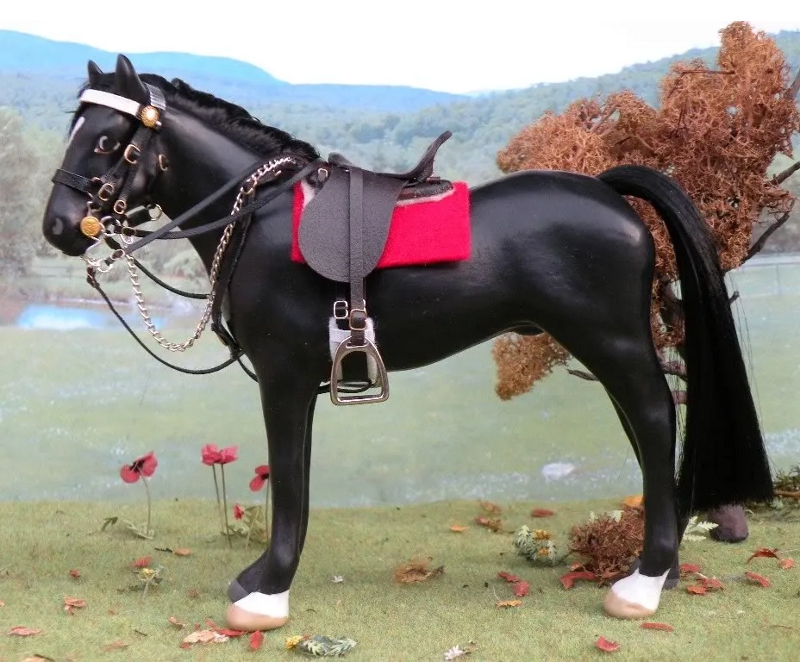
The second cavalry Julip for my collection was less of a patch-by-patch portrait, but a simple black spare in the Thoroughbred mould, which I named after a cavalry horse Gandermack, and dressed to look the part. 


He isn't a direct copy of the real individual (she was a mare, with no white markings, and never played the laying down part the musical ride - I just loved her name!), but is a tribute to the Household Cavalry in general. I even had some tips from an army friend who rode in the musical ride on how to make the uniform more accurate!


I only realised this week that I didn't have a photo of the complete set with trooper mounted, so I took them outside for a new shot specially in time for the Jubilee.


I even gave him a British flag to hold for the occasion (and then had to wait til the wind wasn't wrapping it round his face for the photograph!)

Monday, 23 May 2022

The Mini Megaloceros

Something very different for a change! Papo's magnificent Megaloceros sculpt becomes my first ever prehistoric repaint, the first deer model to enter my collection, and my first custom to come with his own illustration!

When I paint my horses, I'm generally working from a reference photo or two for the colour or pattern I'm trying to recreate, or just making up something I know is realistic, from memory - because, well, I've seen horses before!
With my other wildlife repaints - the Fox, the Cormorant, and the Hare - I've used nice big clear photos from Google to make sure I'm getting the markings and colours in as realistically as possible, in terms of placement, detailing, and paint mixing.
I've painted an extinct animal before - the Quagga - but the Megaloceros (also known as Irish Elk) went extinct a little less than 8000 years ago, rather than lasting into the modern era and leaving photographs and taxidermy specimens in museums.

All the same, I knew I'd be much happier and more confident working from some kind of reference, rather than trying to design my paintwork actually on the model with wet paint and trial-and-error layers to make design changes as I went along.
And I really didn't want to piggyback off someone else's efforts, recreating somebody else's reconstruction or illustrative art from books or CGI tv episodes; even though that can be an honest tribute and perfectly valid resource, I want this to be my interpretation, not borrowing someone else's creativity.

Luckily, we do have one fantastic source for information on how prehistoric wildlife looked, in cave art which has survived all down the centuries from the people who saw the animals first hand.

Here's the first example. All we can really gain from this one is a general impression of darker on the neck and shoulder, and along the back - but it's possible the painting is either unfinished, or cropped to focus on the head and antlers, and the 'paler' part is just not there!

Here is the next example, a much more complete animal. Again, we see darker along the back, the neck and throat, and the shoulder added as shading within the outline. There's also a very distinct diagonal stripe from the hump at the shoulders down to where the hind leg meets the underside of the belly. This is a recurring detail in cave paintings from different locations, so can't just be one artist's weird quirk or error in constructing the body shape - more than one person painted a stripe, it's reasonable to take that as proof it was there.

Here is another example, two animals overlapping but if you just follow one set of lines at a time, you see the same thing - dark hump, dark shoulder (as a stripe this time), diagonal body stripe . There's also a dark throat, though this time the neck itself is paler.

Of course, all these paintings are simplified, and stylised, and all are more outlines with markings, rather than full colour like some of the horse and cattle paintings, where we can see shades of brown entirely filling in the body shapes.
But the general idea I get from them, and other examples, is a paler body colour with a darker top line, dark neck possibly with throat and chest 'collars' rather than a single wide band, and there must be a marking along the side.

When I was reading up on the Megaloceros, I learnt they were a relative of the Fallow Deer rather than the Red Deer, which makes perfect sense when you consider the antler shape in all the preserved remains.
This is my only real-life connection to the species, by the way - I have seen a head of 'Irish Elk' antlers on the wall at a castle here in the UK, found in a bog and mounted as an impressive curiosity in the 19th century gentleman-naturalist boom era.

So I decided it was quite important to avoid making the model look like an oversized (and over-antlered!) Red Deer when designing my paintjob, and the best way to do this would be to not even look at Reds in my preparation time, and take my colour palette from a darkish Fallow stag - this exact photo, to be precise.

The markings I've adapted, of course, by adding in the diagonal band along the side of the body, and altering the placing of the white and dark from the throat down toward the chest. I just worked where it seems to naturally blend and mix with the real deer's colour, while keeping each marking we see in the cave art.
And I've taken the spots away entirely - because I'm sure if the ancient deer had had such a noticeable feature, the cave artists would've put them in. They painted some spotted horses, and DNA analysis on horse bones and teeth from the era has proven leopard spotting genes were present in the prehistoric horse population at that time. Other animals in the same caves, like Red Deer and Przewalski-looking dun horses, are painted in accurate colours we easily recognise today. So I think the painters can be trusted on this, and if there were spots, they'd have put spots.

Enough rambling, here's the actual picture bit of the post (well done if you read all that instead of just scrolling this far, hahah). I've never drawn a deer before, so I worked from the Papo model instead of figuring out anatomy and inventing a different pose from scratch, and after all, it's for him rather than a stand-alone artwork in it's own right.

Here he is blank and waiting for his colour.


My intended design - though I'm not sure how easy it will be to match the actual paintwork to what I've done with him here! But I don't mind if it's a little different, and I'm not going to drive myself crazy trying to replicate these precise shades and blending exactly, as after all it's all guesswork and based on tweaking a modern animal, cos none of us have seen the real thing, except those cave artists who left us such helpful clues!


And finally, here he is with a background, just cos he makes a pretty portrait (recycled from the folder of my older art - that one originally had a horse in front of most of it so it's a bit rough and unfinished, but was the only background I had which didn't include a hedge, gate, stone wall, brick-walled stable yard, or ploughed field!)

Now, on to the model...


Here's the before picture, so you can see what colour he started out. 
He's not the same scale as Papo's horse models, or any of the other horse ranges you'd be familiar with, so I can't really say 'oh, he's a big as a so-and-so' to give you a better mental image - I'd say he's standing around halfway between Breyer Stablemates and Schleich/CollectA large breeds in size, but not scale - remember, the Megaloceros was much bigger than a horse in real life, more like a moose (although not many of us in the UK have ever seen a moose either!)

And now some in-progress stages. Apologies they're not very bright or clear photos, I started too late in the day to use real sunlight, and I couldn't figure out how to switch on the flash on my camera!


Layer one, adding some more milk-chocolate brown to soften down the dark colour, and some tan shading where the lighter parts start.


More of the paler brown, mostly to the lower half of the body, plus the initial layer of cream to the legs under the belly, and top of the head. At this point, I'm applying the paint straight from the pots so it's thick and sticky, smudged with a big brush to spread it as far as possible and rub into all the little hair details of the sculpt.


Starting the texturing of the body colour, and beginning the detailing of the face, with light round the eyes and nose. At this stage, I'm using some dry-brushing to catch the sculpted texture on the mould, and at other times I lick the brush then touch it to the paint, so it's diluted and thinner. As I've said before, only do this if you're sure your paint isn't poisonous; if you're not certain it's safe and/or you're less lazy than me, you could set up a soaked sponge in a bowl to get the same damped effect, without saturating your brush too much like dipping in a glass of water would.


And now upping the contrast a bit, with added white for the chest & belly, and darker colour for the back of the neck, shoulder hump, and side/chest stripe markings. Again, there's some dry-brushing and some fine brushstrokes.
I tried to make the markings quite blended in and not have a 'painted on afterwards' look, I know some animals do have very sharply defined stripes (like the dark band markings on Thompson's gazelles) but cos the sculpt has quite shaggy fur I didn't think there could be quite such a crisp dividing line between black and beige, more of a soft overlap would happen.


More definition and detail for the markings, especially filling in the face with eyes and nose and a hint of pink inside the ears, then the feet (I always do them toward the end, otherwise handling the model on my lap to continue the body colour rubs the paint off the edges and toe-tips), and finally the antlers. They were done with a base layer of beige, then blacks and browns dabbed on with a very fat brush, to try to get a different texture to the body fur. The very tips are given white highlights - where deer rub their antlers the bone polishes very clean, white and smooth at the points.


Finished!
The next day, he went outside for a much better photoshoot in the sunshine...


I'm so pleased with how he turned out, I really like him and will enjoy having him in my collection, even if he is my only prehistoric mammal and has no friends to stand with yet.


The shade makes his dark markings stand out more, but he looks prettier in the sun, so most of the other photos I've chosen do favour bright light.


There's a couple of areas which don't fully match my drawn design, but as that's also just an interpretation and not an authentic image of the real animal like when we can work from photographs of modern species, I'm not too annoyed with myself for going accidentally off-plan!


I may have gone a bit overboard on the number of pics, but this sculpt looks great from so many angles!


Do not sneak up on the Megaloceros from behind.


Those antlers are just amazing; they'd look impossibly impractical and unrealistic, if we didn't have so many examples as proof in real life, from peat bogs and the like!


You know that feeling when a Red deer stag stares you down, and you don't know whether to feel intimidated cos he's massive and potentially dangerous, or safe cos you're such a small insignificant creature in comparison that he'd not even waste the energy to come at you? This one has the same look about him!


SUCH a handsome head! I'm really pleased with his face, but the sculpt has a lot of detail there anyway, so it's giving me a lot to work with. I took his face markings from another Fallow deer reference; the little pale rings around the eye which help exaggerate it, and the way the profile of the nose shades to dark, but with white just around the nose and mouth.


I took a couple of different headshots without the miniature background, his outline contrasting nicely against my nice dark hedge.


A close-up portrait, and more of that mildly-threatening side-eye going on!


And one more full photo to finish on. A very different project for me, but a lot of fun. 
I'm considering doing a cave-painting inspired prehistoric horse next, so he's got some contemporary company, though there's no specific sculpt for that era so I'd be picking from modern horse breeds to find the most primitive look. Perhaps the CollectA Mongolian for that upright mane and flat back, or the Exmoor or Konik which are so often described as the closest to our European horses' ancestors.

For now, I'm just happy with my little giant deer!