Showing posts with label OF mid-scale plastics. Show all posts

Sunday, 31 December 2023

CollectAs to keep

Time to tell you all about a huge and very enjoyable parcel I had last month - a GIANT box of second hand CollectA horses!

They were listed on Ebay in bulk lots, really reasonably priced, and with an element of mystery - from the photos, you couldn't really see what was in each batch cos they were piled into shelving in multiple rows, with only the first few clearly on show. So I decided to choose some of the mixed lots at random, after all I don't mind so much about duplicates as many collectors - the spare ones can be passed over to have a new lease of life in the repainted side of my collection!

When they arrived, I unpacked the box and set them to one side of the table for 'keeps' and the other side for doubles. I was surprised and very happy with just how many I didn't have already - a grand total of 15 new horses for my herd!

Which made me think....I did a little bit of mathematics, and figured out that the brand-new prices for all the models I'm keeping as they are, add up to MORE than I paid for the entire boxful. So every single custom horse I create from the remainder of this bulk lot, has effectively cost me nothing at all - the difference even pays for the cost of the paint I'll put on them!

I'll show the first few customs in another post very soon, but for now, here are the original finish arrivals which are staying just the way they are.


When I first started buying CollectAs, I picked my favourite colour whenever there was a choice of two, but more recently I decided it was a bit of a silly 'rule' to restrict myself to just one when many of the alternate colours were just as nice. So I've been gradually adding the rest of the colours to my collection. That'll be the case with almost all of today's introductions, sculpts I had already but now in a different colour too. This is the palomino pinto mare, no breed was given officially but my bay pinto I've got as a Sandalwood Pony so this one will join her on that breed's page of my website.


The matching foal, I had the standing foal already but now I have both mares this foal can be paired with the second one.


The Standardbred Pacer in black, I picked the chestnut before cos I thought he might be rather plain looking, but the really dark colour shows off the fine detailed sculpting better, I think! I'm so glad they did this breed before the chunky leg era, it works so much better as a long lean-limbed horse!


The palomino Missouri Fox Trotter, her colour is better in person than in the official picture OR my photo, one of those models which doesn't photograph brilliantly but looks nice in hand!


The very sweet Quarter Horse foal, the bay colour is better shaded than the matching adult!


The black Thoroughbred, who's far from being plain black, with a lot of brown tones subtly shaded in. And again, hurrah for the slim-legged older moulds, I dread to think how chunky a collectA TB would be if they released it now! I'd already been thinking of ordering this mare brand new, but giving a home to a second hand bargain one is even better.


The Tennessee Walking Horse foal in black, which is an odd choice by CollectA as they didn't make an adult this colour, their TWH stallions were bay pinto or palomino!


The chestnut Hanoverian, who made a last-minute change from 'duplicates' to 'keeps' - I was convinced I had him already but when adding the others to my site I realised there was no photo, so I checked my shelf, and I really did only own the bay one after all!


The really dark chestnut Morgan, which I did get in a second-hand parcel once before, but in a very scuffed state so I repainted him. This one is in much better shape, and I think his paintwork is better than the other one I had, too - a nicer shade of brown showing on the paler parts, and the black is deeper and less greyish.


The Norwegian Fjord foal in grey dun - the matching adult in this colour was among the first few I picked out when I was adding second-colour horses to my CollectA collection, so it's nice to add the matching foal as well.


The grey Andalusian, another model I had once before but had to repaint - he was all marked up with felt pen marks which wouldn't come off, this one is in lovely clean condition so gets to stay as he is!


The gorgeous Clydesdale mould in very roany black sabino (not grey, that colour doesn't occur in the breed - all the 'grey Clydesdale' photos on Google and various picture-sharing sites are mis-labelled grey Shires)


And the matching foal to go with him, a little bit wobbly but by tilting the base board here I convinced him to stand without leaning on his dad!


The Shire foal in grey (which is grey, but shouldn't be - they're always born dark and it's too young to have gone this pale!) I already had the mare but not her baby, so this little one completes a family for my shelf.


And finally, the draft horse with a cat. I didn't buy this model when it was released cos I wasn't too keen on the idea of them being fixed together permanently - the cat seems a bit too big for the size the horse sculpt, so I'd have preferred it to be removeable so I could take a picture without! But now I've ended up with the pair of them anyway, I'm justifying the slight mismatch in scale by saying it could just be a very big cat, and a smaller than average heavy horse!
No breed was specified for the drafter, I'm trying to find one which has SUCH a convex nose but also not a lot of feather and comes in chestnut. Nothing ticking all the boxes so far!

Saturday, 19 August 2023

WIA's new release - Marwari in two colours

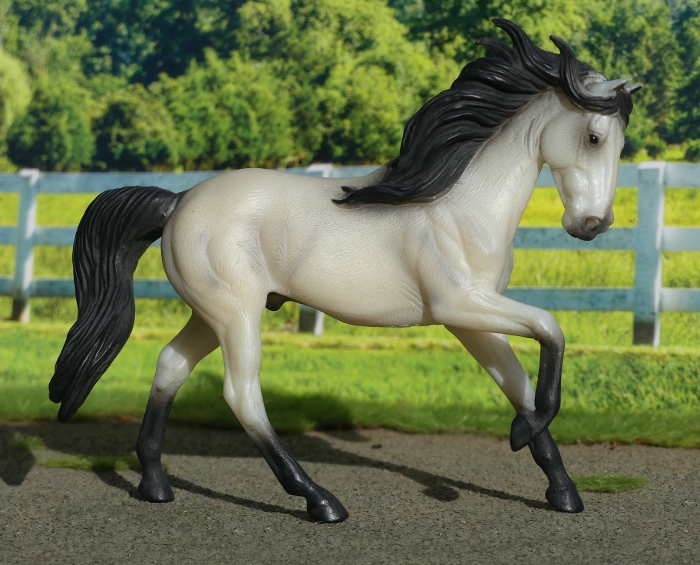
I thought you might like to see some photos of this year's new WIA horse! Another sculpt by Horraw Studios, this time a Marwari stallion, and like all the WIA plastic editions so far, he's available in a choice of two colours. Or, if you're anything like me, not a choice at all cos you end up wanting both.

Let's have a look at them - you can see their item listings on MPV here and here, for the official pictures, and prices (log in to the site from another country and the prices may drop substantially lower for some sort of international tax reasons, it knocks over €2 off when I'm logged in with my UK address!)

But I always find real, in-hand photos from collectors to be more helpful in deciding how much I like a model, so I had a little photoshoot with my new arrivals on a sunny day!

We'll start with the lighter colour first, cos I always think these show the mould details and contours better than a dark colour.


A really nice sculpting style, with an intricate level of detailing, as with the Arabian by the same artist they're distinctly different to both the original Brigitte Eberl WIAs and the later Morgen Kilbourn addition to the range, but not in a way which stands out and makes them clash or jar with the existing horses. They still have the same basic WIA horse traits : smooth bodies (no over-exaggerated grooved 'fur' texture here, no bows in the hair I'm looking at you Schleich!), well-proportioned slender limbs rather than chunky legs (sorry CollectA but you just won't do a light hot-blood sculpt any more!), and expressive faces with great detailing.


Now, let's have one of those conversations about horse colour. This one's going to be difficult, haha!

The model is marketed as a Dominant White, at which I thought 'hurrah!' cos I only have one other with this rare colour pattern in my collection, CollectA's Camarillo White Horse.

To put it in the most basic terms, you know how some horses have white 'sabino' markings on their faces, legs, and bellies? Now imagine those white markings getting bigger and bigger til they cover the entire horse. A really extensive Dominant White IS one big white marking, with none of the original colour left at all, or maybe just a tiny little bit which isn't very noticeable - often on the ears, the top of the head, or in the eye sockets. Although in the past Dominant Whites have been described as Albino horses, it's not a red-eyed albino like you see in other species, born without pigment - it's just got white marking all over, mane and tail and all. Pink skin shows through wherever the hair is very fine, most of all on the face and especially the nose.

Now, take another look at the model. It's not pure white, but not pinkish either. The body colour has been given a definite creamy yellow tone. The nose is pinker, but that's not the colour paint which has been used on the rest of the horse, so they're not trying to show skin visible through fur - they're saying the hair itself is cream coloured? And by contrast, the mane and tail are white. Look along the neck, you can see the line where the mane paint is applied.

Could it just be an effort to make the horse look less dayglo-white and more realistic cos real life horses are rarely spotlessly clean? 
Hmmm. Here's a lovely long-maned example of an actual Dominant White horse (he's from a website about genetic testing for this colour, they'd have a correct example!), and you can see the natural long-term picking up of environmental dirt all horses get if they're not kept shampooed for the showring, has darkened his mane to a blonde-ish cream. So, if anything, a realistically low-level-grubby Dominant White horse would have a fractionally darker mane and tail than the body colour, never the reverse. I don't buy that they'd paint the horse's body yellowish then give it a contrasting pure white mane, IF they really were designing this paintwork from dominant white reference photos.

So, what colour is it?

The only real contender would be cremello. This is perfect for a body colour which is cream all over, showing pink skin on the nose and round the eyes. And the mane and tail being pure white also fits, some cremellos are a bit more on the blonde side but the majority do have the contrasting white, just like this model stallion.
But wait a minute, back a bit.. I mentioned the word 'eyes', and that's where we come unstuck. A cremello will always have blue eyes. It's a part of the dilution gene, there aren't any with the standard dark brown eye colour, it can't happen.

While waiting for this parcel to arrive, I was doing a bit of reading on the All India Marwari Horse Society's very comprehensive website, and there they have one crucial fact which is relevant to this debate. In the breed description, 'Albino colour is a disqualification for this breed'. Since true albinism doesn't occur in horses, they must be referring to what's now better known in other countries as Dominant White.

So if the paintwork says it can't be Dominant White cos it's painted yellow, and the breed society says they're not allowed anyway, but the eyes say it isn't Cremello... that's kind of two against one and I'm siding with writing this one up as 'cremello' on my collection website despite the release info!
I've given him the name Badali, meaning 'cloud', for his pale colour whatever it may be.


Enough of the colour debate, it's still a glorious little model of a very old and interesting breed I've liked for the whole time I've been into horses, and I'm extremely happy to have him in my collection! My only other Marwari models are Breyer's big Traditional scale mould, CollectA's mildly depressed-looking stallion, and one mini custom, so it's great to have another on the market, and in this affordable and popular scale, too.


One thing which has been a bit criticised over the years is WIA's decision to use some separate parts in the manufacturing process, to allow for easier moulding of complex poses and awkward deep detailing. Sharif had his mane attached with a visible seam at the neck, Vincenzo had one ear cast separately and stuck on afterwards. I've never found the joins to be too intrusive in the finished models, but just for anyone who's disappointed or put off by them, the Marwari does have his ears moulded as individual pieces then attached to his head. You can see it most clearly in this back view, though the strong sun shadow's not doing him any favours here by making the groove more noticeable than it is in real life!


Now, on to the next one! Described as dark chestnut sabino, this colour's much less tricky to get my head round. Even though he looks dark enough to be a bay, chestnut is a massively varied colour, and some do look almost black. He doesn't have any true black shading on his knees or hocks, so I'm happy to accept this colour as a very very dark liver chestnut, and his sabino markings are nicely designed too.


With his face marking incorporating both eyes, they've been painted blue, with a little hint of pink in the corner.


Although I said the paler colour shows the mould off better, I do think he looks just as good in a nice dark colour with eye-catching flashy markings, I'm not sure which would be my favourite of the two. I've named this one Gadadi, which means 'fox'.


Looking a bit wild and dramatic from this angle! I'd quite like to do some tinier-than-usual tack making and give these two some of the beautifully decorated traditional tack Marwari horses are decked out with for special events. Even something simple like the colourful braided halter with an upright tassel on the headpiece, would be an intricate challenge to make at a smaller scale - here's one I made for a Traditional (1:9) scale Marwari.


The ear seam looks much less visible on this colour, I think if I hadn't pointed it out you wouldn't even notice it was there!

For anyone unfamiliar with WIA horses, the plastic is notably more firm than Schleich, Collecta, Mojo etc, it's got a very slight give in it which reassures me that they'd probably flex rather than snap like resin if I was to knock any over, but they don't feel like they'd stand up to play. The paint's also a lot more prone to scuffing and marking (I had some duplicates in my body box for a while, they came out covered in a multitude of small shiny marks just from touching other models!), so I'd recommend them as shelf models for the teen/adult collector, rather than suitable for adding to an active play herd.

Saturday, 24 June 2023

WIA Arabians

Here's the next bit of the parcel I received earlier this month - a new WIA model released last year, an Arabian mare in a choice of two colours, chestnut and bloody-shouldered grey. I gave them a post of their own, thanks to the way my blog is organised by tagging brands, types, and scales - for reasons of tidiness, the WIA models are best kept separate from the Breyer ones!

This is the first time I've seen any work by the sculpting artist, who goes by HorRaw Studios. As with the Erren sculpt from earlier this year, I can see the difference in art style and detailing from the initial four WIA models by Eberl, but as a whole they work well together, these mares don't stand out as a bad fit with the older models - even though you could pick out which ones are by someone else, they still look like they belong.

I admit I'm surprised the company have gone for another Arabian horse, so soon! With such a small range, you'd think they'd be more keen on developing a good spread of breed types, so having ticked off Draft, Arabian, Andalusian, Warmblood and Criollo, I was predicting the next choice would an American stock or gaited horse, or a native pony, not a repeat on one of the few breeds they've got already!

The grey is interesting, because her shoulder patch is created with a stencilled solid outline, speckled over the top with random spatters for more detail. This means all the individuals of this model will be slightly different, depending on how the paint spots spread out as it's flicked on. The softer speckling over the rest of the body is unique to each model, too, but stands out less - I think it's under the sprayed white coat, so it's very nicely blended in - a really lovely effect!

Oh what a face! Everyone who's known a mare has probably been on the receiving end of those ears a time or two!

The chestnut's paintwork is less complex but still effective, with a nice rich brown base and just enough shading to avoid it looking flat. And her white markings are flashy and realistically designed.

The beautiful flowing mane on the other side. As with the Erren release from last year, the different sculptor doesn't mean the WIA models don't match well as an entire range, the style is slightly different but the general feel is the same, lean elegant models with great proportions and slim legs, detail without over-crisp texturing, and plenty of expression and character in the face and the pose.

Thursday, 30 March 2023

CollectA's 2023 horses

Last week I ordered most of the CollectA models with the early-2023 release date. I did leave out the Arabian foal on purpose, though - the shop I use (bigjigstoys.co.uk) does free postage over £40, so it'll help me make up another good size parcel if I leave one out now, and order the matching Arabian pair together when the stallion comes into stock later in the year. But all the rest of the Standard size range came to me in one lovely big parcel yesterday.


First, the Holstein stallion, in dark bay. He's well shaded but because it's such a dark variation of bay, it's harder to tell at first glance, though still an improvement on the initial CollectA paintjobs which had minimal shading over a bare coloured plastic. He also doesn't get eye colours, though that's something I'll come back to as we go through the rest of this year's horses!


The sculpt isn't quite so crisp or detailed as the majority of CollectA's horses. This stands out most in the lower legs, where the hooves seem rather small and a bit too upright in angle, and there's no sculpted definition for the tendons, or at the coronet - the division between the furry leg and the hard hoof is shown entirely with paint colour. His ears are also a bit on the chunky side, and there's a lack of musculature all over - if you compare him to any of the older CollectA moulds it's quite noticeable. Here's my Hanoverian, a similar German warmblood breed - worse painting, better sculpting :


The Holsteiner still isn't a bad model, though - the proportions are sound, the anatomy is fine, the expression's appealing. Even at their most blunted and lacking detail, CollectA are still miles ahead of Schleich in terms of that anatomical realism, so while this one might seem at first like a step towards Schleich levels of simplicity, he does still match the correct shape of a horse!


The second one out of the box is this Andalusian, one of the older sculpts, from CollectA's 2010s glory days of fine legs and perfect precision detailing!

Palomino is one of those colours which has only been accepted and recognised in the Andalusian breed in more recent years - they used to have a very strict stud book, only allowing bay, black, and grey. Chestnuts and many dilutes existed, but weren't allowed to be officially registered, unless they could be snuck in under the 'grey' option, which didn't require you to state the base colour the horse was before it started to change!
When I first got into model showing over twenty years ago, the hobby rule was that any Andalusian sculpt in a 'wrong' colour would just be shown as a Lusitano instead, and it's very hard for me to get that habit out of my head! To this day I often file any cream dilutes or chestnuts automatically into the Portuguese side of my Iberian model herd, and I think I'll do that again here, though there's nothing stopping anyone having a palomino Andalusian these days - don't take my decision as advice!


The paintwork here is interesting, as it's a bit more like the old way CollectAs were painted - the pale golden tone on the flanks is the solid bare plastic we're looking at, with a hint of darker shading across the body to give it some depth, which seems to also include the mane - the roots are definitely a richer deeper blond than the tips.


Next up, another unusual colour for the breed - a perlino Thoroughbred.
Perlino is what happens when a bay horse gets two cream genes, one from each parent - they double up, causing the colour to go even paler. Cream's very rare in the Thoroughbred breed. I've seen some very impressive lifesize portrait paintings of early imported ancestors which were palomino and buckskin (incorrectly called dun in those days), but the colour was bred out very early on and for the last few centuries the British thoroughbred has been exclusively bay, chestnut, grey, or black.
Flashy colours like palomino and sabino crop up mainly in Japan, and there's quite a thriving market for loud coloured offspring of loud coloured parents - whether or not they had much success on the track they're guaranteed a place at stud, and so the colour continues into the next generations.
I suspect this might be where CollectA got the inspiration for a Perlino Thoroughbred, as it certainly isn't the British, Irish and French racetracks I'm more familiar with, and it's a bit of an odd choice when they could've gone with a much more typical TB colour to broaden their range in a more likely way - we've seen this mare in black and bay, so how about a chestnut or a grey? Too boring, perhaps!
Personally, I'm going to show mine as a Kinsky Horse, a relative of the Czech Warmblood. A lot of Thoroughbred blood was used in the development of the breed (one of their early names was 'half-bred', a TB stallion bred to a local mare) so they tend to be finer and lighter than some of the older warmblood breeds, and a Thoroughbred mould in a cream dilute colour works just fine.


Here she is with a bit more sunlight. Although I have my reservations about the colour choice, it's certainly a nicely done perlino, with the shade not too brassy or too pink, and the mane and tail darker. The pinking of the skin is also done in a pleasant and subtle way.

 
And she has a blue eye, look! Essential for the realism of the colour, and neatly painted in, I was very pleased to see this one did get the added level of detailing for the eyes.


The new-look Clydesdale with his wild sabino makeover was one of the best repaints on offer this year, and in person it's just as impressive! It's a shame they didn't add any variation in the black, as it's very solid monotone - there could've been a bit of depth if they'd added just a hint of grey-brown for the flanks and face, but I think he gets away with it as the markings are so eye-catching and contrast so well. Rather than spraying or stencilling the patches this time, they've gone with a sort of wrap-around decal application, little bits of white stuff carefully applied to each model by hand. There's potential for slight variation between individuals, depending on how accurately each piece was laid on, but the markings themselves will be the same template for every horse - like we saw on the Paint Horse last year.


You can see a tiny flaw in the marking application on the hind leg this side, there's a bit of white where there shouldn't be, but it's very minor, and I can easily dot a bit of black paint over it when I remember. On the whole, I do prefer this way of adding markings without leaving it up to the factory artists to hand-paint, when the results can vary wildly depending on the care they take and the time they're given, or using a stencil to spray through, which inevitably leaves a blurry edge.


I think this is the nicest of the colours they've released on this mould so far, and of course it is a very beautiful and dynamic sculpt, with a great action pose and all that flying hair! Again, as a dark-eyed colour, there's no brown painted in for the eyes, they're a glossy black instead.


The foal gets a makeover to match his father, and again the markings are crisp and sharp, though he doesn't have any white on the body, which is a bit of a shame - perhaps it's too fiddly to apply to a smaller mould, though even a tiny patch either side would've been better than nothing! He does have that hint of brown in the paint, though, which is a nice touch, especially as black foals are born pale, go through this dark chocolatey stage later in their first summer, then don't turn fully black til they grow their next coat. So while CollectA missed the 'baby coat' stage which is a sort of mushroomy grey-brown, they did still remember not to give a foal an adult colour.


Here they are side by side. I admit it matters less whether an adult-and-baby pair have good co-operative poses when it's a stallion rather than a mare, as they wouldn't be turned out together in the field, but I still like to take a family picture or two!


Now, the silver grulla Morgan stallion. This one sadly doesn't quite live up to his catalogue photo, as the dappling isn't so soft or subtle as we were promised. Last year's dappled grey Hanoverian was brilliant in that respect, so I'd got my hopes up for this 2023 release, but it's not quite there. In the promo pic, the dappling continued up the neck and faded out gradually, where on the actual production models, it reaches the shoulder and then...just stops.


The fade-out of dappled into the flanks and on the quarters is just fine, so I'm not sure why they couldn't have done something similar at the front end and had them carry on up the neck. I think there is a slight difference in the paint thickness for the final row of dapples before they stop, as they don't look so defined as the central ones - kind of like the ones on the hindquarters, they're there and still have the sharp edge, but not so starkly pale as the shoulder area. I'd be tempted to blend the brightest ones in with a bit of my own paint to tone them down, only then the model wouldn't be Original Finish any more and I'd struggle to file him properly on my collection website.


Another angle - he's got a very handsome head, the leg shading is lovely, and I like the face markings a lot. His eye, though, isn't coloured.
Looking back to last year, any CollectA horses treated to the new modern paintjobs (the Arabian mare, Hanoverian, Paint Horse) had their eye colour painted in, with a hint of gold in the brown, a black pupil, and an eye-white too. But this year, the only models which have eye colours are those with blue eyes! I wonder if they were just a bit too time-consuming for the production line and whoever's designing was asked to leave out that level of detail this time round, unless it really had to be there for a blue eyed colour!


Here he is again, in the shade, which doesn't make quite such a pretty photo but does help illustrate how the dapples are less 'spotty' in some places than others. Again, this might be individual variation, I like mine better than the other in-hand example I've seen so far (which was in the US, so possibly a different production batch than was shipped to the UK?) but can't promise that all this batch have the same application of dapple layer!
I've saved my favourite til last, here is the Mustang mare in a wonderful splash pinto colour! 


The edges of the markings follow such a realistic line, it's great. Splash is one of the hardest pinto types to do really well, as it seems less logical than the much more common tobiano and overo patterns which we get used to seeing, understanding, and speaking as a model painter myself, being able to invent in a believable way!
Splash seems to defy all logic, so you can't easily predict the likely outlines and placements of markings, but you can tell when it looks wrong - so many times a custom-painted splash pinto will look like the paint splashes the pattern takes it's name from, but CollectA have avoided that and hit the nail on the head here. One of their very best designs!


This is one of my favourite CollectA sculpts, a mustang which looks true to the breed without being overly dramatic. Yes, mustangs can fight, and yes, they can rear, and yes, they probably do both those things a little more often than the average domestic horse - but they don't have to be sculpted looking fierce or standing on their back legs every single time. I love that this mare's just trotting along minding her own business, doing horse things, and not in a temper about it!


Her colour is officially given as bay, but there's a sort of light and sandy tone to it which reminds me of a sooty buckskin, so I think I'll be crediting her as a slightly different coat colour when I come to catalogue her on my collection website.


Because the white face marking includes the eyes, they're blue (hurrah for eye colour!)

That's the majority of this year's CollectA horses covered in one big review this time! As I said, there's the Arabian foal out already, the Arabian stallion to follow later in the year, along with the Boulonnais, and I'm far too addicted to CollectAs not to want every breed for my collection as they're released, so I'll be reviewing them here on my blog in due course.