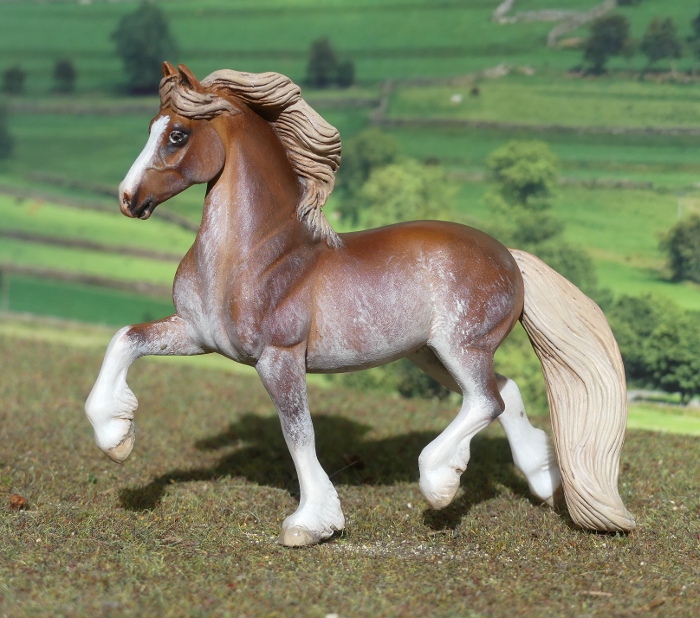
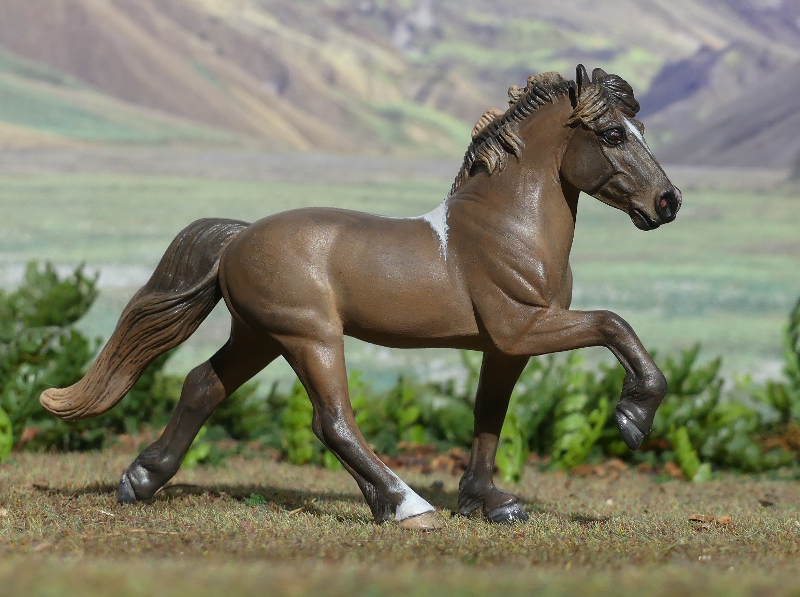
Showing posts with label SM icelandic. Show all posts

Friday, 11 June 2021

Tales from the Body Box - Ýruskjóttur

Icelandics are one of my favourite breeds to paint, partly because they come in such a wide range of colours. Many breeders have websites with accurate and well explained coat colour information, incidentally providing a handy wealth of knowledge and reference material for model painters, and proving that colour genetics are fully understood and rationally dealt with in the Icelandic horse world (unlike, for example, the stubbornness over incorrectly registering as 'dun' because 'buckskin is an Americanism' in some British breeds!)

A few years ago, one particularly unusual Icelandic stallion called Ellert hit the headlines - a new colour, never seen before in the breed! A foal from solid colour purebred parents, who should've been a plain bay dun, but came out with a wild white sabino pattern - genetic tests proved he had a unique variation linked to the dominant white gene. Icelandic horses are notoriously pure and ancient, with strict rules against importing or cross breeding since the 10th century, so there's no doubting it spontaneously and naturally occurred, without human interference.

You can read about him, and see plenty of photographs (from clear and steady standing poses, to artistic shots and fun candid snaps from his owners), in this excellent article from CNN.

He now has several offspring of his own which carry the same colour, and in future it'll be interesting to see how his genes spread through the population, giving the chance for more flashy patterns down the generations.

Ever since his photographs first did the rounds in the horsey corners of the internet, I've thought what a nice custom painting project he'd make - his historic new colour being a worthy subject to bring into the world of model horses too. 
I avoided definitively adding him to my to-paint list for a little while, just because complicated colours are, well, complicated to paint, but having mentioned it to a fellow collector and customiser, I felt like I was only delaying the inevitable, and would have paint him next time I got a Breyer Stablemate Icelandic body - which my friend then offered to sell me in a mixed bundle, and that was that - now I had to make it happen!


And here he is! Because his colour is so mixed up and roany, it was daunting - but not so tricky as the sabino patterns with distinct patches and sharp edges, and I'd had some experimental practice with my model of Paragon. Some fine-brush detailing and some soft smudging, dry brushing over the bay dun base coat, and a little reworking with the dark colour over the top.
You can also see he's got a single egg-shaped solid spot just below his hip, which was painted on last because I couldn't figure out any way to mask it without risking peeling the body colour underneath whatever I stuck on!


His head seems to have a more chunky speckling of colour than the rest of him, possibly because the coat is shorter there and the white blends less with the brown - a bit like how you can see the edges of face markings in more crisp detail than the edges of pinto patches, even if it's the same horse. 
I do think it looks like I painted his head a different day to his body and didn't manage to match my brushwork very well, but when you compare to the reference pictures you can see it's on purpose rather than heavy handedness!


Luckily, I managed to find nice clear photos of both sides, rather than just the famous side-on shot of him being held by his owner which appeared in most articles, so I didn't have to guess at what the markings of the 'wrong' side would look like!


As well as the roaning, he's got high white stockings and a very big white face marking, which just catches the corners of his eyes, causing a bright blue flash in each iris. I tried catching that in the photos, hoping this one with the blue sky behind him would bring out the eye colour, but it's more noticeable in hand than in pictures.


I've decided to call him Ýruskjóttur, the name given to his new colour in Icelandic : it translates to 'speckle'. Not only because the colour was the reason for painting this particular individual, but because many names Icelandic horses are given in real life translate as colour descriptions, things like 'palomino with a blaze', 'brown pinto', or 'yellow dun with a dorsal stripe', so there's nothing wrong with naming a speckled horse Speckle!


And finally, here he is joining my home-painted herd of Icelandics (click to see the photo larger)
From left to right : Gullinbursti, Falhófnir, Háfleygur, Jarpskoni, Tviserkur, Alsk​ær, Ýruskjóttur.

Wednesday, 19 May 2021

Tales from the Body Box - a busy weekend

Last week, I bought a nice little parcel of bodies from a hobby friend, and included were a couple of moulds I'd been hoping to get hold of. I always have a little mental list of ideas to paint, but til now I hadn't got the breeds I wanted for the colours I had in mind.


First up, Alskær Fra Harecroft, an Icelandic in a gorgeous shade of dun inspired by this reference photo. The horse is described as a bay dun on Pinterest and other image-collecting pages, and annoyingly I can't find an original source, but I'm wondering if perhaps he isn't just an unusually light bay dun, but rather a dunskin - buckskin plus dun.


This photo was taken in the shade with the camera's cloudy day white balance setting, in reality he's somewhere between the two pictures. His name translates as 'most bright' cos he's just about as bright as a dun colour can be, and my prefix becomes a suffix in the Icelandic naming tradition.


A high angle to show his dorsal stripe, the most nerve-wracking bit of any dun paintjob!


Making use of my free bit of Icelandic scenery from the Breyer Elska box - it's such a shame they've abandoned these attractive and useful photo backdrops in the boxes' bland new redesign. 
I do love this Icelandic mould, and still have plenty more colour ideas I'd really like to paint, whenever more of them come my way.


This one was the result of a bit of recent reminiscing with another Breyer collector online - she loves her Llanarth True Briton model just like I love my Danaway Tango on the same mould, and remembering his wild patchy roany sabino paintjob inspired me to finally get round to the sabino SM welshie I'd had in mind for years. 


I didn't base him on Danaway Tango himself, just used made up markings over a similar bright chestnut shade. I find messy smudgey roaning on bays tends to get worryingly pinkish, so the more gingery tones in this colour prevented that from happening.


He isn't quite how I intended, the white softer than my original plan to flick it on as speckles with a toothbrush - in the end I chickened out of such a haphazard method in case I lost control and got more paint where I didn't want roaning than where I did. I've named him Harecroft Baledwr, the welsh for balladeer, as in writer and singer of folk songs.

Finally, not just another clipped bay thoroughbred, which I know I've painted several times already, but one more for my line-up of famous racehorses in miniature - Faugheen!


One of those horses who made a big initial impression and went on to live up to the hype, Faugheen always stood out as full of character and enjoyment of the game, and in return I enjoyed following his career over hurdles and then over fences. 
He retired safe and sound at the beginning of the month, and the very same day I picked out one of the G2 TB models I've been saving specially for portraits. Something about it just didn't seem quite right for him, and when I was looking for reference photos to properly copy his distinctively shaped stripe, I realised what it was - he seems to have his ears pricked so often, I just had to resculpt his mini self to match!


The new ears really change the expression of the mould, while it didn't look unhappy before, just concentrating and running hard, with them pricked up it's got that look of a horse who thoroughly enjoys his job!

Saturday, 27 June 2020

Tales from the Body Box - three Icelandic horses

I've had some of the great little SM Icelandic mould tucked away in my body box for a while, quietly waiting for their new coats of paint while my colour ideas settled into place. Finally having decided, I got the tins of paint and brushes out, and the result is this little conga line trio of Icelandic horses :


Let's meet them individually, in the order they were painted...


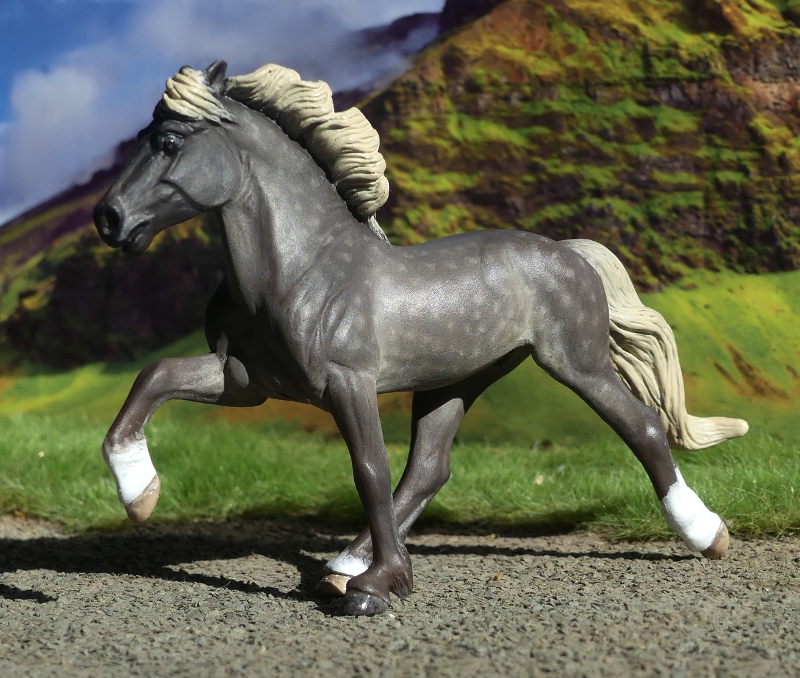
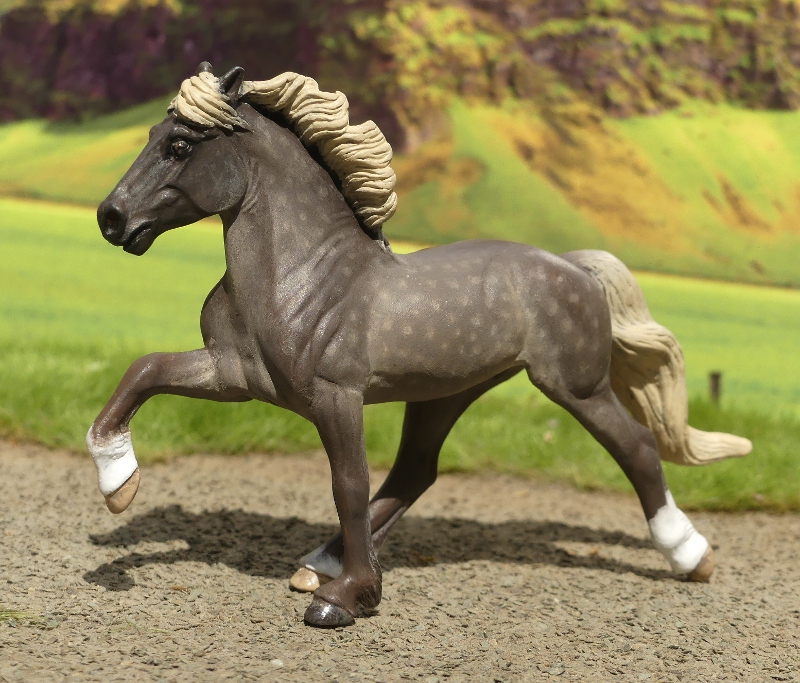
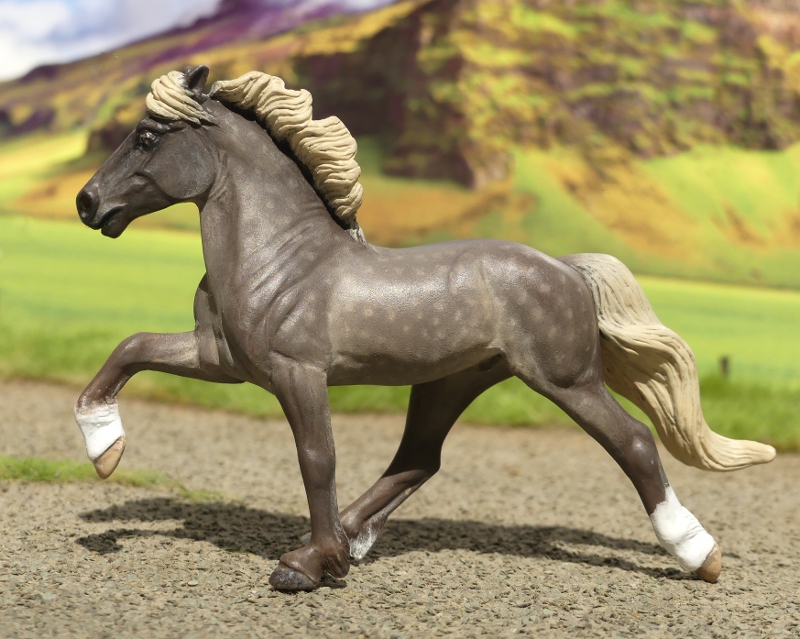
First up, we have Háfleygur, an example of the silver dapple colouration (black, plus the silver gene) which seems more common in the Icelandic than any other pony breed. I'd always wanted to paint one of these, from the moment the mould was released it's been simmering away as something I need to get round to for my collection one day.


These sunnier shots are probably a closer match for how his colour looks in real life, it was hard to get the lighting right so in reality he's somewhere between the two - but I know I put quite a lot of brown tones into the paints as I mixed so he's definitely got this soft, warm tinge rather than being a plain black'n'white-mixed dappled grey!


Háfleygur's name means 'high flying' - I rummaged through several lists of Icelandic-language horse names in search of something silver-themed, but in the end went for something which didn't reference his colour at all!


Jarpskjóni, on the other hand, has a very literal name - it means bay pinto horse! So many Icelandics are named for their colour, markings, or other physical descriptions, it seems fitting to go with tradition and call at least some of my customs after their colouring.


He's another colour which rumbled around in my head for a while before really settling. I'd noticed that the patches on pinto Icelandics sometimes came out with a wide band of white right round the middle, leaving just the head and hindquarters in colour. Of course this can happen in any tobiano, but it seems more common in the Icelandics, so it was an ideal colour custom for the breed. I picked a plain bay to go with it, as we spend so much time focusing on the unusual dun/silver/cream combination colours they can be, the ordinary bays and chestnuts get overlooked.


They're photographed on the bit of Iceland that came inside my Breyer Elska's box! I forgot I had such a fitting background last time I painted some of this mould, but got it out in time for this batch.

 As I'd been reading pages about Icelandic horse coat colours, I kept seeing reference to the rare 'colour changing roan', and in the lists of names, I'd see those which translated as colour changerhorse which changes colourdouble colour, and even the charmingly quirky literal meaning of two coats or two shirts. Finally, this page shed more light on the colour change phenomenon - a seasonal moult made much more obvious by the white undercoat. 
The article also came with a gorgeous photo, so as well as satisfying my curiosity about the colour, it gave me the 'I must paint this!' inspiration for what to do with the last Icelandic mould in my box.


And here he is! It was a really fun colour to recreate, from just one partial photo (I had to guess the lower legs!), trying to get that rough, scumbly mixing of white and dark so it wasn't too smooth and perfect, with the dramatic shading of the base colour in contrast to the body, and the mixed, sun-faded chestnutty blondish mane and tail. 


It takes a moment to think what base colour this would be, behind the roaning - if you look back at the real horse the face looks liver chestnut, but the legs are distinctly looking black rather than red. But it can't be a bay - the ginger mane doesn't fit! So I'm assuming a very dark liver chestnut, and left a hint of reddish brown in the paint mix for the legs, rather than going for pure black.


I decided to go with the name Tvíserkur for him, that's the one which translates as 'two shirts', just because it amuses me so much for a horse which changes coat colour like we change between clothes.


And I have to include this unflattering picture just because he looks so wild and ungainly with his eye-white showing and legs in all directions!

Wednesday, 3 June 2020

Breyer Stable Surprise sets

Another little parcel of horses I've had tucked away saved for a while, and opened this weekend - the full set of 2020's four Stable Surprise sets, each contaning one adult and one foal.

These were intended to be sold as a lucky dip sealed mystery box, kind of like the Stablemate blind bags, an idea I didn't mind when they announced it because retailing at about £9 per box, and me being into customising, it wasn't too great an expense if I ended up with duplicates - they were all moulds I like, I could happily repaint the doubles.
But a few weeks ago a seller listed opened boxes on Ebay, and I reasoned that by paying just £1 more per set, I'd know I was getting one of each, and not having to spend out on ordering multiple extra sets til I'd collected all four - especially as I'm minimising my buying while the pandemic continues, to avoid giving the postman too much unneccessary stuff to deal with. Oddly enough, the seller upped their price right after I'd bought and paid for my four, so perhaps they decided they weren't charging quite enough for the privilege of being able to choose your horses!


First up, the Icelandic horse set. Lovely speckly red-chestnut roan stallion, who comes with a solid black foal, which although nice, seems a bit of a mismatch as it's rather big for what is a pony sized breed, and the colour's not related in the slightest!


I've named the stallion Morgunroði, an Icelandic name meaning 'morning red' and referring to a brightly coloured dawn. I rememebered the Icelandic backdrop I've got, this was the inside of the box of my trad scale Elska and is just the right size for photographing SMs of the same breed.


The foal I've named Lina, which is picked from the Icelandic names list but chosen as something which doesn't stand out obviously, because of how she doesn't look very Icelandic - it can work just as a pretty filly name of any nationality!


Next we have the paint mare and foal, a much better pairing of moulds and colours here, I think!


A nice tobiano pattern on the loping quarter horse mould - admittedly I'd have preferred masked socks seeing as they were doing masking for the patches anyway, but I've long given up hope of regular run SMs going back to sharp socks and just had to get used to the annoying blurry ones if I wanted to keep collecting them!


Such a sweet foal - I really do like the smallness of the patches, which sounds a bit strange typed out but you know what I mean, it's always good to see a nice wide variety of markings on pinto models and we don't seem to get as many with this white to colour ratio!


Third set, the new standing warmblood mould with a trotting foal, another pair where the colours don't seem all that linked!


This is my first in this mould, and in general I like it, the head is lovely especially, and I like having another plain basic standing pose when so many moulds are sculpted in action. But I can't help thinking there's something off about the hind leg/pelvis proportion or angle? I just can't put my finger on what or even where and it niggles in a most annoying way that I ought to be able to tell what I don't quite like, but can't!


Lots of the SM trotting foal seem to be aggravatingly tippy, needing blue-tacking on the shelf to avoid initiating unwanted domino effect disasters among their foaly friends, but this is one of the lucky ones who's come out of the mould really steady on her tiny feet!


And the final set, the walking thoroughbred with a scrambling foal. Yet another where the colours aren't remotely related to each other! 


I started off photographing him on the scenery I'd got set up anyway, then had a better idea - not being a normal thoroughbred colour, he either needed to go partbred or have a change of breed entirely, so I switched the backdrop, flipped the base around to the side without the grass, and gave him a little braided collar : one akhal teke! 


Though not perfect, this mould is by far the nearest we have in the SM range to the akhal teke for conformation and light wiry build, here combined with the metallic golden colour the breed is famous for. I've named him Altyn Bürgüt, meaning 'golden eagle' - reading up on Turkmen naming traditions and fashions, the names often refer to the horses' coat colour, or liken them to birds, so this seemed ideal!


Of course that meant his little bright bay filly needed a matching picture, and she even got to borrow the collar (because I forgot to make her one of her own - I'll do that later!). I've named her Damouchka, because unlike the Icelandic foal not looking Icelandic, this one's long and leggy enough to work alone as an akhal teke baby.

(P. S. This is my first blog post compiled on the new Blogger format, forgive me if anything's a bit wonky or weird; some features are clearly redesigned to work better on phones and just don't on laptops!)

Monday, 14 October 2019

Tales from the Body Box - Icelandics

One of my favourite recent Stablemate moulds is the Icelandic horse, a breed I've been interested in for decades - even before the internet, their unusual gaits and colours fascinated me in the pages of my horse breed books.
I happily welcomed into my collection the Trad scale Svali frá Tjörn (who I thought was a bay, but in asking google how to type his name with the right little accents on the letters, I've discovered he's really a dark buckskin!), and later Elska the pale dappled grey on the same mould.
But the arrival of an SM-scale counterpart opens up another opportunity - not only are the releases going to be cheaper to collect, but they're also cheap enough and small enough to buy a few spare bodies and paint up some customs!

First, here's my small OF conga - Eirikke the grey 2018 regular run single, Hrimfaxi the flaxen chestnut from the 2015 mystery foal set, and Heimdallr from 2018's glow-in-the-dark set.


Last month at Burghley, I picked up a couple of duplicates of the plain grey for my body box, but they didn't spent long languishing in it, and both have already been given their new coats of paint!


The palomino was inspired by a pony in one of those free advertising-stuff horsey magazines you find in tack and feed shops. I always pick one up even though I don't really buy much for my real horses (they live out, their rugs are all second hand, and I don't buy riding gear because I don't ride!), so the advertising may not work on me but they're always handy as potential painting references for horse colours. This one provided a lovely dusty greyish shade of palomino I hadn't ever tried before, so out came the paints and here's the result!


Copying the photo also meant the shading didn't go in my usual pattern - I tend toward having the belly paler, especially behind the elbows, with the shoulder and neck darker, where this one's almost the opposite with the deepest golden tones on the girth area but much paler shading to the shoulder and neck. I think that's why it's so good to work from a photo now and then, rather than falling into a basic template of 'this is how I paint a horse' - trying to match a picture forces you out of the habits you've slipped into.
I gave him different socks and face markings than the reference, just because it's not a famous horse but someone's pet pony; it'd be a bit weird to make portraits of ones which aren't in the public eye or our own personal friends!


I've named him Falhófnir, meaning a horse with white feet - Icelandics are very often named by a physical trait, with names having literal meanings like 'brown head', 'stripe on face', or 'long mane'.


For my second Icelandic, I decided to go for one of the more obscure colours that are found in this breed, this little stallion is a smoky black. The smoky gene is a dilution factor, acting on base colours, a bit like the better known cream or dun. Actually, I was a bit concerned he was looking more like a dun during painting, but there's no dorsal stripe or leg barring, and the mane and tail fade out to brown and blond toward the tips, so hopefully he doesn't look overly grulla-like. 


He did look good plain, but even as I was buying the bodies I'd wanted one to be a pinto, so I decided to go for a minimal flash of white and a small star, snip and single sock.


I've called him Gullinbursti (the name of a mythical boar ridden by Freyr in the Norse sagas), which is just a fantastic-sounding word to an English-speaking ear!

My main thought on completing them : I wish I had some more of these! I've already had a look but the single one seems to be out of stock everywhere, so I have to wait before I can paint up any more colours, but I'll definitely be adding to this conga at some point.