Showing posts with label SM hanoverian. Show all posts

Friday, 1 April 2022

Tales from the Body Box - Another Stablemate roundup

Since my last Tales from the Body Box update in early February, I have quite a few more customs to share!

I recently added a few of the mini 1970 'Indian Pony' mould to my body box, which I was quite pleased about as I'd never painted one of those before. So I picked the first one out, and gave her a new colour...


Meet Shikoba, the Choctaw Pony mare. I wanted to do a pinto all along, but wasn't sure what colour I'd use as the base; I dithered between sandy chestnut, red dun, or this warmer bay dun, in the end I decided this would be most different from her original finish chestnut pinto paintwork colour, so that's what she got.

Her name means 'feather', because my existing original-finish pony in this mould I named Hushi ('bird') and I enjoy linking my same-breed models with a theme, like they're part of a family line. I chose the Choctaw pony breed for my first one, and they come in a wide range of colours so this and any future customs will all be allocated the same breed for my site.

It's important to mention again that calling Native American horse & pony breeds what their indigenous owners and breeders call them is the only respectful way to refer to them - singly, by breed name, rather than lumping them together under the old-fashioned casual racism of 'Indian Pony'.
It's not the 1970s any more, the mould name from back then may not have changed, but all hobbyists can help acknowledge and respect people by dropping racist terms from the model horse world.


Some of the releases in the original 1:9 scale mould have sculpted feathers in the mane, so I thought it'd be a nice detail to add those to the tiny version. I made a couple from painted paper - unfortunately the blustery wind took them off mid-photoshoot and I only managed to find one, so even if I reattach it she won't look quite the same as in these photos.


I was going to do her tail plain black, but as I was applying the first coat the smudgy edges blended so nicely I thought I'd leave it with this fade-in effect - a lot of real duns have a mixed mane and tail where the centre is black and the edges are the same as the body colour, so it's something which looks deliberate and not like lazy painting which needed filling in to the edges.


The dorsal stripe down her back, as I always say, the most nerve-wracking bit of any dun paintjob - to minimise hand-shaking, I hold my breath, and brace my elbow against my side.


And here's some photos from after the feathers got away - I'm not entirely sure they looked realistic enough in the first place, as a copy of the model ones (like on this example here) they were ok, but the thickness of the paper made them look rather chunky and stiff, not soft and fine like real feathers. So I took a second set of pictures without them, in case I decide to leave them off after all.


She's got two blue eyes - a lot of frame overo pintos have a white face and if the marking is wide enough to catch the eye sockets, they'll have full or partial blue eyes. I think she looks very happy and friendly.

The very next day, I painted two more, with spots instead of patches.


I've had a couple of these dressage horses in my body box for a while (they were in the blind bags the first year I got a cheap whole boxful to work my way through!), but hadn't had any nice ideas for colours on them lately, then I happened to see a photo of a spotted horse competing in dressage and realised that would be the perfect fresh idea to give one of my horses a very different paintjob!


I decided to go with Knabstrupper as they're the most famous pure spotted warmblood breed, rather than yet another partbred for my collection! With this new nationality in mind, I've named him Harecroft Heroisk - 'Heroic' in Danish.


One of those moulds which has two good sides, as it's posed moving on a perfectly straight line it photographs just as well from either side.

Now, the next one has a bit of a problem. I painted him working on my lap, as usual, and when I'd finished I was really pleased with how he'd turned out, didn't notice anything wrong at all. The following morning, he still looked lovely, and I was happily satisfied with my work - til I got him outside for a photo.


See the issue? 
Handsome enough horse, pretty colour, no massive errors in the paintwork, no missed bits, no stray fingerprints or stuck fluff... whatever could have made me say 'Oh, no!' out loud at him? 
Look at that back foot! His back leg nearest the camera is so warped, his foot is hovering far above the ground when the pose means it should be touching down, and supporting his weight.

It's because I don't have a desk or table or workbench - if I'd stood the mould on any flat surface before painting, or even during the boring basecoating layers, I'd have noticed this and been able to fix it first!
So okay, I think, I'll just take him inside, use boiling hot water to bend the leg, hope hope hope the paint doesn't peel off with the wet or the heat, then retake his picture.

The paint's fine, but the plastic doesn't soften. Not even a little bit. 
I try reboiling the water and putting him in again. 
I try pouring it directly on the leg.
I try leaving him in longer. 
I try more force. 
I try everything, but the leg just will not bend.

This body was made from a different plastic, completely clear, sold in this set designed for making decorator pieces, like stained glass or rainbow or however you wanted to colour them. They paint up just fine with normal model paints, too, and I've had several of them for turning into ordinary horse-coloured customs in the past, without ever realising that the different plastic can't be softened with heat in the normal way!

So I was left with only one alternative to fix him - first, my little hacksaw to cut the leg almost all the way through, trying not to scratch up the paint anywhere else. Then I wedged the gap open the right amount with a piece of compacted metal foil superglued in, and used Milliput filler to smooth over the edges, with a slight overlap. Then once it had dried hard, I repainted that little section carefully, trying to match the previous day's paintwork enough that the patching won't be obvious.

And then he was back out for another photoshoot...


I'm much happier with him now, I liked the way his colour turned out anyway, and now he doesn't have a mistake in him I can feel pleased with the finished custom!


I took more photos the second time round, so you get to see some extra angles now!


I've chosen the name CampĂ©on ('Champion') for him, and I'm going to have him as a historical breed on my site, one of the Iberian spotted horses from the past, probably a Spanish Jennet  - the extinct kind from old Europe, not the current re-creation project of named crossbreeds in the Americas.

The next project was one where I foresaw the potential for problems...


I'd got one of these gloss finish Fighting Stallions in my body box, and wasn't sure how well I'd get on with painting over the top of the gloss. Not just cos it's shiny and paint may not stick, but also the clear gloss layer is quite thick, and might've settled into the fine detail of the mould, making it look blunt and blobby once painted with colour over the top of that.
But it turns out it's just fine to paint over the gloss, I had no issues with the paint failing to cover well, or rubbing off with layering or handling, and the detail's not obscured at all, so all's well!


I'd had some reference photos bookmarked since a previous sabino custom a while back, and decided to go with this horse's colour for him - although I didn't copy exactly, more took the general idea of where the white was than trying to recreate every patch and speckle as a portrait, the one in the pictures had this interesting marking on one foreleg, with white across the knee above a solid black leg, so I just had to include that!


The real horse he was inspired by is used as an example on a couple of pages about the Barb breed from North Africa, but I think they've got their sources muddled and picked an incorrect picture, as I've found photos uploaded to Flickr by someone who photographed this exact same horse, and they're captioned as the Wilbur-Cruce breeding line of Spanish Barb horses (which is an American breed, also called the Spanish Mustang, descendants of the horses taken there by the colonists).

Later in the month, I painted a few more customs, and because I haven't been keeping up with the blog very promptly, they all get to share this one post.


First up, a dunalino - this is what happens when you get the dun gene working on a palomino coat; the golden colour gains a dorsal stripe, darker points including dark ear tips, and sometimes leg barring and a darker shoulder too.
Here is the reference photo I used, he's the classic photo example used when dunalino is listed or explained!


I used one of the new moulds from my box of anniversary Stablemates - the older G2 Appaloosa/QH sculpt is just as nice but I've painted a lot of them and only a couple of the Mini Smart Chic Olena. So he got to be a colour I've never painted before, on a fresh new mould too.


I really do like how he turned out, especially the shading on his shoulder, and the colour was fun to mix - warmer than the buckskins I did recently, but not as coppery-bright as a palomino can be without the dun adjustment!
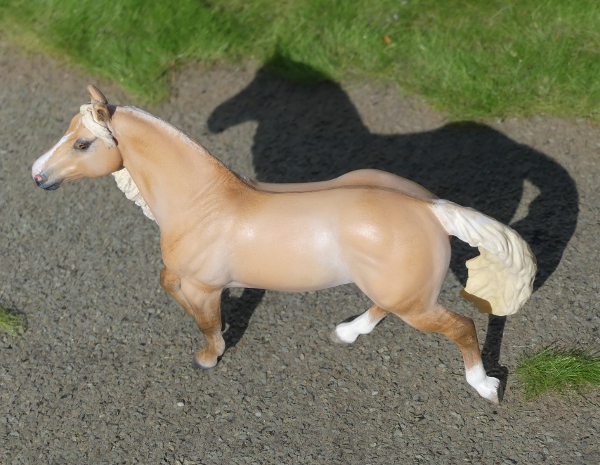

His dorsal stripe, which annoyingly isn't at all obvious from the side, yet it's one of the most important parts of the paintjob! I'm just glad to have ticked this colour off my list, it's fascinating how horse colours combine and vary depending on the various dilution factors, and dun plus cream was one I'd wanted to tackle for ages!

Next up, the results of hours reading and research - I wanted to know what other breeds the new Mini Connemara mould would be best suited for.
I've already painted one as the Connemara it was sculpted for, one as my own pony (Welsh x New Forest, looking more like this sculpt than anything else on the market!), and the Sable Island Pony Breyer once released it as themselves. 
But there's a lot of pony breeds out there in the world, and I'm especially fond of the native and feral types rather than the cross-bred showring types, so I sat with my books and referenced Wikipedia and various breed websites, and came up with a shortlist of ponies which matched both the breed type & conformation of the sculpt, and the free, feral attitude in the pose.

So which breed stood out as best suited, and one I'd most like to add to my collection?
The Pottok, from the Basque region of France and Spain.
These ponies are rather like the 'mountain and moorland' natives I'm so fond of in the UK - ancient ancestry, hardy, thrive on the roughest of land, can manage just fine as feral herds doing normal horse things in the wild, but can be brought in to a domestic environment and loved just as much as any other pony when tamed and trained.


They also come in lots of good colours to paint, with pinto being notably common, so my first Pottok is a seal brown pinto mare! Well over 50% of the reference photos I've seen have been flashy tobiano patched bays, chestnuts, browns, and blacks.


I hadn't realised how good this mould would look in a patchy coat, I think cos I'd only seen solid colours so far I'd not even considered it before, but it really does suit it - especially this slightly dirty unpolished coat, I gave her grubby heels and a bit of mud on the knees and hocks, like she's a proper outdoors pony and never gets bathed or shampooed!


Looking very happy frolicking in the spring field. I may well set aside another of the Connemara bodies to paint her a companion, it wouldn't be fair to have only one of the breed in my entire herd!


And the other side, because the markings are never symmetrical on a pinto, so each side will have different shapes.

The final custom of this whole March batch is a portrait of a very famous racehorse, Tiger Roll. He's so well-known in the UK and Ireland that many people who've never watched a horse race have heard of him, while anyone who does watch racing has ended up quite fond of his sweet little face, and admiring his big achievements. He's one who's attracted so many supporters and fans that he gets referred to as 'the People's Horse'.
There's a lot of biographical videos, compilations showing all his races, and even a couple of full documentaries about him, over on Youtube if you have the time, but here's a nice short summary telling his life story while visiting him at home.
When he finished his last ever race, and did his final lap of honour in front of a cheering crowd at the Cheltenham Festival, I just had to paint his miniature - I think I always knew I would, I just wanted to see him retire safe and sound first!


His colour is much redder than a lot of bay horses, here's a photo of the real one to compare - it's a very deep, bright bay with a lot of red tones rather than dark browns and blacks, so he looks quite different to the other racehorse portraits I've done.


The big star on his forehead - in later races he wore a black visor to help him concentrate his attention forward and you couldn't see this, but up to and including his Grand National win, it helped make him easy to identify in a crowded race. His only other marking is a little white patch on his shoulder, which I spotted in a video of him being tacked up - under his saddle pad you wouldn't know it was there.


I think the mould looks better from the other side, the eye is rounder and happier-looking when he's facing left, but his plaits show more on this side. I had to cut away the sculpted loose mane and replace it with Milliput in these little rolled-up braid blobs. I wish more of the famous horses I wanted to paint could run with loose manes, but so many of them seem to have needed plaiting! I also gave him bigger hooves, and a slightly different profile as the original face had too much of a dished nose.

All in all, I'm happy with my month's worth of customs, but already plotting what breeds and colours will be next!

Monday, 9 November 2020

Tales from the Body Box - the day of the Akhal-Teke

One of my favourite more unusual horse breeds is the ancient and striking Akhal-Teke, there's just something about their beauty and strangeness which is fascinating. Last year, I treated myself to a copy of Golden Horse : The legendary Akhal-Teke, a huge, beautiful thing to be read slowly and savoured, as much a work of art as it is of information, full of stunning photography by Artur Baboev - chances are, if you've spent any time looking at pictures of this glorious breed online, you'll have seen a lot of his.

Inspired by the book, I really wanted to make myself a custom Breyer Akhal-Teke. I've got models of them already (two resins and a Collecta), but in my Breyer herd there was only the OF metallic dun on the Lonesome Glory mould (I won him in a raffle!), and I really wanted to make a model look more Teke than just a thoroughbred mould in a metallic paintjob!

First things first, I'll admit it : I'm not the biggest fan of resculpting. I usually regard it as something to tackle if it absolutely unavoidably has to be done, like a damaged body which needs repairing, or a portrait custom which needs a different mane to look like the real horse. All other customs just get painted as they come, with just some craft-knife carving now and then to sort out seams and occasionally refine legs or jawlines. But it was clear that this time, I was going to have to get out the knife and milliput if I wanted the model to look right.
Back then I didn't have the new walking TB which would probably have been a far better starting point, but this project began last summer and moulds which've come my way since just weren't in the body box at the time - the only one I had with potential was the dressage/hanoverian, so that's what I picked out. 
Now, I did intend to take photos as I went along, and I'm certain I took at least two stages, but seem to have lost them entirely since then, so you don't get step-by-step pictures, and I'll just list what happened to the poor horse...

Plaited mane and forelock removed. 
Neck and topline reshaped.
Throat cut almost all the way through to lift the chin without detaching the head.
Ears filed pointier.
Shoulders and hips filed to remove warmbloody bulk and roundness.
Belly filed to 'lose weight' along flanks and underneath.
Legs carved thinner, especially thighs and cannons.
Raised foreleg sliced and bent at knee and fetlock.
Tail filed away so it hangs to a point, not a thick tail cut straight across.
Ribs scored in with the edge of the file.
Milliput added along spine to sharpen & straighten back and add the prominent withers & hip.
New throat filled in.
Eyelid and profile slightly resculpted.
Horse set aside because intended colour is difficult and painter is better at delaying than getting on with things.
Over a year goes by.
Dust gathers.

Last week, I finally got myself into the right frame of mind (you know, the paint this while you're still painting at all cos once you stop it'll be years again one), and it was time to tackle the Teke...


He's done! And, amazingly, he looks more or less exactly how I hoped. Perhaps my mental image was a little bit darker, more layers of the sooty shading, but I reached this stage and somehow he just looked like the colour he was meant to be, so I stopped the shading layers before I ruined him! 
I've named him Mele BĂĽrgĂĽt, 'brown eagle' in the Turkmen language, as many Akhal-Tekes are given names which reference their colour or liken their speed and character to birds.


I had a tube of gold paint (just a pound shop metallic acrylic, bought years ago for a Household Cavalry tack project), which I started off mixing into the tan and sandy shades, but found two problems with this - a) the paint took forever to dry and felt sticky, and b) you couldn't see the gold. I think the normal paint was coating the fine metallic specks so much it was lost in the mixture, and adding more just made it all the stickier. So I abandoned the gold paint, concentrated on getting the colour I wanted, then once he was done, dry-brushed the gold lightly over the top to give the metallic sheen I'd been trying for. It's there, but it's subtle, and looks more noticeable in person than in static photos.


Here he is with some dramatic low-sun lighting, in tribute to the Baboev photography which inspired his creation!

And then I washed my brushes, braided him a little colourful collar, and sat him on the mantelpiece, enjoying that moment of satisfaction and relief that the paintjob had worked. At long last, a custom project which'd been sitting half-finished for over a year, all done.
Now what?
Start another straight away, of course, one Akhal-Teke wasn't enough!

There in the body box was a mare mould who had the basics of Teke conformation - deep chest, high withers, long flat back, slim legs, fine long ears, and a flighty, spirited pose to suit the character just fine. Sure, she had way too much mane and tail, but that was nothing a sharp knife and a metal file couldn't fix...


Meet Roksolana, palomino mare on the Magnolia mould. Her colour's based on the gorgeous palomino on the Golden Horse book's front cover, a slightly greyed-down shade rather than the famously 'new penny' kind, again with the metallic paint gently smudged on as a thinly applied dry top coat (actually, I took the worst of each brush-dab off on the back of my hand before it touched the horse, so I ended up almost as shiny as she did!)


Another traditonal neck collar, and I think she looks just typey enough to say 'akhal-teke' at a glance, even without having had all the resculpting work the stallion did. Have a look for the little black spot inside her stripe - I didn't mean to put one there, but a slip of the hand while detailing her nostrils and she gained a marking which looks like it was designed on purpose!

And the painting didn't end there, either - having made myself a pair, it only seemed right to give them a matching foal, and there was a good mould for that in my body box, too...


I had a think about what colour babies would be possible for a buckskin and palomino bred together, and rather than have to paint the same as either adult, I went with a double cream dilution and made her a cremello. Akhal-Teke foals are traditionally named with the same letter as a parent - colts to match the stallion, fillies the mare, so this little one is Roxana to go with her mum.


Here they are together, and below, the whole family of three. That's enough painting for one day, I'm happy now!


Sunday, 5 July 2020

Tales from the Body Box - the lockdown herd grows and grows

During lockdown, I suspect many hobbyists are finding a lot of distraction, comfort, or just plain time-filling while other interests are off the schedule, by throwing themselves into whatever creative pursuits they can get on with in the safety and seclusion of their own homes. 
I've already painted as many Stablemates in the last few months as I did in through all of 2019, resulting in rather flooding the blog here with newly finished customs. Luckily I've not yet run out of paint, and have even had a little parcel of exciting new SM bodies arrive, so there's no sign of this Tales from the Body Box category fizzling out any time soon!


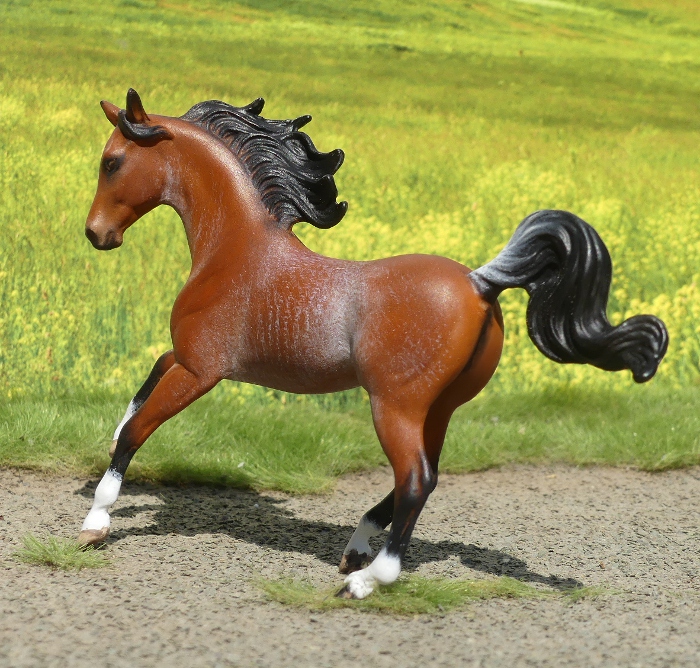
First we have Courvoisier, the dressage hanoverian mould in fleabitten grey. The inspiration for this was the Burghley winner Ballaghmor Class, though it's not a portrait model I've always liked how extremely speckled that horse is, and I'd never tried painting one with that much colour, so I gave it a go. I did the faintly shaded grey base coat first, then used a toothbrush to flick on the dark brown paint, diluted a tiny bit to make it spray finely rather than spattering in an appaloosa spot style, and just built up layer after layer til I was happy with the level of speckling. I'm quite pleased with the results, I'd definitely try this technique again.


Next up, another grey, based on this reference picture, though he ended up a little bit different because dappling by hand is so fiddly and nerve wracking and easy to mess up, I stopped before it got any worse! 
I've named him Maximus, and was going to dress him up for the show ring with braid and ribbons, cos a bright colour would make his paintwork pop, but soon realised his mane's on the wrong side of his neck for that (it'd be plaited with the loose hair falling down the off side in real life), and that put me off wanting to do it - a whole lot of fiddly work, just to create something that'd be wrong anyway!


What I love about this mould is how they can be tipped into a rearing pose - they'll balance like this ok for photos but I do make sure they have their front toe down on the shelf just so they can't suddenly decide to shift position and set off an equine domino effect all along the bookcase in the middle of the night!


Finally (for now - I've already started on the next batch!), here's Thunderbird, a colour idea I've had in the back of my mind for absolutely ages : the mustang in a loud pinto. 
Maybe I paint too many of these round-patchy tobianos. 
I definitely paint too many bay pintos. 
But I like painting bay pintos, so who cares! I think now more than ever the #1 rule for model horse collectors should be to buy or paint what you enjoy, whatever makes you happy; and painting bright little skewbalds is keeping me happy so there'll always be more and more.

Sunday, 26 April 2020

Tales from the Body Box - another mixed batch

I suspect a lot of people, all over the world, are finding a hobby to be a great a help in these difficult and worrying times, with safety restrictions and cancellations limiting things we'd usually be out doing, and much more time at home to pass in a constructive way. Whether it's making tack or rugs (or even fully furnished stableyard buildings!), photo showing, or customising, many of us in the model horse hobby are finding it a welcome distraction and creative outlet.

I'm yet to be inspired to dig out the craft materials and make any tack, miniature props, or scenery, and I haven't sewn a rug for a very long time indeed!
I always say my creativity goes in phases, and I'm unable to do more than one thing at a time : if I'm writing, I won't be touching the paints. If I'm drawing, I won't be making any miniatures. If I'm painting, I forget I ever could draw, and all my ideas remain unwritten. But rather than seeing this as a useless disappointment, I just embrace whatever I do feel like I'm in the mood for, and my painting phase is carrying on far longer than they ever usually do, so this week I've got a few more customs to share.


Firstly, the horse I intended to paint last time I picked up this mould! I'm really not very good at painting what I had in mind when I set out (one of the many, many reasons I've never considered taking commissions!), some paintjobs just go off in a different direction part way through and I like the results too much to go and spoil it by insisting my original idea was better.
This one's called Bronzewing, and the markings are inspired by a skewbald I saw out competing cross country last year, I just liked the idea of the entirely white back view, as opposed to the flash down the sides of the quarters I more often see - and paint - on a more minimally marked tobiano.

One of my aims this year is to push a little more out of my coat colour comfort zone, or rather, extend that comfort zone so I feel competant tackling a wider range of colours. 


Overo pintos are one of those colours which feels very 'other' to me, totally outside my little world of UK horsey experience and knowledge. 
This, of course, goes for a lot of breeds - I don't travel the world, so I've never met a Lusitano, or an Icelandic, or a Peruvian paso, either. But their colours, and markings, aren't unfamiliar territory : the same bay I could paint on a TB would look at home on a Marwari. The greying I understand on a welsh pony, that works on an Andalusian, too. Dun for Norwegian fjords, well that's just the same as dun for Highlands but with a cooler haircut. Familar and well-understood white markings and patterns can, with a little research, be applied to lots of different breeds. 

But overo? Nope, that's crazy!
It doesn't do what my mind says markings do, when sabino and tobiano are the only white-marked coats I ever see, the patterns I've been painting for years. 
Tackling an overo meant hours spent googling through pictures, trying to 'learn' the likely shapes and spread of the white patches. My first one was fairly tame, with not a lot of pinto bits, so this time, I decided I had to be brave and go for a lot more white! 


I'm pleased with how he turned out, I think the colour was more or less a success (although it'd take someone who actually understands overo the way I'm at home with tobiano to truly judge whether I'd done a decent job or not!), and I do think it suits the mould quite well, the action pose calls for something eyecatching. I've called him Diamond Creek Dazzler.


I finally found a little pot of blue paint in an old craft kit, so now I can do blue eyes without having to resort to colouring pencil over a white eye!


Here's another colour I'm not used to painting, but this time I've actually known several of them in person, the much more familiar sunburnt black! Some look practically bay in their faded stage, and because I've already got the OF black in this mould I didn't want them to be too alike, so I went quite heavy on the reddish shading - some sunburnt blacks have a much more subtle tint, to the point where you only really notice it if they're near a non-fading jet black horse to compare!


This angle is better to show the mould and pose, but doesn't bring out the colour quite so well. He's now named Romario, I'm doing quite well keeping up with naming this batch promptly!


Having done a couple of new colours, I decided to go for something else I'd never tried before, though pretty popular for model painting - a rabicano roan. Most commonly found in arabians and quarter horses, I picked a G3 stock horse and gave her a simple dark bay base coat, then got to work adding the roaning. First some white flicked on each flank with my thumb over a chunky paintbrush, then I picked out a finer brush and added the rib barring, lines following the hair whorl from belly to hip, few flecks of white on the quarters, throat, and behind each elbow. I finished it off by blending in the hand-painted hairs and adding the white top to the tail with some careful dry-brushing, gentle dusting of a very soft dense brush with not a lot of paint touched on the very tips of the hairs, so it leaves a faint smudge of white which increases with every pass of the brush.


This head-up, mouth-open pose is a bit odd from the side, but does make good characterful pictures from the front, like a horse who poses for the camera!


The bum-emphasising angle so favoured by real-life stock horse people! I've named this mare Plum Velvet, cos her colour reminds me of the sheen and lustre on dark velvety fabric.


Having thoroughly enjoyed one rabicano, I rummaged through the body box to find another suitable breed, and came up with this Magnolia arabian, one of my duplicates from the second series of blind bag mystery horses. This time I picked a brighter shade of bay as the base coat, and added the roaning in the same way as the first mare - it's showing up a little less because there's not the dark and light contrast, but I think the colour really suits the mould and it's far more interesting than she looked in plain bay part way through!


My first Magnolia custom, this was one of the moulds I was a bit unenthused by when first released, but the process of painting one, handling it and seeing it from all different angles, has made me like it more somehow. I did file down a couple of extremely overlong toes, though, and shortened both the ears a little bit! I'd like to get more of the mould eventually - perhaps one day if any full cases of series 2 mystery bags come up for sale cheap like the series 1 boxes did! 


I've named her Lumina, a name which has been kicking about on my list for aaaages but I've painted a lot of geldings and stallions lately and was saving it up for a mare. 

My supply of Stablemate bodies is starting to look seriously depleted, now, with how many I've done over the last few months, though I'm far from running out entirely I know I've used up all I'd got of certain moulds : I really need to lay them all out together and take stock of what's left in there, what I paint next will depend on managing to match remaining breeds to my colour ideas and inspirations. We'll see!