I'm going to catch up and share all my Breyer arrivals from the last four months in one big post - I didn't mean to neglect the blog quite so much, and want them to be here in 2023's posts, rather than spilling over into the wrong year!

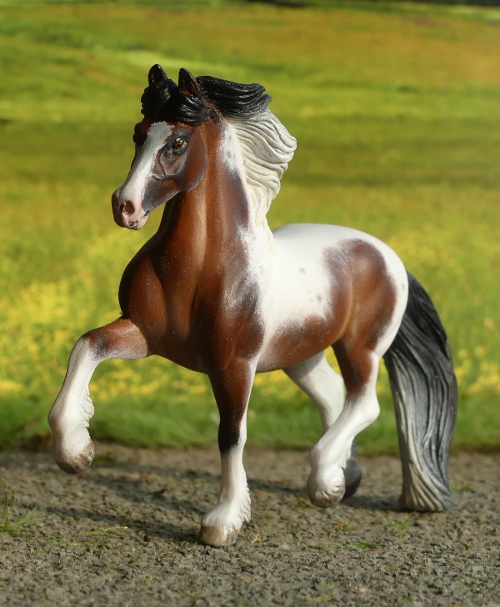
This handsome horse was a Brick And Mortar special run - meaning you could only buy him from stockists with physical shops, not online shops and not internationally. 2500 were made, which sounds like a huge amount, but maybe not when you consider that's spread across somewhere as big as the USA, and a lot more types of shop carry Breyer over there, too, not just specialist toy and model sellers like we're used to using in Europe.

His mould is an interesting one, originally sculpted as the Marwari but that limited the amount of releases Breyer could use it for without repeating the same breed more often than they'd like, so they reworked him as this adapted version with the curled ears replaced with standard ones, and a longer thicker mane and tail too. Now he can be different breeds too (although personally I'd love to see another regular run Marwari - I mean, it's been ten whole years since the only one we ever had!)

This 2019 release of the normal-ears version was sold as a Barb stallion. Barb as in Berber, the original North African breed, not the US breed also known as the Spanish Barb. Their ancestry is truly ancient, unlike a lot of the created European breeds which only date back a century or two, but interestingly they're very varied for such an old breed, with some Barbs having noticeable similarity to the PRE in the body type and head shape, some looking more like a light-framed leggy Arabian cross, and some looking much more coarse and heavy. So while this model doesn't immediately jump out as a typical Barb, due to the long lean limbs and thin upright neck, he's not massively outside the realms of possibility either, so I'm content to leave him as his allocated breed when filing his picture on my collection website.

Here's his other side, cos he's got nice sabino markings on his coat and I thought I better get a photo of this one too!
The second purchase back in September was also a bargain special run, but I bought him more from sympathy than for his rarity or price!
Sometimes when I'm browsing Ebay for Breyers, I'll spot rather intriguing listings. Horses which sold once already, will pop back up later, either from the same seller or someone different, at a much reduced price. Sometimes the reason is right there in the description, 'relisted due to non-paying bidder' or 'paintwork damaged in the post, selling as someone might be able to fix him up'. But sometimes the listing's photo speaks for itself - first time round this horse looked perfectly fine, on his relisted page there was an obvious new problem : he had no tail!
I investigated a little more through the feedback pages, and it turns out the seller had shipped him in totally inappropriate packing, he'd arrived broken, and been sent back when Paypal stepped in to give the buyer a refund. Now back up for sale, listed cheaply as a body with the tail included, I decided to take the risk to save the horse - too handsome and unusual to just become a custom body and lose his original identity!

Here he is on the day he arrived - the tail is all in one piece and the break is clean and crisp, and aside from the obvious he's in decent condition, just a couple of rubs on ears and tail tips. He's also missing the little plastic disc which attaches to one foot and helps him stand upright, but they're such ridiculously brittle fragile things it's not at all uncommon for this mould to have lost the base even if the model's been carefully looked after, those things are a design flaw from day one!
First task was to reattach the tail, it's a surprisingly heavy chunk of solid plastic so I wasn't sure if superglue alone was going to be up to the task, but it was worth a try cos the alternative of using a drill to hollow out a hole in both halves then filling the space with a wire pin and milliput was a LOT of work! And luckily, the glue worked on the second attempt, after dropping apart when I didn't hold it together long enough first time. Second try was more determined, I held it very firmly in place with both hands for a good five minutes, then when it seemed firm enough to let go, wedged the horse head-down between two cushions so gravity was helping while the glue had even more time to become fully solid right through!
Once the tail was back on, it was time to disguise the join. Because the plastic is white inside and the horse is a fairly dark colour, the repair showed as a hairline crack, but by mixing a colour-matched paint and carefully rubbing it into the tiny space, so the original paint isn't covered but the giveaway white line was. I also touched up the tiny rubs to the end of the tail and the tops of the ears, so now he looks almost good as new!

Can you spot the join? I can, just, but only cos I know it's there - on the shelf he'll look just fine!

And here he is! He's a Breyerfest special run, from 2001 - the days when you could only attend the event in person, with no online alternative way to buy the models. Atlantis Bey was a son of Huckleberry Bey, the very horse this mould was sculpted as. So he got to be made in the same mould as his father - but it's also a really good match for the horse himself, see this real photo here. He's slightly metallic, but not in the plasticky, unrealistic way I always complain about when they make models too silvery or pearlised, this is much more like the real-life coppery sheen so many chestnuts do have.

It might look as if he stands up just fine without his base, but there's a little trickery involved here - there's actually a wooden kebab stick propping him up in both these photos! With the grass base slightly tilted, the model naturally wants to tip toward the backdrop, so his own weight presses the pointy end of the stick into the fake grass, which grips it, and he stays balanced. The secret is to place the prop in line with the upright front leg, so it's totally hidden from view - check out the shadow when you're setting up, too, sometimes that will give away that there's something weird going on behind the model, but as you can see here the shadow of the prop is absorbed into the outline shadow of the horse himself.
Unfortunately it does limit the camera angles you can use, so there's less pictures of this one. But I'm really pleased to have added him to my collection, and to have mended him after his misfortune!
Another very pleasant and unexpected buy came my way last month, and it's one of the big models from Breyerfest in 2021, when the theme of the event was 'A Horse of a Different Colour', and they made a lot of interesting and unusual colours!

This is a fun arrival for me, not just a pretty model, but I was aware of the horse before she was announced as a Breyer!
Having read a LOT of information sites and blog posts about horse colour over the years, this mare had come up several times as an example to be discussed. So when I saw the reveals for that year's Breyerfest included Queen Of Hearts aka Josie, I immediately thought 'I know that horse!'
Having read a LOT of information sites and blog posts about horse colour over the years, this mare had come up several times as an example to be discussed. So when I saw the reveals for that year's Breyerfest included Queen Of Hearts aka Josie, I immediately thought 'I know that horse!'
At the time, I couldn't get her - shipping and the inevitable customs and handling fees would've put her total cost at around four times the usual price of a Breyer - but I did kind of hope that eventually some would turn up on the second hand market over here.
The first few went for high prices, as an in-demand and interesting model - even recently I've seen one for sale at over £100. But I was very lucky when bidding on this one, and got her for just £42 - that's quite a bit less than a brand new regular run in this country (£55-65 seemed to be the average RRP for the last releases the UK was able to get, just to give a rough idea to the international collectors out there!)

Another angle, as well as the eye-catching colour which is her main talking point, it's also a really beautiful sculpt, dynamic and very elegant!

There's two theories on how she manages to be one horse but two colours.
The one Breyer give as if it's certain, is that she's a chimera - two embryos of different colour twin horses, which fuse together at an early stage and develop as one horse with two sets of DNA. This can and does happen, the majority of the time the colour patches are less marbled together but occasionally it's more of a brindled pattern. There's one major flaw to this theory, though - Josie was born with the white colour streaks, where a grey horse will be born dark and turn white with age. so if she was a chimera of bay and grey, you'd expect her white bits to have faded in gradually over the years.
The second theory, which I personally find more likely, is a somatic mutation where the pigmentation of cells just didn't develop equally all over. When the embryo is growing, growth of skin cells starts along the line of the spine and spreads down on either side, onto what will become the neck and flanks of the horse. The trails of white look to follow these usually-invisible lines on the body, known as blaschko lines. The dark pigmentation just failed in those specific streaks, and so they grew white hair right from the gestation period, and the foal was born with them. Just for interest, here is a very similar phenomenon on a couple of human examples!

Here's her other side, a very handsome but much plainer solid dark bay - it's obvious which way I'll want this one on my shelf!

I never really know how to handle a jumping model for photos, cos they're either jumping mid-air over nothing, or I put in a log or hedge to create logic for the pose, and then that just looks weird cos a horse wouldn't be jumping plaited with no tack on.
I've considered if it's worth making a nice neat-looking realistic jump wing and some poles at this scale, now I have three of this sculpt and four of the jumping pony, but that still wouldn't explain why they're jumping 'naked' - even a loose-schooling horse will usually have a bridle, halter, or lunge cavesson on it's head.
So I just took pictures of her jumping nothing anyway!
Now, on to the Stablemates...
I don't usually make much effort to collect the Breyerfest minis on the second hand market, they're always an awful lot of money for such a small size of horse, so I tend to accept them as the ones I admire but don't intend to own. But this year there was one in a set of four which stood out as EXACTLY the kind of model I really wanted for my collection, and from when I first saw the photos I kind of hoped that sooner or later one might turn up on UK Ebay.
I got outbid on the first one which did appear here, but was the only bidder on the second!

A blagdon cob! He reminds me very much of a lovely natured and very handsome cob who lived over the fence from my pony field for a few years, he was such a gentle and polite chap, and both me and my horse missed him when he went off to a new home! Breyer very rarely tackle this sort of pattern on their mini scale models, and I think they've managed it very very well considering how small and intricate the masking is.

The mould is a scaled down version of the Traditional 1:9 scale sculpt, I've got a couple of others this size already (one spotted, one silver bay...oh, and a whole handful of piebald and skewbald custom repaints!), I think he looks just as good in miniature. The flying feathering on the legs and the huge mane and tail really do look dramatic, and he looks like he's having a great time playing out in the field.

The other side, just as detailed. 'Blagdon' is the traditional name for the colour between cob owners and riders, especially in the traveller community, we all know them as that when they're a jumbled up scrambly roany colour with big splashes of white too - but genetically it'd be more accurately described as an extensive sabino pattern.

I'm really happy to have bought him, even though he cost quite a bit, but I did cover my boss's saturday while he was away so in theory I can say I paid for this model with that extra work morning of sitting about doing not much, and that's a much better way to think about it than in cash!

I've named him Harum-Scarum, cos I've already got cobs called Helter-Skelter and Hurly-Burly, so these fun rhyming words seemed a good theme to carry on with!
The last few to add here are some more of this year's Breyerfest Stablemates - released as a set of five, four of them were being sold together on Ebay. I'm assuming the seller got the set for just the fifth model which they kept, and funnily enough that's the one I'd have wanted least as it was a glossy. Highly collectable in the hobby, but I've never liked the thick smooth gloss coating - it makes them look like china ornaments rather than the more realistic sheen of a standard model, which matches what you see on a real horse's coat.
Here's the four I bought...

The Missouri Fox Trotter in a red dun pinto, I'd already thought of painting one of my duplicates from the blind bags in this colour and pattern, before this model was announced, so Breyer had the same idea as me, hahah! I think it suits the mould well, and it's good to have a pinto after the solid grey and palomino regular runs, he's my easily favourite from the three I've got.


The other side, this mould can display facing either way as it's walking on a straight line, but I think I prefer the side with the mane showing

The second one from the set is this great little Mustang, the first on the scaled-down mini version of the 1:9 scale 'Fireheart' mould. I love how well he matches with the bay overo on the G4 Mustang mould, even though they're different sculptors the style is compatible and the chunkier type with a bit of heel feather is a perfect match - you could imagine them as father and son in a little herd running free.

It amuses me that I've ended up with a relatively rare special run on this mould first, rather than having to wait for a regular run as usual. Breyer don't seem to like issuing the most recent moulds in any accessible way - after the initial club-only runs to fairly reward the people who've paid into that system, the new moulds still seem to be set aside for things which can't be bought outside the US, and then in a few colourful/glittery unicorn sets, and finally allowed out to the poor regular run collectors many years later when they're not even exciting any more, hah.

Cos it's a new mould, an extra photo! This autumnal backdrop was fitting for the time the models arrived, it just took me ages to get them as far as my blog as well.

The Driving Horse mould in a really pretty and detailed appaloosa pattern, I initially put this one on the Sugarbush Draft page of my site but she's not really quite heavy-built enough in the body even though the legs are thick and the hooves large - I swapped her to be a draft cross instead.

I think the Breyerfest models often get a little bit more attention to detail in their colour designs than the regular runs, which have to be made in much greater numbers - they're simplified for speed and ease of painting on the production line when the run is going to be huge.

I've saved my favourite SM for last, this gorgeous little rose grey on the Magnolia mould! Definitely the stand-out of the set for me, even though it's never been one of my top moulds it's just so lovely in this well-painted colour, with so much shading and even soft dappling!

The sculpt isn't issued with an official breed, though many people have them as Arabian mares I've always felt they were a bit too long-legged and not deep'n'round enough for a true typey Arabian, mine are usually some sort of partbred (National Show Horse, which is Arab x Saddlebred), or one of the older breeds which derived from Arabian stallions crossed with a mixture of Anglo and local mares. Tersk horses are often grey, so that's what I've gone with for this pretty mare.

Another angle, what lovely markings she has - the striped hooves are especially nice!

And that's it, I'm all caught up on posting my original-finish Breyers, just in time for the end of the year.