Friday, 2 April 2021

WIA Eberl Lancelot and Sharif

One of my most-viewed blog posts here at Harecroft Horses is the introduction & review of my wonderful WIA Gustavs, so I thought some of you might enjoy seeing the contents of this week's parcel.

I can't quite remember what made me look there in the first place, but one afternoon I was browsing on Modellpferdeversand, and spotted something rather exciting - new colour WIA horses! 
I'd seen the original plastic release of Sharif in black, and Lancelot in pinto, but now there were more
Because most marketing and PR is done by Facebook these days, I never see news of upcoming model releases unless any friends particularly wave links at me for stuff they think I'd like, and somehow these second colour releases hadn't come up in any conversations, so it was a total surprise that they existed, and I had one of those irresistible impulse-buy moments, and just had to have them!

It was only the instant after paying that I suddenly remembered Brexit and customs fees, and inwardly groaned at the prospect of the dreaded red Parcel Force ransom fee of double figures to get hold of my parcel once it reached UK soil. But I needn't have worried, it came sailing through international shipping so quickly that it was on my doorstep quicker than many things ordered in this country, and not a penny extra to pay. Whether Germany has some kind of trade deal organised to avoid import fees, or whether the value threshold is just a lot higher than the US limit, I don't know - but for anyone worrying that Brexit might've ended a long loyal following of MPV for British collectors, don't panic, it was fine!

So, what's in the box?
Horses by WIA are much the same scale, and cast in a similar slightly flexible tough plastic, as the better-known Schleich, CollectA, Safari, Mojo, Bullyland or Papo models. I call these 'mid-scale plastics' in my blog tagging, for want of a better term to group them all together, though obviously the quality and realism varies vastly from one company to another.
 
WIA have two distinct strengths when compared to similar brands : the moulds are scaled down versions of Traditional scale resins by Brigitte Eberl, one of the most celebrated and highly-esteemed sculpting artists in the model horse hobby; and the paintjobs have careful shading and better detailing than the more mass-produced toy type models. You can tell these are aimed at discerning collectors, not children for play, though the prices are no more than a Schleich or CollectA figure.

Let's meet them...


Lancelot, in dark dappled bay. You can see the original resin Lancelot here, and hasn't he scaled down well! WIA certainly haven't followed the trend for those safely chunky legs we see on newer CollectA sculpts and some Breyer Stablemates; small plastic Lancelot is every bit as lanky and long-legged as his tall resin self, and it's really refreshing and satisfying to see that.
I think, because they're being aimed at teen and adult collectors from the model hobby, there's no worry about making the models tough enough for rough play - they're not worried about parents complaining over snapped legs and play-scuffed paint, cos they know their models will mostly be admired, photographed, custom painted, and maybe taken carefully wrapped and boxed to live shows.


Isn't he a handsome chap! I really like the colour they've gone for, the deep sooty shading and dapples which fade in and out in all the right places, realistic choice of white markings which set him off nicely, and a warm reddish tone which makes him so different from the first dark bay in their range. It's also nice to have a simple standing horse with neat plaits, when so many models are in action poses with dramatic flowing hair.


I've named him Harecroft Maestro, though I haven't picked a breed for him, yet. The resin was sculpted as a Hanoverian, but they're one of the heavier warmblood breeds, and as he's much the lightest conformation compared to my CollectA warmbloods, I think he ought to be allocated one of the finer types.
I'll have to consult my scribbled list of WB breeds, where I went through five different breed textbooks and noted down all the useful bits of their descriptions. There were a lot of 'good all-round conformation' and 'well-formed' generalisations, but enough specific mentions of lightness/heaviness, build, colour, and notably long or short backs/necks/limbs to help me narrow down which models should be which breeds (when I first got into showing, 15 years ago, just plain 'warmblood' was considered enough, but not any more!)


Lancelot's first release last year was this bay tobiano pinto. Again, I shall have to refer to the magic master list of scribble to pick out a light warmblood breed which can be skewbald. His markings are neatly painted, apart from a small area on each side of his neck which is a little blurry, where the masking probably didn't stick close to his contours and let a little spray overlap the intended edge. But I don't think it matters too much, we've all seen real life pintos with a bit of odd roaning on their patches, so I'm happy to write it off as a thing that can happen rather than a terribly spoiling paint flaw!
Oh, and by the way, it looks as though he's got one ear too long and curled forward, but that's just an unfortunate lining up of his actual ear with a bit of a leaf in the background, which I didn't notice when taking the shot - oops!


I've given him the name Harecroft Polestar, and he is a very handsome horse! Look at that interrupted stripe face marking, and the sharp prick of his ears. These remind me of the photos studs and competition yards take of their star horses, all perfectly turned out and standing to attention for the photographer, even if it takes an extra person in the background jingling keys or rustling a crisp packet to get that perfect alert shot.

Also in the parcel was one spare Lancelot to repaint, but because my favourite colours to paint are bay and bay tobiano, and I've got here an OF bay and an OF bay tobiano, I either have to accept I'm just painting one the same colour as I've already got, or go for a colour I don't enjoy painting quite so much, which seems a shame when I only have the single body to get creative on!


Next up, arabian stallion Sharif (see his Trad resin self, here). 
When we first saw finished photos of the WIA Sharif, I remember being very disappointed in the way they'd arranged his neck seam. The mane is cast as a separate piece and attached afterwards, but rather than designing the join to run alone the hairline where it seems logical, they included a big chunk of his crest in the section, so the seam runs down the groove between his neck muscles.
It seemed enough to put me off buying him back then, but I decided to go for it now - if I couldn't put up with how bad it looked, I could always smooth it over with milliput, repaint the filler, and just never show him cos he wouldn't be OF any more.
But, in person, the seam just isn't that bad. You can see it, of course, if you look there, but it doesn't stand out as glaringly obvious - did you even notice it, in the above photo, til I pointed it out? 


I'm not normally a huge fan of black model horses, because they can look either very flat and plain, or else shiny-plasticky and difficult to photograph well, but he's got a hint of brown tones rather than jet black, just enough white to give him individuality, and a paint finish not gloss, not fully matte, but with a subtle sheen which just catches the light to bring him to life. Now named Harecroft Malik, he's instantly one of the nicest black models in my whole collection!

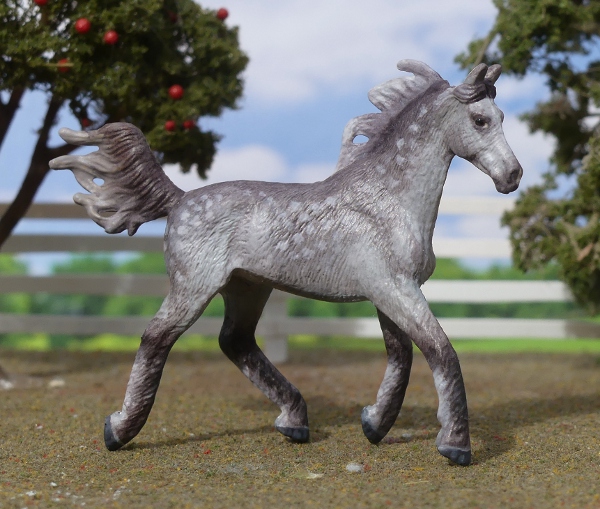
As well as a spare Lancelot, I thought I'd get myself a duplicate Sharif for the body box, and rather than the black, my cunning plan was to order two dappled greys - as that's the most difficult colour to get right, ugly/wonky/clumsy dapples are a real possibility in most brands, and as I'd only seen the prototype photo, I didn't know how well the production models were turning out. So I'd order two, have two chances at getting a good one, and choose the nicest dappling to keep.

But look!


The left-hand dark version was the first one I unwrapped, and I thought 'wow, ok, I really should've trusted WIA with this, they're good', and laughed at myself for expecting there might be dodgy dapples. Then I unwrapped the second one, and his high-contrast dappling is even more prominent and more striking, and just as perfect! Of course I can't bear painting over either of these gorgeous greys, so they both get to stay, and I don't get to create my own custom colour after all.


Here's the dark variation first, his smaller dapples are painted in much more softly, the base coat is deeper grey, and the shading over his neck and shoulders kind of blends them almost away, so the overall impression is a young steel grey with a hint of dappling. I've named him Harecroft Karakal, after the beautiful wild cat (spelt as Caracal in English) found in North Africa and the Middle East.


Once again, the neck seam really doesn't bother me, you can see it isn't conspicuous in 'normal' model photos like these, set up at angles like real horse pictures. Sure, if you took a photo looking down on his neck, or angled just right in hand, you could get it showing clearly as an ugly 'scar' and frustrating production decision, but that's not really what we do with our horses, is it.
So, much as with my Brexit reassurance, I'll say this : if you like the look of him but were worried about the seam, don't be, it's fine.


And here's his paler brother, with larger dapples, painted much more distinctly but still in a gentle, accurate and believable way - none of the awkward airbrush 'fish-scales' or blobby spotting, these are as nice as you could hope for on an OF, and most hobbyist custom painters would be proud of them, too!


I remembered to take a photo of the other side! Tack makers, note - there's a convenient gap between his flying mane and his neck, and an even more ingenious space left between his forelock and forehead, so he could easily wear an arabian halter, tasselled collar set, or even full tack.
I'm tempted to try a Bedouin/Egyptian style braided halter, but he's a substantial bit smaller than the Julip (12th/Classic scale) ones I've done before, and I'm not sure my tassel technique would work neatly enough!


I've called this one Harecroft Al-Shaahin, the arabic name for the peregrine falcon (pronounced Shaheen, sometimes spelt that way too). I don't think I can choose a favourite between them, each one is lovely in his own way, and I'm glad I ended up with both of them, even though keeping two wasn't the plan!

What mould could be next for WIA? We've had a draft horse, an arabian, and a warmblood, so maybe something Iberian next? A stock horse? Or a gaited breed? Perhaps a pony! Whatever they make, at this point I'm almost certain I'll buy it and love it!

Sunday, 21 March 2021

Tales from the Body Box - The Rockies

Just two completed horses from the body box this time (I'm trying to take them slowly, as the box is not infinite and I don't want to run out of the inspiring moulds and be left with only those I have no more ideas for!)

First up, a portrait who's been a rather long time coming - it's somehow got to twenty years since I met and worked with the real horse - but in my defence, I do already have Julip and Feltie versions of him, it's just the Stablemate which it's taken me forever to get round to painting.

Rocky was a rescued horse, saved from neglect and abusive handling but still feral and untouchable when I first met him, living in the field behind the place I was doing my college work experience as a teenager. Very afraid, and violently defensive, he just needed understanding and patience - it didn't take long to gain his trust and discover the genuine, friendly, loyal horse he was inside.
Once we'd made friends, 
and done a lot of careful educational handling to get him friendly and socialised, I started him from scratch, climbing on the fence to sit bareback in the field at first, then we started to go for little hacks down the lanes. All that summer and into the autumn I kept going back, to bring him on; we did some schooling, and a lot of wandering the countryside encountering new things, exploring, learning, relaxing, and we had a couple of brilliant gallops. His adopted family learnt to love him too, and a few years later he found a good home for life, with his owner's best friend.


There'd never been a Stablemate mould which really felt right for Rocky. I've done coloured cobs on the Friesian mould before, but that's too flashy and high-stepping for his placid, kind nature. And I've used the G2 Clydesdale, but that build is too chunky, and the pose isn't fitting, either.
Then the Cob mould was released, and at the time, I wasn't the biggest fan : it seemed too slim, too young - all legs and underdeveloped topline, a friendly cute face but not a typical adult cob. 
Just recently, I realised who it reminded me of. Rocky! Suddenly all the faults didn't matter, cos they made it look even more like him than any other mould ever had. So I got out the old photo prints, and the last cob from my body box, and got to work...


Meet Harecroft Rocky Blue-eyes. He had to have a 'surname' to tell him apart from the other Rockies in my herd, but this was one of the nicknames I used to call the real one, so it's got a nice fond-memories nostalgia to it!


I really like how he turned out, I did his patches colour-over-white this time as there's so much more of the white to paint in, it's easier to get flat and smooth when not having to fiddle round the edges of markings which need to stay the right shape (it matters less on made-up paintjobs than on portraits!)


He's got really unusual patches along his spine, a series of spots which I remember seeing when I used to step over his back from the fence. It's unusual for tobianos to carry colour patches along an otherwise white topline, and I've never seen another marked quite like Rocky's string of round-ish blobs!


The second 'rocky' custom is a spur-of-the-moment idea, inspired when I happened to see a photograph of a Rocky Mountain Horse. Oh, how I'd like to have a go at that chocolate colour with the graduated blonde mane! So it was back to the body box, to see if I had any moulds which would do - the closest was the G2 Morgan, while not a perfect example of breed type, was close enough to satisfy me wanting to paint one!


And I do love the way his colour worked! I always aim to vary my brown-based paintjobs - the brand I use only has three shades of brown paint to buy (one chocolatey, one reddish, one rusty orange), so it would be all too easy to paint the same three coat colours over and over again. I have to make a conscious effort to blend them in a new way each time, and be aware of adjusting shading to capture coat colours differently, so my chestnuts don't just look like bays with the points left off, and my silvers aren't just pale browns, and so on.


He was enjoyable to paint, his colour turned out almost exactly as I imagined, even the dapples which usually cause me difficulties went on smoothly, and blended into his colour just how I hoped. But I do have one regret - in the left-hand shot here you can see his profile is almost straight, but in the others it looks dished - I gave him a crooked stripe, and the curve to the right makes it look like a straight stripe following an inward contour. If I'd curved it to the left instead, it wouldn't have given that optical illusion of wrong-for-his-breed conformation!

But he's very pretty anyway, and I'm always far too nervous to change a completed custom incase I spoil what was a perfectly decent paintjob with a clumsily-matched or rough bit of extra paint to correct something which looked ok as it was. So he gets to keep his crooked stripe!

Saturday, 20 March 2021

CollectA customs little & large

This week I had two new custom CollectA arrivals, co-incidentally both painted by the same hobby friend of mine - Chloe at Henhafod. One was a newly finished piece straight from the artist's studio, the other second hand from Ebay, having lived with someone else for a few years in between.


This mould is intended as a pure arabian, but the legs are rather chunky for that, so I think I'll be having him as a Tersk instead. The Tersk (or Tersky) is a Russian breed, based on European arab stallions but with a mix of thoroughbred and hunter-type blood. They do vary, from what I've read, with some lines looking almost purebred arabian, while many would make a good hunter, jumper or eventer type - an all-round riding horse with more height and bone.


He's my first of the small scale Mini CollectA models, shrunk-down versions of their Standard 20th and Deluxe 12th scale moulds. They're a bit bigger than Breyer Mini Whinnies, so I took a picture to show the size (for any international readers, a UK penny is the same as a US one, the Euro cent, and matches the penny/cent coin in a lot of other places, too!)


I think I'll call him Pascha, another of those names I've had on my list for ages but never had a horse to suit it - apparently it means 'small' and is of Russian origin, so it's ideal for this tiny little chap!


Although I like the photos with my smallest-scale trees in, he does stand out really nicely against the open sky, and I'm undecided which to use as his show and website image. Note the extra small white paddock fence, hastily made from sliced up packaging box last time I had some micro-mini scale models to photograph!


And here's his wrong side : I always try to find the 'right' angle to show off a horse to the most flattering advantage, and like many, this mould's posed on a slight bend, with his head turned, making this the non-display side.

The second of Chloe's customs was painted a few years ago, when he popped up on Ebay my first reaction was just 'ooh, pretty!' cos I liked his colour. I clicked for a closer look at the photos, because I do love my CollectA models and this is such a friendly-looking mould I'd decided I might have to try for him. But once I saw I knew his painter (and we've been friends for well over a decade now), I was even more determined to get him for my herd, and was delighted to be the winning bidder by the end.


He's a lovely toned-down smoky palomino colour, a really soft and pleasant variation on the usual copper-penny bright tones. Even though I paint lots of models myself, I always think it's well worth adding other artists' work when they've done something I know I couldn't just do for myself. And these gentle pale dilutes are the ones I've always struggled with, to the point of avoiding cos I know how rarely they go well for me. So I buy other people's instead!


I love the expression on so many of the Debra McDermott CollectA sculpt's faces - that head-turn with an alert prick of the ears, like you've just made a click of the tongue or jingle of keys to get the horse's attention for a photograph.

Saturday, 13 March 2021

More Magpies - a donkey and a shetland pony

In my previous post on Magpie Models, I mentioned that I'd been for a rummage through another area of body box, and found not only the shells I knew were in there, but an extra donkey shell I didn't even remember buying!
Any model collectors reading this without being an enthusiast of Magpie might not know just how sought after these rare donkeys are - I've seen an OF sell on ebay for over £130, and even blank shells making upwards of £50 each on a good day, so to say I was pleased to find I owned one more than I remembered is an understatement!
It's possible the extra one was a lucky find on a sales table at a live show some time before the prices started to rocket up (I wouldn't have paid more than about a fiver per body), and tucked away with the other shells to do something with later - then I promptly forgot about them entirely for however long, heh

With my Magpie collecting enjoying something of a renaissance with the photo show re-igniting my old love of my existing herd, and my new welshie customs turning out so nicely, I was on a roll and just couldn't resist getting to work on the first donkey. 


As I've already got Julips of the two donkeys I used to look after for their owner, I decided to go with the colour of a different donkey I'm only vaguely acquainted with - I cycle past his corner paddock every time I go to work or to my own ponies. I started to call out 'hello, donkey' so I didn't make him jump by suddenly appearing on my bike, now it's become a habit to always greet him, and he always stops what he's doing to watch me go by.


I really like the way he turned out, the textured hairy-coat sculpting had me worried that with my brush-smudging painting technique the shading would catch on all the raised areas, leaving a rough patchy look, but he's just smooth enough that it wasn't an issue. I've named him Harecroft Tholomas (pronounced 'toller-muss').


Making his tail was the hardest part of the whole customisation process. I admit I hate working with the combination of glue and mohair at the best of times, so my usual tactic is to sew it into a sandwich of paper for a mane, and make a tight ponytail with a bit of wire wrapping for a tail, and slot them in without gluing just to avoid the ruining mess! 
Adapting to a donkey mane was fine, as it's the same construction as a horse's mane, just trimmed to stand upright, and coloured with a bit of diluted black paint to dye it streaky. But for a donkey's distinctive tail anatomy, where the dock has the same short smooth coat as the body, I had to use glue to bundle the top half tight together, leaving just the fluffy tuft at the end. Once the PVA had dried completely, I attached it to his bum with a dot of gel superglue to make sure it's extra firm and can't drop off, and used a bit of paint to match the colour.

You'd think one new Magpie for my herd would be enough, but no, it seems now I've started I can't leave them alone ...I'll go back to have another look in the body box.

Magpie bodies come in matching halves to join together yourself, that's why we call them shells, and in here there's four pieces - enough to make two ponies.
Well, I have an actual shetland pony. So, even though I got my Julip of her only last month, I suppose it's somehow inevitable and only right that my first shetland shell should be used as a portrait of my own shetland, and the second shell can become a made-up one in a colour I just fancy painting.

And here she is!


Bonnie has a notoriously difficult colour to paint, but I managed it using some golden beige shades, with a hint of 'chestnut' paint mixed in to deepen the colour without losing the warmth, then a little black and stoney grey-brown added for her legs, with the colour fading up into her hindquarters.


Exactly as with her Julip self, I chose her in-between coat colour - not the darkest chocolatey brown of her midsummer coat, or the much blonder winter fluff, but the golden shaded tones she goes twice every year. One of these days I'll have to do a winter Bonnie SM, but I'll need to resculpt the entire surface with rough thick fur first!


I'm really happy with how she turned out - I did think maybe it was a bit silly to paint myself a Bonnie so soon after getting her done as a Julip portrait, especially as shetland shells haven't been in production since the early 90s so they're almost as scarce as the donkeys. But Magpies are very different models and I'm sure I'll enjoy owning both of them - it's not a waste of the precious shell at all, but the best way I could possibly have used one up.


Here's a little before-and-after comparison, you can see that I did a little Milliputting work to reshape the face before painting.
It has incredibly tiny ears, which would just be lost amongst Bonnie's blonde forelock, so I made them about twice the size. Then I decided I may as well make it look even more like Bon and tweak some of the less pretty aspects of the face, so I enlarged the eyes, which weren't bad but were on the small side, and redid the muzzle chunkier, with larger nostrils and a closed mouth.
The original mouth is sculpted in a rather odd open-lips, gritted-teeth expression - I wonder if they were intended to be cut open to take a bit, like the Magpie arab and hunter can.


Bonnie's mane presented a challenge - I only have black, white or mixed black'n'white mohair, so I made up a plain white mane by sewing to avoid glue as usual, then used paint to colour it blonde with a hint of chestnut and some grey at the shoulder. It's still a tiny bit damp from styling mouse in this photo, but I forgot to take a better shot of her wrong side the next day when the sun came out!


Bonnie with her real self!
I've had to name this one Bonnie Surprise, her passport name which we never actually use, because I already used just plain Bonnie for the CollectA custom which was my first model of her, Little Bonnie for her Stablemate self, then chose Bonnie Bunny for the Julip after the real one's nickname (as well as having a Bonnie Scotland who was a lookalike Julip of a totally different Bonnie I used to ride, and had to have her name adjusted after my Bonnie arrived!)
I just have to remember who got which name variation if I'm entering this herd of Bonnies in any photo shows.

Breyer Mini Whinnies - saddlebreds

Until the Mini Whinnies selection was expanded with scaled-down versions of popular Trad and Classic moulds, one of my favourites from the older range was the standing saddlebred - yet he was the one mould I'd somehow never managed to get! When someone on Ebay listed a set of four different colours as a job lot, I just couldn't resist, and this morning I had a little parcel of extra tiny horses through the door.


The original Mini Whinnies might be a bit basic and clunky, with less accurate anatomy than the new generation made from shrunk-down larger scales, but they're sweet in their own way - and because I'd always wanted this particular mould, I'm really pleased with them, even though in general I'd favour the more recent releases for realism and accuracy.

The first three all come from the 2019 blind bags, series 3. Their release names were Muffin, Hunter, and Louie, but I'll be changing those to better suit my herd and my taste in horse names! 


And the final one was part of a packaged 'Six Stallions' set, 2005-6, he didn't come with a name.

I thought that once I finally had some of this mould, I'd be satisfied - but actually I'd like even more of them now I've started!

Friday, 5 March 2021

Tales from the Body Box - Wait, what, HOW many?

I'm aware I've perhaps been doing too much painting. Eighteen models in the first two months of 2021!

There's such a fine line between making the most of a creative high, and burning through the body box at an unsustainable speed, building up to an abrupt end of this phase for another however many years.

And it's cyclical - you know the burn-out is coming. Sure, at the moment I can pick up a horse and feel enthusiastic about a breed, a colour, I can sit and smudge away with my brushes and tiny paint pots and an hour or so later, have a little full colour horse just how I wanted him. But eventually, I won't be able to do that any more. There's been gaps of five years before I felt like picking up a brush again.

So all the ideas I've got, all the bodies I'm currently excited about getting painted?
Half of me says 'slow down, make them last, take your time', while the other half is screaming 'hurry, hurry, paint them now while you can!'

There's a frantic fragility to it which will resonate with a lot of artists, painters, writers : creating is both a compulsion which takes over, and a spark which can go out in an instant. I do as much as I can while I still can.

Here's a round-up of february's models (let's pretend I got this post up in the same month rather than leaving it into march!)


This is Harecroft Napoleon, who came about because I realised I'd somehow never done the G2 warmblood mould in my favourite/signature colour, bay skewbald. I don't know how this oversight could've happened, considering I've painted just about everything else in bay tobiano at least once!


He's also the recipient of a new tail, the original swishing sculpted one being very short and flimsy-looking as well as out of sight on the non-display side of the mould.
I had the dubious benefit of a brand new pack of Milliput recently, and while it's much, much easier to mix, it's also disturbingly soft compared to my old pack (I'd been buying it from a tiny old fashioned shop in town where they sold maybe one packet every three or four years, the stock was so dusty, fly-spotted, and aged to the point of being very firm when I got it!). The sculpted tail was so bendy I had to support it with a quickly formed tinfoil tail-rest so it didn't just flop down to his hocks like a greenish dead slug. Nice mental image.


Another Milliput victim, this G3 belgian gained a full tail (actually, this was my first attempt at the WB's tail, but I didn't like it for him, snapped it off, and gave it to someone else!) and a loose mane. I was trying to think of which draft breeds would suit both the mould and the full tailed look, and came up with the American Cream Draft. 


They're not actually a genetically cream colour, but rather gold champagne (chestnut plus a champagne gene), so she's got a mottled pink muzzle, and eyes more olive-greenish than blue. I brushed on a tiny tiny amount of gold paint over the top of her coat colour, to give a faint sheen, not all champagne horses have a metallic shine on their coat, but enough do that it was worth adding the little extra detail. I've named her Mississippi Queen, as the origins of the breed are in midwestern states run through by that famous river.


When I painted my other two mustangs, I mentioned roan as a possibility for the third one in my body box, and this is exactly what happened. I've named all three after mountains in Wyoming, so this is Eagle Rock, the spotted one's Dunraven Hill, and the pinto got Wolf Mountain (some peaks on the list were just wildly inappropriate for a horse name... Katie's Nipple or Gobbler's Knob, anyone?!)


I went for bay roan as I find they turn out better than black (blue) roan. The biggest trick is making sure adding white to a reddish colour doesn't result in a pink horse! The best way I've found is never to let the bay and the white meet as wet paint. I start off with a base coat of warm light brown, then richer colour to the head & legs, followed by the white over the top on the palest parts, with some brushstroke hairiness and healed-scar corn spots for this one, to emphasise he's a hardy wild horse, not anyone's pampered pet. 

A little while ago, a hobby friend of mine included some horsey postcards in a parcel, and one of them featured John Whitaker on the gorgeous grey Everest Milton, one of the celebrities of the equine world in the late 1980's and into the early 90's. The first showjumping horse to reach over a million pounds in prize money, he obviously had talent but also a huge personality, and was a great favourite for horse fans at the time, with magazine articles, books and videos, posters adorning hundreds of bedroom walls, and Milton himself making guest appearances at big horse shows and events after his retirement. I was lucky enough to meet him in person at one of these, and after telling the sender of my postcard about the experience, decided I should really paint a custom of him!


I only had one jumping horse in my body box, so I'd been saving it for something special, and although grey isn't my favourite colour to paint, Milton was certainly worth using up the mould on!
As well as slightly resculpting the face to make a better likeness, I tried to give his colour plenty of interest with grey skin, creases and hair patterns, an off-white mane and tail (because although he was always turned out immaculately, this was before the days of artificially glowing-white horse shampoo!), topped off with fleabites copied directly from the real one so the biggest specks are in just the right places.


I tried some pictures with a bit of a jump in, but still don't like this pair any better than the first shots. It's the old problem : jumping model needs a jump, but wouldn't be jumping without tack, so looks wrong anyway. The only way round this would be to make a mini indoor school set-up with a single jump, and have just a bridle, cavesson or headcollar on the horse and say he's loose-schooling. And I can't make tack that tiny without gluing it to the horse, and don't want to risk ruining customs, so it never happens, and I'm left with photos I don't like even when I'm perfectly happy with the model itself!


Looking through my horse breed books to see if there were any major, well-known breeds I'd somehow never painted, I happened to notice the hackney was a glaring gap in my herd, with neither OF nor CM models in my collection. The build and pose in the books' photos seemed closest to the G2 saddlebred mould (not surprising, as hackneys played part of the founding of the breed), tweaked with a new mane and reshaped face. I've named her Harecroft High And Mighty. Her paintwork looks a lot darker in person than in these photos, I tried so many times to get a more true to life shot but my camera insisted on making her brighter.


Another angle, showing the little row of plaits. One of them broke off and bounced away while I was painting, never to be found again, but luckily it was the braid nearest her withers, rather than leaving a gap further up, so you can't really tell there's one missing! I'm kind of regretting not resculpting the tail a bit too, cos her original one just shouts that she's the ASB mould, but UK hackneys are shown with full tails, never docked or bobbed like in the US, held high and gently tapering out, so this existing tail is pretty much exactly right, even if my mind won't stop reading it as saddlebred!