Saturday, 27 June 2020

Tales from the Body Box - three Icelandic horses

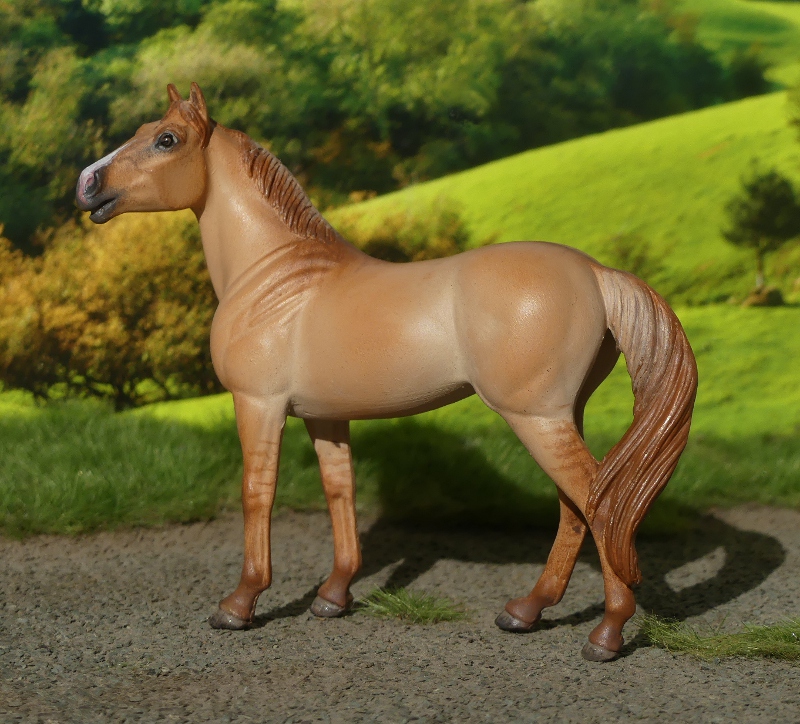
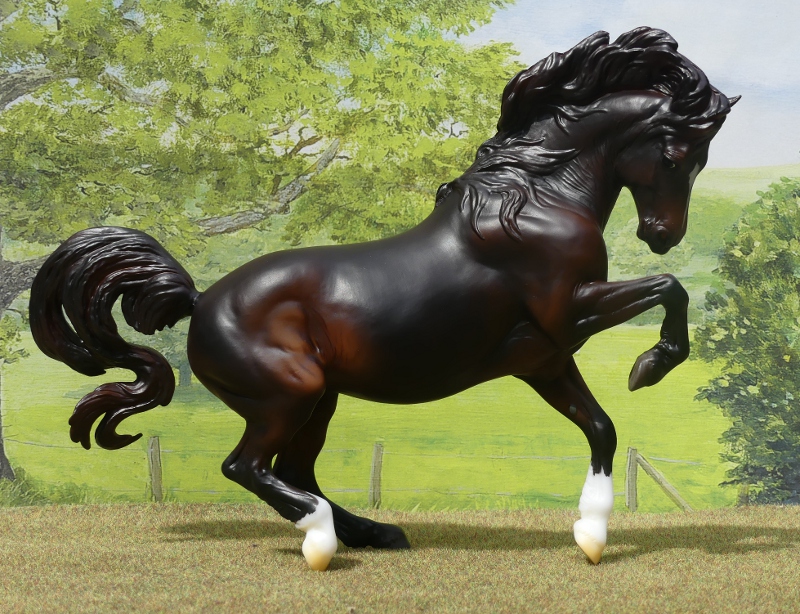
I've had some of the great little SM Icelandic mould tucked away in my body box for a while, quietly waiting for their new coats of paint while my colour ideas settled into place. Finally having decided, I got the tins of paint and brushes out, and the result is this little conga line trio of Icelandic horses :


Let's meet them individually, in the order they were painted...
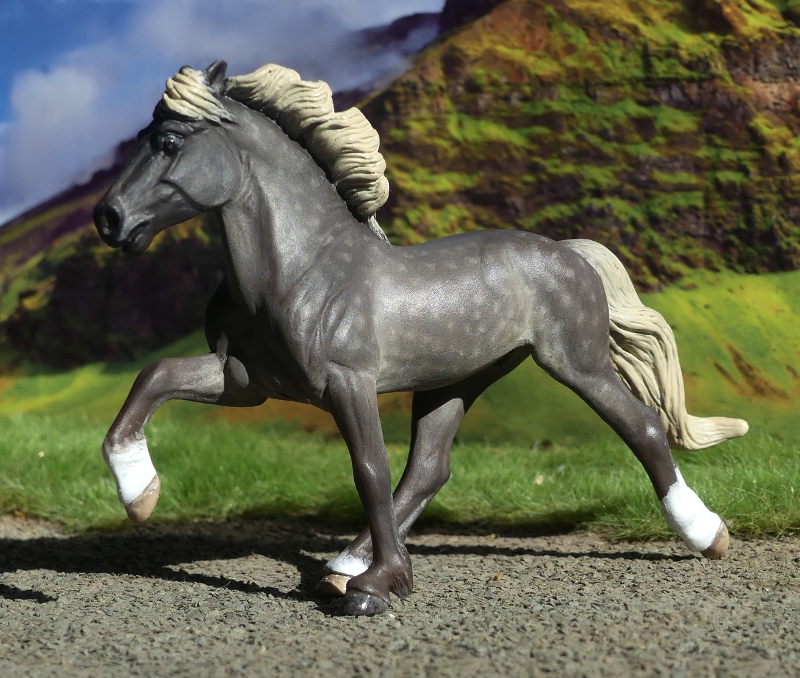

First up, we have Háfleygur, an example of the silver dapple colouration (black, plus the silver gene) which seems more common in the Icelandic than any other pony breed. I'd always wanted to paint one of these, from the moment the mould was released it's been simmering away as something I need to get round to for my collection one day.
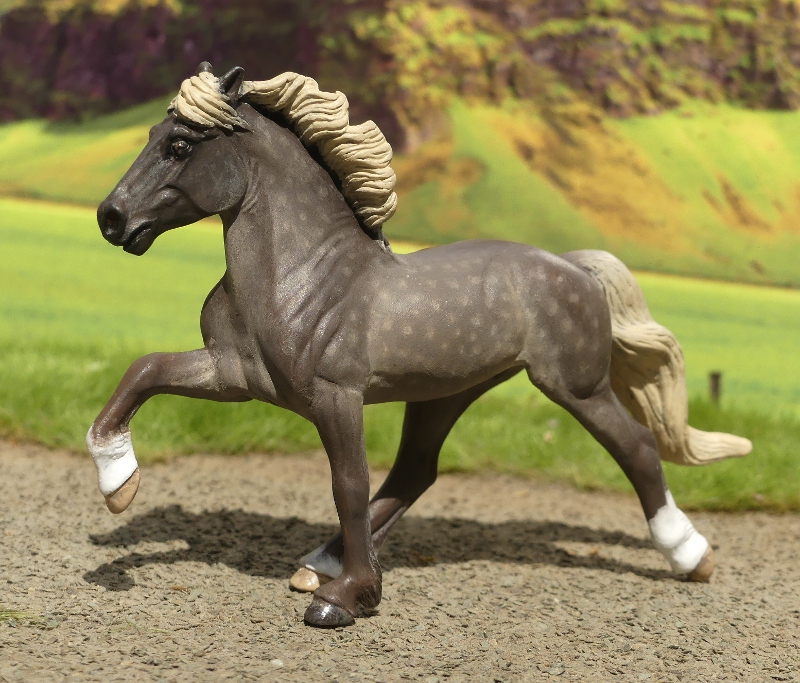

These sunnier shots are probably a closer match for how his colour looks in real life, it was hard to get the lighting right so in reality he's somewhere between the two - but I know I put quite a lot of brown tones into the paints as I mixed so he's definitely got this soft, warm tinge rather than being a plain black'n'white-mixed dappled grey!
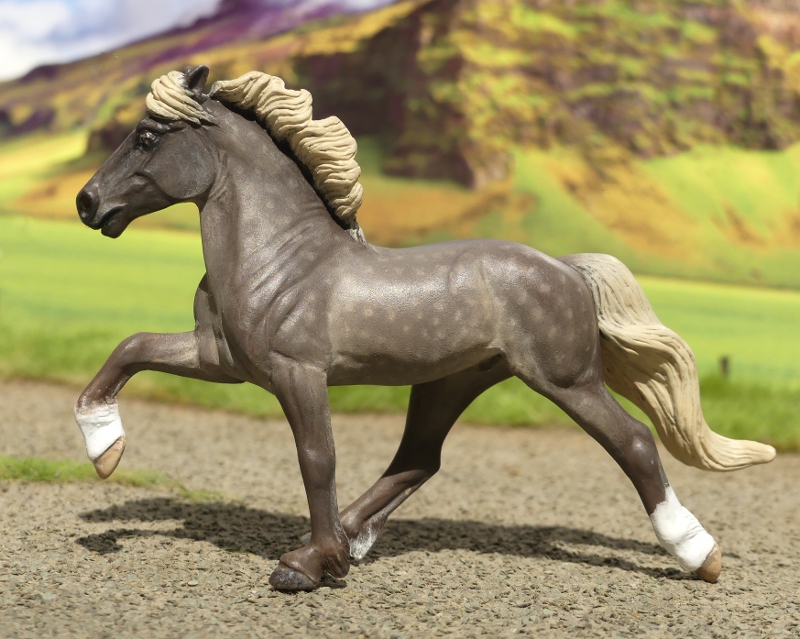

Háfleygur's name means 'high flying' - I rummaged through several lists of Icelandic-language horse names in search of something silver-themed, but in the end went for something which didn't reference his colour at all!


Jarpskjóni, on the other hand, has a very literal name - it means bay pinto horse! So many Icelandics are named for their colour, markings, or other physical descriptions, it seems fitting to go with tradition and call at least some of my customs after their colouring.


He's another colour which rumbled around in my head for a while before really settling. I'd noticed that the patches on pinto Icelandics sometimes came out with a wide band of white right round the middle, leaving just the head and hindquarters in colour. Of course this can happen in any tobiano, but it seems more common in the Icelandics, so it was an ideal colour custom for the breed. I picked a plain bay to go with it, as we spend so much time focusing on the unusual dun/silver/cream combination colours they can be, the ordinary bays and chestnuts get overlooked.


They're photographed on the bit of Iceland that came inside my Breyer Elska's box! I forgot I had such a fitting background last time I painted some of this mould, but got it out in time for this batch.

 As I'd been reading pages about Icelandic horse coat colours, I kept seeing reference to the rare 'colour changing roan', and in the lists of names, I'd see those which translated as colour changer, horse which changes colour, double colour, and even the charmingly quirky literal meaning of two coats or two shirts. Finally, this page shed more light on the colour change phenomenon - a seasonal moult made much more obvious by the white undercoat. 
The article also came with a gorgeous photo, so as well as satisfying my curiosity about the colour, it gave me the 'I must paint this!' inspiration for what to do with the last Icelandic mould in my box.


And here he is! It was a really fun colour to recreate, from just one partial photo (I had to guess the lower legs!), trying to get that rough, scumbly mixing of white and dark so it wasn't too smooth and perfect, with the dramatic shading of the base colour in contrast to the body, and the mixed, sun-faded chestnutty blondish mane and tail. 


It takes a moment to think what base colour this would be, behind the roaning - if you look back at the real horse the face looks liver chestnut, but the legs are distinctly looking black rather than red. But it can't be a bay - the ginger mane doesn't fit! So I'm assuming a very dark liver chestnut, and left a hint of reddish brown in the paint mix for the legs, rather than going for pure black.


I decided to go with the name Tvíserkur for him, that's the one which translates as 'two shirts', just because it amuses me so much for a horse which changes coat colour like we change between clothes.


And I have to include this unflattering picture just because he looks so wild and ungainly with his eye-white showing and legs in all directions!

Monday, 15 June 2020

Tales from the Body Box - the unicorn

In the 17 years I've been collecting Breyer models, they've made quite a lot of unicorns.
We've had Trad scale unicorns, Classic unicorns, unicorn foals, blind bag unicorns, and sparkly clearware unicorns. They've varied from arabians to ponies to draft horses. In fact, you might think there's been a unicorn for every possible kind of collector. But one thing (the regular runs at least) all had in common is the fact they've not been real horse colours. Sure, there's been 'grey' unicorns, but they're heavily pearlised and usually given metallic hooves, while the vast majority have been colour-tinted, too, with pink, blue or lavender pearly paint, and the recent Stablemate blind bags and mystery foal sets have added to this shiny rainbow with yet more colours.
But even though I can appreciate the variety and choice, and know that a lot of people love them, it's left my collection completely unicornless, because I didn't want a decorator unicorn, I wanted a real unicorn. 

Yeah, give me a moment here, let me explain!

I don't for a minute believe there could be unicorns out there in the hidden quiet places of the world, merrily going about their daily business of eating and napping and pulling grumpy faces at other unicorns, like wild normal horses do. But if we look at the unicorn in antiquity and legend across many cultures; it all comes from a creature people did believe was real. They thought it absolutely was a living animal, flesh and blood, just extremely rare and hard to find in far away places, which explained why nobody they knew had seen one.
The unicorn of middle-ages to renaissance art is usually a white grey, occasionally with dapples or dark legs, sometimes more of a steel grey shade, even more rarely a pale cream or sandy colour. I've seen a magnificent dappled rose-grey in the border of a manuscript once, though that could've been colours fading to browner than they were originally painted. The point is, the artists who painted these pictures, designed these tapestries...they made their unicorns in real horse colours. All the pastels and glitter came much, much later, and the unicorn as the sparkly rainbow fantasy creature of current popular culture is very far from the original horse-ish - and sometimes goat-ish - realistic animal of legend.

I must pause here to point out that I'm not suggesting there's anything wrong with loving Breyer's colourful pearly unicorns, as with all collecting it's a matter of taste and you should buy what you love, what puts a smile on your face every time you see it, what gives you a thrill to track down and tick off the list. I can easily appreciate that for some people, that might be decorator unicorns. But they're just not me. Because for as long as I've been collecting models, I've been wanting Breyer to make one, just one, regular run unicorn in a lifelike matte grey horse colour.

Last month I got myself a bulk lot of SM bodies to repaint, and in amongst them was the pink G3 arabian unicorn. My first thought was that I could easily remove the horn and use it as a normal body, but then...the idea clicked and slowly settled into place...here was my chance to paint that real unicorn. 


And here he is! I went for a light, faintly dappled grey, with darker legs, just to give him a little bit more interest than being plain white paintjob, and to emphasise that he's based on the concept of a real equine with a coat that would grey out over time, and just happens to be a unicorn too.


I think out of all of the SM moulds to have been unicorned so far, this is what I'd have chosen if this custom had been more planned, so it's kind of a perfect co-incidence that it was this one which found it's way to my body box.


So, at long last, my collection includes a model unicorn, and it's a very satisfying thing indeed!

Saturday, 13 June 2020

Breyerfest Drum Horse

Last week, I treated myself to a second hand buy on Ebay, a 2012 Breyerfest special run I've wanted ever since they first revealed him : Mariah's Boon. And I've got a way to get round my pictures not working on New Blogger (thanks for the tip!), even though the upload gallery function, uh, doesn't, and the images can't be moved around the page any more, so I can introduce him straight away as long as I'm careful with where the pictures drop in!


Big hairy patchy thing, what's not to love! 
As well as several solid colours on this mould, I've already got the skewbald who was part of the Treasure Hunt series a while back, but it's great to add another to my herd. It's quite fitting that he arrived just in time for the weekend that would've seen a drum horse in action for Trooping the Colour any other year. I haven't managed to name him yet, but something imposing and noble seems a must!


The real Mariah's Boon is an American Drum Horse, which is more an official label for a cross-bred type rather than a long-standing breed, being made from a mix between shires, clydesdales, and the bigger piebald and skewbald cobs. The website does acknowledge that they're "working to bring this horse from type to breed", rather than claiming it's a breed already like the marketing-mad 'vanner' people! 
The actually-in-the-cavalry drum horses over here aren't a breed of their own, either : some are purebred shire or clydesdale, while others are partbreds that come with that iconic tobiano colour we'd all imagine first if told to think of a drum horse, though of course there's been plainer solid colours and sabino roans too. I've been lucky enough to meet the recent drum horses backstage multiple times, and been licked and pestered for carrots as well as seeing them on official duty when they accompany the musical ride.


What a spectacular mane! I also like the little dark spots on his muzzle, and here, look closely...


Yes, two different coloured eyes! Not many regular run models seem to get eye colours (off hand, I remember Bryant's Jake having one blue eye, and the miniature horse Magic had two, while Voyeur from last year had pale brown ones) but the Breyerfest models seem more likely to have that extra bit of detail. 
He's signed underneath by the real horse's owner, who's put her own name and Boon's too, which is quite sweet - the original buyer of this one must've met them in person at Breyerfest that year.

Saturday, 6 June 2020

Trouble blogging

Annnnnnnd they're gone again.
Yes, my last post's photos keep disappearing. No, I don't understand why. 

I can edit the post, add the pictures back in (using URLs from postimg, as I have done ever since starting my blog here), and they show up just fine in the preview, and on the post once it's published. Then, after an undetermined amount of time, they all start showing as empty broken images, both on the public post itself and within Blogger when I click to edit. I'm not sitting here every day re-editing pictures into my posts over and over again on the off chance anyone wants to view it before they break and vanish again!

It's ONLY happening on the one post I created with the new Blogger, and the one older post I edited in it, because I moved some pics from one folder to another so their URL changed. The photo on that post which I didn't change, still works, as do all the photos on older posts. So it's a problem specific to the new format Blogger, though quite what would cause a 'picture only works for a little while then dies' kind of issue, I don't know.

I won't bother posting anything else til I can find out what I'm doing wrong, which is a shame cos I have some more customs to share already!

[edit, 13-6-2020]
Ok, so thanks to my friend tipping me off that uploading direct to Blogger might be a way round it, I've done some test posts in drafts and the photos do seem to stay put for more than 24 hours. So I've gone back and edited the troublesome posts. 
It's not a perfect fix to sort all my problems, as there's still issues with the New Blogger interface - firstly, you can't drag and drop the images within a post any more, so it's much tricker to get two small shots to display side by side, and if you decide you want them in a different order, you've no choice but to delete the one you want to move and re-upload it into the new place. Because the second problem is that you're supposed to be able to add in any previously-uploaded-to-blogger photo by choosing it from a sort of gallery folder, only clicking on that folder does nothing on my screen, so I can't access the photos I've uploaded if I wanted to!
Also the formatting is horribly difficult because the left-alignment of text usually doesn't work, and getting it to go left and stay left involves a stupid amount of jiggling it about the page using the photos to bounce off, but I think I've figured out the seven or eight steps required to trick it into actually going where one click used to send it, now!

Wednesday, 3 June 2020

Breyer Stable Surprise sets

Another little parcel of horses I've had tucked away saved for a while, and opened this weekend - the full set of 2020's four Stable Surprise sets, each contaning one adult and one foal.

These were intended to be sold as a lucky dip sealed mystery box, kind of like the Stablemate blind bags, an idea I didn't mind when they announced it because retailing at about £9 per box, and me being into customising, it wasn't too great an expense if I ended up with duplicates - they were all moulds I like, I could happily repaint the doubles.
But a few weeks ago a seller listed opened boxes on Ebay, and I reasoned that by paying just £1 more per set, I'd know I was getting one of each, and not having to spend out on ordering multiple extra sets til I'd collected all four - especially as I'm minimising my buying while the pandemic continues, to avoid giving the postman too much unneccessary stuff to deal with. Oddly enough, the seller upped their price right after I'd bought and paid for my four, so perhaps they decided they weren't charging quite enough for the privilege of being able to choose your horses!


First up, the Icelandic horse set. Lovely speckly red-chestnut roan stallion, who comes with a solid black foal, which although nice, seems a bit of a mismatch as it's rather big for what is a pony sized breed, and the colour's not related in the slightest!


I've named the stallion Morgunroði, an Icelandic name meaning 'morning red' and referring to a brightly coloured dawn. I rememebered the Icelandic backdrop I've got, this was the inside of the box of my trad scale Elska and is just the right size for photographing SMs of the same breed.


The foal I've named Lina, which is picked from the Icelandic names list but chosen as something which doesn't stand out obviously, because of how she doesn't look very Icelandic - it can work just as a pretty filly name of any nationality!


Next we have the paint mare and foal, a much better pairing of moulds and colours here, I think!


A nice tobiano pattern on the loping quarter horse mould - admittedly I'd have preferred masked socks seeing as they were doing masking for the patches anyway, but I've long given up hope of regular run SMs going back to sharp socks and just had to get used to the annoying blurry ones if I wanted to keep collecting them!


Such a sweet foal - I really do like the smallness of the patches, which sounds a bit strange typed out but you know what I mean, it's always good to see a nice wide variety of markings on pinto models and we don't seem to get as many with this white to colour ratio!


Third set, the new standing warmblood mould with a trotting foal, another pair where the colours don't seem all that linked!


This is my first in this mould, and in general I like it, the head is lovely especially, and I like having another plain basic standing pose when so many moulds are sculpted in action. But I can't help thinking there's something off about the hind leg/pelvis proportion or angle? I just can't put my finger on what or even where and it niggles in a most annoying way that I ought to be able to tell what I don't quite like, but can't!


Lots of the SM trotting foal seem to be aggravatingly tippy, needing blue-tacking on the shelf to avoid initiating unwanted domino effect disasters among their foaly friends, but this is one of the lucky ones who's come out of the mould really steady on her tiny feet!


And the final set, the walking thoroughbred with a scrambling foal. Yet another where the colours aren't remotely related to each other! 


I started off photographing him on the scenery I'd got set up anyway, then had a better idea - not being a normal thoroughbred colour, he either needed to go partbred or have a change of breed entirely, so I switched the backdrop, flipped the base around to the side without the grass, and gave him a little braided collar : one akhal teke! 


Though not perfect, this mould is by far the nearest we have in the SM range to the akhal teke for conformation and light wiry build, here combined with the metallic golden colour the breed is famous for. I've named him Altyn Bürgüt, meaning 'golden eagle' - reading up on Turkmen naming traditions and fashions, the names often refer to the horses' coat colour, or liken them to birds, so this seemed ideal!


Of course that meant his little bright bay filly needed a matching picture, and she even got to borrow the collar (because I forgot to make her one of her own - I'll do that later!). I've named her Damouchka, because unlike the Icelandic foal not looking Icelandic, this one's long and leggy enough to work alone as an akhal teke baby.

(P. S. This is my first blog post compiled on the new Blogger format, forgive me if anything's a bit wonky or weird; some features are clearly redesigned to work better on phones and just don't on laptops!)

Friday, 8 May 2020

Tales from the Body Box - four more

My painting spree continues without any sign of fizzling out just yet, this time there's four little Stablemates to share.

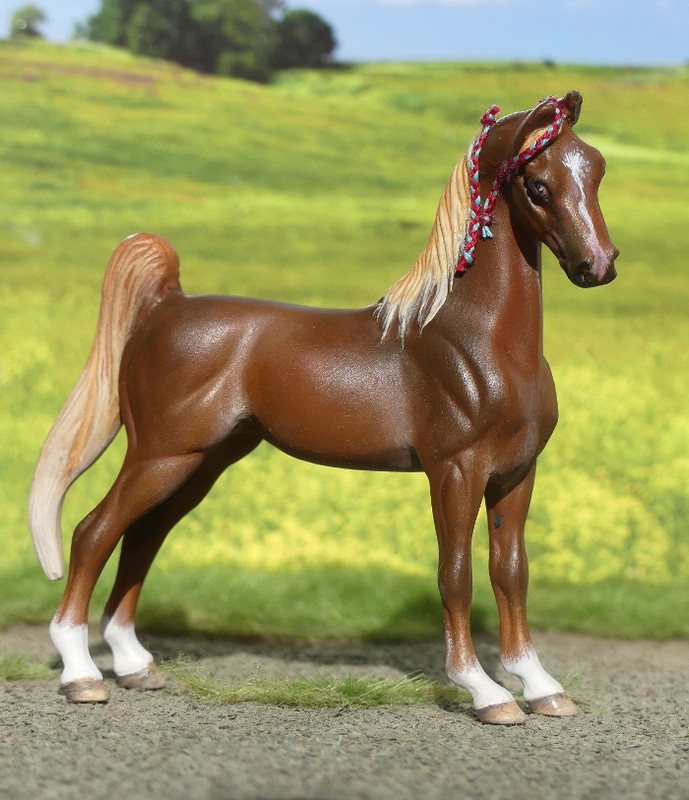
Last weekend I was just googling horse colours for the usual mixture of inspiration and entertainment, and it struck me that one of the commonest colours for the saddlebred breed is a solid liver chestnut, and I'd never painted one on the little G2 mould I have so many of, so it was off to the body box to get out one of my unpainted blanks and give her a coat of paint.


 I went for a flaxen chestnut cos the contrast of very pale mane would look so good against the dark coat colour, and I'm glad I did cos I really do like the way she turned out. I love the customising part of the model horse hobby for this reason, it's just so satisfying being able to have an idea then go off and create exactly the horse you want to own!


Despite not being as flashy as all her pinto sisters in my herd, a good solid colour makes a nice change and stands out in its own way, I think!


Her original moulded plastic braids I set upon with a scalpel to cut and carve them away, and gave her fine thread braids instead, I don't mind painting in the sculpted ones but I think the 3D effect of plaited thread really adds to the realism in photos, extra detail is always a good thing!

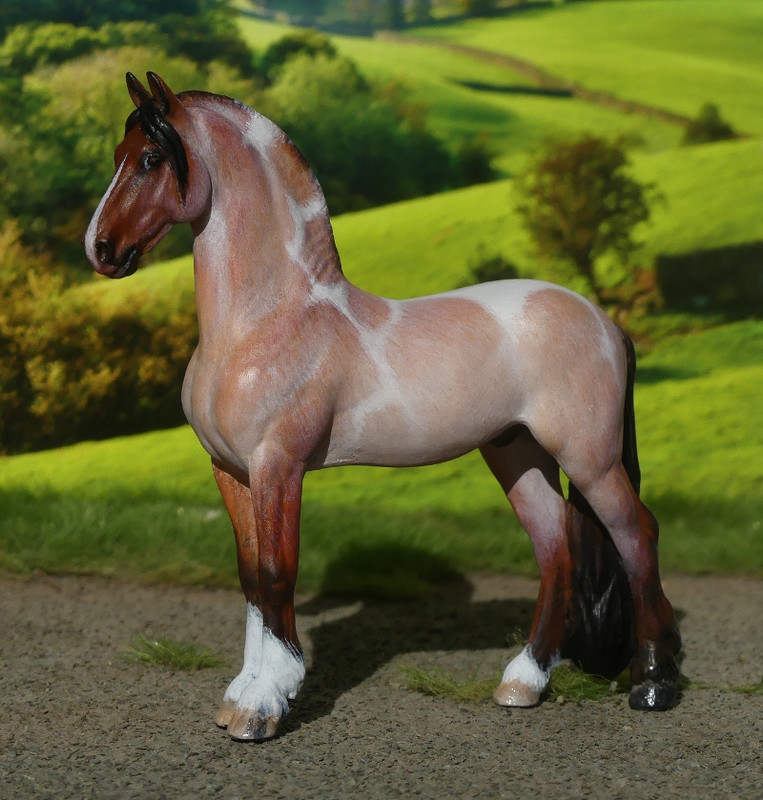
The next custom Stablemate was also a result of random colour googling for amusement one evening, the horse in the photo looked more like a riding pony type and didn't have any white on whatsoever, but I'd been waiting for inspiration for my final Django body and a bay roan pinto just clicked as yes, that'll suit him!


And having completed the paintjob, yes, I think it does - he looks just how I hoped he would! When the usual aim of applying paint with a brush is to get the colour as smooth and blended as possible, roans present a bit of a difficulty, especially the more mottled kind with patchier dark parts - it can be kind of hard to get your head round handling the brush in a way which will deliberatly leave a rougher shading, a suggestion of mixed white and brown hairs. This is why I paint so few of them, but I was determined this time it was the right colour for this horse to be.


I remember a long, long time ago having a discussion with other model horse hobbyists about the rarity of tobiano pintos with a totally solid leg and dark hoof : so many of them automatically come with four socks or stockings, we notice (and maybe try to get a handy reference photo!) when we spot one with a dark leg and black foot. There was even a website at the time, where somebody had collected all the pictures of dark-legged skewbalds and piebalds they could find. So I thought I'd paint one! 
The only thing is, I'm now out of Djangos, and that makes me sad cos I've enjoyed making three patchy little cobs out of them, and would happily do three more!

The next two horses are the really, have I never painted that before? batch! 
I was messing about amusing myself by making one of those horse colour charts you so often see with small drawings or photos of real horses, some pretty basic and intended for riding school and horse-mad-kids' walls, others more in depth and explaining the genetics for particular colour enthusiasts, breeders, artists, and painters. 
I was fitting in pictures of my models for the various basic, variant, and dilute colours, and realised I was actually missing some pretty standard colours in my herd of customs. For a start, I'd never painted a cremello! I thought I had, but when I went to fetch the photo of the one I had in mind to represent the colour on my little chart, he was actually a perlino - oops!

So, another trip to the body box, and I chose a mould that would both be a breed likely to have cremellos, and equally importantly, look good as one!


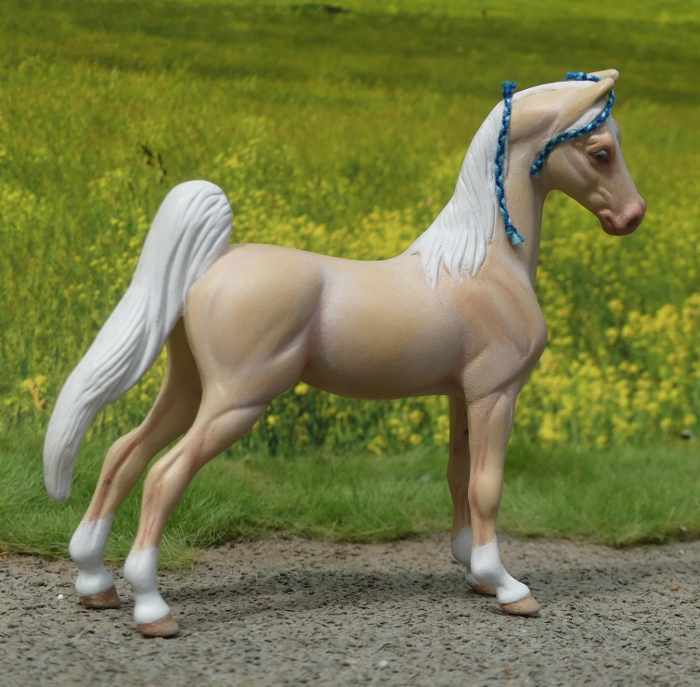
Another saddlebred! I'd done a dark golden palomino one on this mould, and I've got a much paler palomino my friend painted, but cremello looks easily different enough to warrant picking the mould again, with the cream colour against pink skin, and blue eyes.


Rather than a stripe or blaze which'd reach her nose, I stuck with a forehead star, so there'd be no need to figure out how to handle a face marking on skin which is already pink! 


This one has blue braids, to match her eyes. I know the real ribbon colours are chosen to co-ordinate with the browband and rider's outfit (just like some showing classes here use those ribbon browbands which come with a buttonhole or hair bow so the person matches the pony), but for my mini ones I always go for something different picked out to compliment the horse's colouring.

The next big glaring gap on my colour chart was a red dun. How?! Out of all the duns I've ever painted, not one!
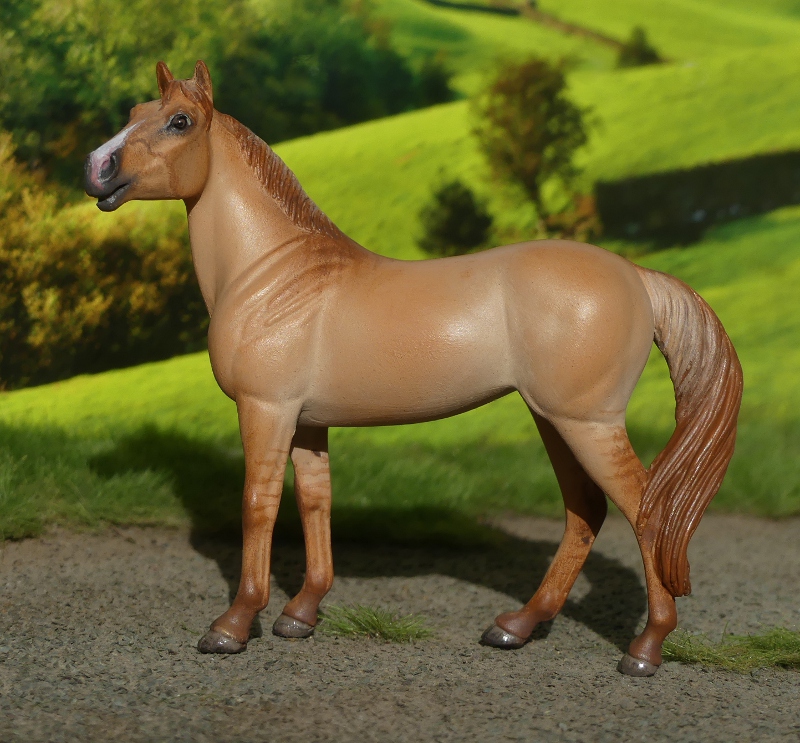
So again, time to pick a relevant breed from the body box - this one was part of a batch of cheap Stablemates which I got on ebay, some perfect enough to fill OF gaps in my collection and others which had clearly been very played with, with a lot of scuffs and breaks, missing ears, and legs sellotaped to backs if they hadn't been lost entirely. A while ago I reattached the leg of this unlucky mare (or perhaps lucky, that she didn't just go in the child's bin!), and she's been waiting for a new colour ever since.


I think the colour suits her, it was a toss-up between a stock horse type and a highland when picking what breed body to go with, but I decided to start with this one and I can always do another for my dun highland conga next time. And look, she got the pink nose I avoided on the cremello!


I can tell which leg's been off, but hopefully the milliput join is strong enough that it won't happen again, and neat enough that it's not immediately obvious she had to be reassembled!


Because there was a danger of red dun looking like a bit of a wishy-washy attempt at a chestnut roan, I made sure to give her full-on dun markings, with a barred dorsal stripe, zebra striping to the legs, and frosting along the mane and at the top of her tail. As with the others, she got photographed before getting named, I haven't managed to think of anything to call any of this batch yet!

I need to have another look at my colour chart in progress to see if there's any more glaring omissions, quite how I painted for over a decade without reaching cremello or red dun is beyond me, so who knows what else got missed!

Monday, 4 May 2020

Breyer Sable Island Horse, or, An exercise in self control and forward planning

Yesterday I managed to have a parcel day despite not having a parcel arrive!

This year we've lost the entire calendar of British Eventing fixtures, understandably cancelled til further notice. Of course this lack of competition is mostly a shame for the competitors themselves, but as a spectator I'm really missing getting out to a nice cross country course on a sunny (or not-so-sunny!) spring day to watch and photograph the horses in action.
At some of the bigger events, there's also the treat of finding my favourite trade stand, which is naturally the one which stocks Breyers. It's usually my first chance to see each batch of new releases in person, getting a good look at new moulds or seeing how paintjobs have worked out in the actual production runs when the stock photo can be a bit misleading, and picking out a model to take home is a highlight of the day. This year, with no eventing, there'll be no trade stand visits either, but a little while ago I'd noticed the same company, Equestrian Bookfair, had started listing models on Ebay, and at the end of March, I came up with a plan.
To recreate the annual habit of buying a Breyer at their trade stand each time, I'd place a big order in advance, take the very quickest of glances just to make sure I'd received the right things in the parcel, then tuck the models away still in their boxes, and on the date which I'd have visited each competition, get one out to open and add to my collection. This way I get to spread them out through the year in a satisfying way - while one huge parcel day would be fun, there's more anticipation in looking forward to several little ones, and it's closer to recreating my usual experience of gaining Breyers gradually through the season.

This weekend would've been the first opportunity to buy from the stall, and so I got out one of my set-aside models, and this is who I picked :


The gorgeous 2020 Sable Island Horse. A breed, and admittedly also a place, I didn't know about until the model was announced, but have read up on since (see, models are educational - I never would've known I didn't know unless Breyer had sparked the interest!). 


She's my first of this Connemara Mare mould, having avoided the pale grey one as overly plain and a little too translucent-plastic-looking, but the dark colouring on this one really highlights all the fine features in the sculpting, there's a level of added detail which we only used to see on artist resins, with creases in the skin, veining, whisker bumps, and even eyelashes! I may be late to this connemara appreciation party but count me as a big fan, now!
Here's a couple more shots showing off her dramatic pose from different angles...


And here's one of her laying flat (or she could be rolling, though exactly where you'd stand to get this view of a real pony having a roll, I don't know - drone photography?!), this captures the depth of her shading. In person you can really see the red tones in her mane and tail, so she's either a very dark chestnut or a bay but with sunbleaching, I'm not sure which Breyer intended - the box info just says they come in 'solid dark colours' - but whether they designed her as a black chestnut or a bleached bay she's a lovely addition to my herd!


Unlike most of the other recent releases, they haven't given her a name, simply listing and labelling her by breed instead. I decided something suiting that Sable Island background would be nice, so spent a while looking for names on it's map, people from it's history, any native flowers or birds, all yielding nothing useful, but then happened across a map of shipwrecks around the island, and from there found a list of all the ships' names to read through. One name jumped out as there'd been two different ships of the same name foundered on the sandbanks, Stella Maris. The words and meaning ('star of the sea') sounded pleasant and fitting, and looking it up a little further, Stella Maris was used by sailors since the medieval era, as a name for 'a female protector or guiding spirit at sea', which seems just perfect for a remote island herd's protective lead mare.