Sunday, 31 December 2023

Breyer special runs - Traditional and Stablemates

I'm going to catch up and share all my Breyer arrivals from the last four months in one big post - I didn't mean to neglect the blog quite so much, and want them to be here in 2023's posts, rather than spilling over into the wrong year!


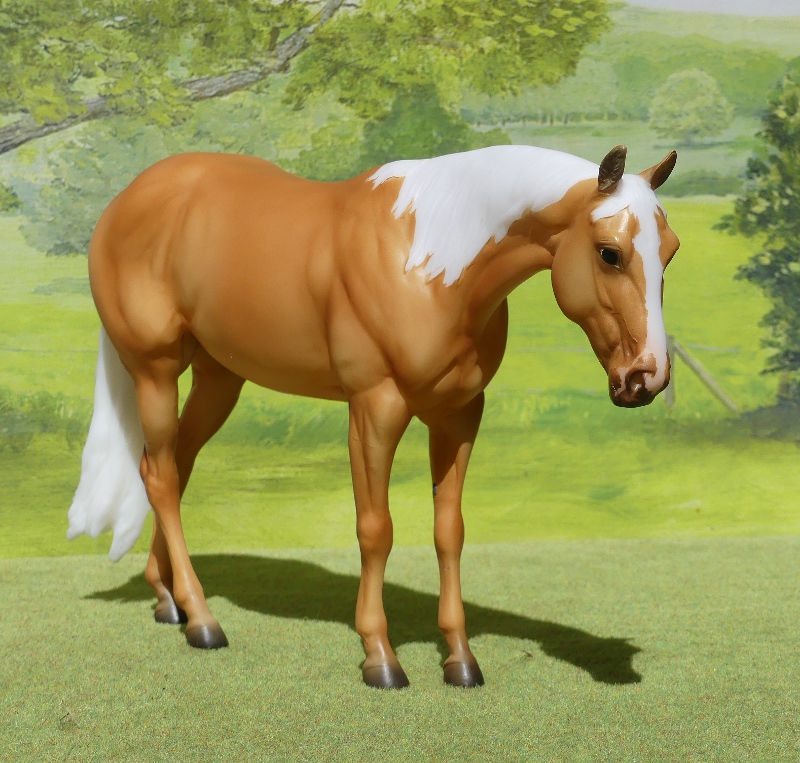
This handsome horse was a Brick And Mortar special run - meaning you could only buy him from stockists with physical shops, not online shops and not internationally. 2500 were made, which sounds like a huge amount, but maybe not when you consider that's spread across somewhere as big as the USA, and a lot more types of shop carry Breyer over there, too, not just specialist toy and model sellers like we're used to using in Europe.


His mould is an interesting one, originally sculpted as the Marwari but that limited the amount of releases Breyer could use it for without repeating the same breed more often than they'd like, so they reworked him as this adapted version with the curled ears replaced with standard ones, and a longer thicker mane and tail too. Now he can be different breeds too (although personally I'd love to see another regular run Marwari - I mean, it's been ten whole years since the only one we ever had!)


This 2019 release of the normal-ears version was sold as a Barb stallion. Barb as in Berber, the original North African breed, not the US breed also known as the Spanish Barb. Their ancestry is truly ancient, unlike a lot of the created European breeds which only date back a century or two, but interestingly they're very varied for such an old breed, with some Barbs having noticeable similarity to the PRE in the body type and head shape, some looking more like a light-framed leggy Arabian cross, and some looking much more coarse and heavy. So while this model doesn't immediately jump out as a typical Barb, due to the long lean limbs and thin upright neck, he's not massively outside the realms of possibility either, so I'm content to leave him as his allocated breed when filing his picture on my collection website.


Here's his other side, cos he's got nice sabino markings on his coat and I thought I better get a photo of this one too!

The second purchase back in September was also a bargain special run, but I bought him more from sympathy than for his rarity or price!

Sometimes when I'm browsing Ebay for Breyers, I'll spot rather intriguing listings. Horses which sold once already, will pop back up later, either from the same seller or someone different, at a much reduced price. Sometimes the reason is right there in the description, 'relisted due to non-paying bidder' or 'paintwork damaged in the post, selling as someone might be able to fix him up'. But sometimes the listing's photo speaks for itself - first time round this horse looked perfectly fine, on his relisted page there was an obvious new problem : he had no tail!
I investigated a little more through the feedback pages, and it turns out the seller had shipped him in totally inappropriate packing, he'd arrived broken, and been sent back when Paypal stepped in to give the buyer a refund. Now back up for sale, listed cheaply as a body with the tail included, I decided to take the risk to save the horse - too handsome and unusual to just become a custom body and lose his original identity!


Here he is on the day he arrived - the tail is all in one piece and the break is clean and crisp, and aside from the obvious he's in decent condition, just a couple of rubs on ears and tail tips. He's also missing the little plastic disc which attaches to one foot and helps him stand upright, but they're such ridiculously brittle fragile things it's not at all uncommon for this mould to have lost the base even if the model's been carefully looked after, those things are a design flaw from day one!

First task was to reattach the tail, it's a surprisingly heavy chunk of solid plastic so I wasn't sure if superglue alone was going to be up to the task, but it was worth a try cos the alternative of using a drill to hollow out a hole in both halves then filling the space with a wire pin and milliput was a LOT of work! And luckily, the glue worked on the second attempt, after dropping apart when I didn't hold it together long enough first time. Second try was more determined, I held it very firmly in place with both hands for a good five minutes, then when it seemed firm enough to let go, wedged the horse head-down between two cushions so gravity was helping while the glue had even more time to become fully solid right through!

Once the tail was back on, it was time to disguise the join. Because the plastic is white inside and the horse is a fairly dark colour, the repair showed as a hairline crack, but by mixing a colour-matched paint and carefully rubbing it into the tiny space, so the original paint isn't covered but the giveaway white line was. I also touched up the tiny rubs to the end of the tail and the tops of the ears, so now he looks almost good as new!


Can you spot the join? I can, just, but only cos I know it's there - on the shelf he'll look just fine!


And here he is! He's a Breyerfest special run, from 2001 - the days when you could only attend the event in person, with no online alternative way to buy the models. Atlantis Bey was a son of Huckleberry Bey, the very horse this mould was sculpted as. So he got to be made in the same mould as his father - but it's also a really good match for the horse himself, see this real photo here. He's slightly metallic, but not in the plasticky, unrealistic way I always complain about when they make models too silvery or pearlised, this is much more like the real-life coppery sheen so many chestnuts do have.


It might look as if he stands up just fine without his base, but there's a little trickery involved here - there's actually a wooden kebab stick propping him up in both these photos! With the grass base slightly tilted, the model naturally wants to tip toward the backdrop, so his own weight presses the pointy end of the stick into the fake grass, which grips it, and he stays balanced. The secret is to place the prop in line with the upright front leg, so it's totally hidden from view - check out the shadow when you're setting up, too, sometimes that will give away that there's something weird going on behind the model, but as you can see here the shadow of the prop is absorbed into the outline shadow of the horse himself.
Unfortunately it does limit the camera angles you can use, so there's less pictures of this one. But I'm really pleased to have added him to my collection, and to have mended him after his misfortune!

Another very pleasant and unexpected buy came my way last month, and it's one of the big models from Breyerfest in 2021, when the theme of the event was 'A Horse of a Different Colour', and they made a lot of interesting and unusual colours!


This is a fun arrival for me, not just a pretty model, but I was aware of the horse before she was announced as a Breyer!
Having read a LOT of information sites and blog posts about horse colour over the years, this mare had come up several times as an example to be discussed. So when I saw the reveals for that year's Breyerfest included Queen Of Hearts aka Josie, I immediately thought 'I know that horse!'
At the time, I couldn't get her - shipping and the inevitable customs and handling fees would've put her total cost at around four times the usual price of a Breyer - but I did kind of hope that eventually some would turn up on the second hand market over here.
The first few went for high prices, as an in-demand and interesting model - even recently I've seen one for sale at over £100. But I was very lucky when bidding on this one, and got her for just £42 - that's quite a bit less than a brand new regular run in this country (£55-65 seemed to be the average RRP for the last releases the UK was able to get, just to give a rough idea to the international collectors out there!)


Another angle, as well as the eye-catching colour which is her main talking point, it's also a really beautiful sculpt, dynamic and very elegant!


A closer look at her fascinating markings. Here's the real horse, and another photo here.

There's two theories on how she manages to be one horse but two colours.
The one Breyer give as if it's certain, is that she's a chimera - two embryos of different colour twin horses, which fuse together at an early stage and develop as one horse with two sets of DNA. This can and does happen, the majority of the time the colour patches are less marbled together but occasionally it's more of a brindled pattern. There's one major flaw to this theory, though - Josie was born with the white colour streaks, where a grey horse will be born dark and turn white with age. so if she was a chimera of bay and grey, you'd expect her white bits to have faded in gradually over the years.
The second theory, which I personally find more likely, is a somatic mutation where the pigmentation of cells just didn't develop equally all over. When the embryo is growing, growth of skin cells starts along the line of the spine and spreads down on either side, onto what will become the neck and flanks of the horse. The trails of white look to follow these usually-invisible lines on the body, known as blaschko lines. The dark pigmentation just failed in those specific streaks, and so they grew white hair right from the gestation period, and the foal was born with them. Just for interest, here is a very similar phenomenon on a couple of human examples!


Here's her other side, a very handsome but much plainer solid dark bay - it's obvious which way I'll want this one on my shelf!


I never really know how to handle a jumping model for photos, cos they're either jumping mid-air over nothing, or I put in a log or hedge to create logic for the pose, and then that just looks weird cos a horse wouldn't be jumping plaited with no tack on.
I've considered if it's worth making a nice neat-looking realistic jump wing and some poles at this scale, now I have three of this sculpt and four of the jumping pony, but that still wouldn't explain why they're jumping 'naked' - even a loose-schooling horse will usually have a bridle, halter, or lunge cavesson on it's head.
So I just took pictures of her jumping nothing anyway!

Now, on to the Stablemates...

I don't usually make much effort to collect the Breyerfest minis on the second hand market, they're always an awful lot of money for such a small size of horse, so I tend to accept them as the ones I admire but don't intend to own. But this year there was one in a set of four which stood out as EXACTLY the kind of model I really wanted for my collection, and from when I first saw the photos I kind of hoped that sooner or later one might turn up on UK Ebay. 
I got outbid on the first one which did appear here, but was the only bidder on the second!


A blagdon cob! He reminds me very much of a lovely natured and very handsome cob who lived over the fence from my pony field for a few years, he was such a gentle and polite chap, and both me and my horse missed him when he went off to a new home! Breyer very rarely tackle this sort of pattern on their mini scale models, and I think they've managed it very very well considering how small and intricate the masking is.


The mould is a scaled down version of the Traditional 1:9 scale sculpt, I've got a couple of others this size already (one spotted, one silver bay...oh, and a whole handful of piebald and skewbald custom repaints!), I think he looks just as good in miniature. The flying feathering on the legs and the huge mane and tail really do look dramatic, and he looks like he's having a great time playing out in the field.


The other side, just as detailed. 'Blagdon' is the traditional name for the colour between cob owners and riders, especially in the traveller community, we all know them as that when they're a jumbled up scrambly roany colour with big splashes of white too - but genetically it'd be more accurately described as an extensive sabino pattern.


I'm really happy to have bought him, even though he cost quite a bit, but I did cover my boss's saturday while he was away so in theory I can say I paid for this model with that extra work morning of sitting about doing not much, and that's a much better way to think about it than in cash!


I've named him Harum-Scarum, cos I've already got cobs called Helter-Skelter and Hurly-Burly, so these fun rhyming words seemed a good theme to carry on with!

The last few to add here are some more of this year's Breyerfest Stablemates - released as a set of five, four of them were being sold together on Ebay. I'm assuming the seller got the set for just the fifth model which they kept, and funnily enough that's the one I'd have wanted least as it was a glossy. Highly collectable in the hobby, but I've never liked the thick smooth gloss coating - it makes them look like china ornaments rather than the more realistic sheen of a standard model, which matches what you see on a real horse's coat.

Here's the four I bought...


The Missouri Fox Trotter in a red dun pinto, I'd already thought of painting one of my duplicates from the blind bags in this colour and pattern, before this model was announced, so Breyer had the same idea as me, hahah! I think it suits the mould well, and it's good to have a pinto after the solid grey and palomino regular runs, he's my easily favourite from the three I've got.


The other side, this mould can display facing either way as it's walking on a straight line, but I think I prefer the side with the mane showing


The second one from the set is this great little Mustang, the first on the scaled-down mini version of the 1:9 scale 'Fireheart' mould. I love how well he matches with the bay overo on the G4 Mustang mould, even though they're different sculptors the style is compatible and the chunkier type with a bit of heel feather is a perfect match - you could imagine them as father and son in a little herd running free.


It amuses me that I've ended up with a relatively rare special run on this mould first, rather than having to wait for a regular run as usual. Breyer don't seem to like issuing the most recent moulds in any accessible way - after the initial club-only runs to fairly reward the people who've paid into that system, the new moulds still seem to be set aside for things which can't be bought outside the US, and then in a few colourful/glittery unicorn sets, and finally allowed out to the poor regular run collectors many years later when they're not even exciting any more, hah.


Cos it's a new mould, an extra photo! This autumnal backdrop was fitting for the time the models arrived, it just took me ages to get them as far as my blog as well.


The Driving Horse mould in a really pretty and detailed appaloosa pattern, I initially put this one on the Sugarbush Draft page of my site but she's not really quite heavy-built enough in the body even though the legs are thick and the hooves large - I swapped her to be a draft cross instead.


I think the Breyerfest models often get a little bit more attention to detail in their colour designs than the regular runs, which have to be made in much greater numbers - they're simplified for speed and ease of painting on the production line when the run is going to be huge.


I've saved my favourite SM for last, this gorgeous little rose grey on the Magnolia mould! Definitely the stand-out of the set for me, even though it's never been one of my top moulds it's just so lovely in this well-painted colour, with so much shading and even soft dappling!


The sculpt isn't issued with an official breed, though many people have them as Arabian mares I've always felt they were a bit too long-legged and not deep'n'round enough for a true typey Arabian, mine are usually some sort of partbred (National Show Horse, which is Arab x Saddlebred), or one of the older breeds which derived from Arabian stallions crossed with a mixture of Anglo and local mares. Tersk horses are often grey, so that's what I've gone with for this pretty mare.


Another angle, what lovely markings she has - the striped hooves are especially nice!


And that's it, I'm all caught up on posting my original-finish Breyers, just in time for the end of the year.

Saturday, 19 August 2023

Breyer 2023s - Mid-Year Mojave and my Mare & Foal set

I recently had another parcel from MPV in Germany - you might've guessed that from my WIA Mawari post! But that wasn't the only thing in the box, the UK import problem isn't resolved yet, so I'm still relying on them for my Breyer purchases at the moment.
Somewhat ironically, we never used to get mid-year releases sent over til the following spring anyway, so ordering this one from mainland Europe means it arrived actually in the same summer it was released, which never would've happened when Breyers were sold here, haha!


This handsome stallion is Mojave, the mid-year model on the fairly recent Fireheart mould. The first time this sculpt has been sold as a regular run, so I'm really happy that the first one I could actually buy is such a good colour!

Sometimes it happens that they go for such a bland or unappealing paintjob that I decide against my first chance to own a new mould, and have to wait years til it comes round again in the regular run line. And some moulds never do - it makes quite interesting reading to see just how many moulds, generally well-received sculpts of popular breeds, have been repeatedly overlooked...

We've still only had ONE regular run of Bluegrass Bandit way back in 2008.
The original Justadream arabian mare with her head up (2009) hasn't been used again - only the head-down version with that conversion error which gave her double shoulders.
Valentine hasn't been seen in the regular runs since 2010 even though her foal Heartbreaker has been used three more times.
We only ever had the one Marwari, in palomino back in 2012.
The Valegro mould has only been 2015's original portrait model, unless we include gold Valegro, and, well, he's still Valegro!
The Traditional cob Vanner has only come back as a Unicorn since his single regular run ten years ago. Although perhaps that last one shouldn't count in this list as he's STILL available after all this time, so rather than being a mould which showed up once then got forgotten, it's more like the release which just never went away and they haven't changed him yet, haha!

So as you can see, sometimes it's a reeaallly long wait for another chance to buy a regular run on any one mould, meaning I'm always extra-happy when they do bring out a GREAT coat colour the first time round!


And isn't it a brilliant colour! His masking is all very neatly done, with super-crisp edges and no blurry bits where the spray got under the edges or the colour smudged. I know a lot of people have found quality control mistakes in pinto and spotted colours, getting worse over the last few years, but this boy doesn't have a flaw anywhere on all that intricately shaped white patterning.


The colour seems to really suit the sculpt, too, he's a mustang but not a portrait of any one individual horse. So many Breyers are done as portraits now, it's quite a surprise when they issue one which is just a made-up example of a breed, but I don't think it detracts from him at all that he doesn't have a life-story to tell, and wasn't chosen for achievements or fame. Those details are nice to know, but not necessary to enjoy the model on the shelf, he succeeds in being impressive purely on the aesthetic appeal of a dramatic mould and colour combo!


With the sun at a different angle, you can see how his coat is very slightly metallic, not overly gold and plasticky looking, but just the sort of sheen a chestnut will often have on a summer coat.


Here's his markings on the other side, just as flashy in either direction! You can hardly tell in the photos, but he has a brown eye on this side, and a blue eye on the other, which was a nice choice for them to make when not having to copy a real face - the extra effort in each paintjob to carefully add in the brown and blue paint isn't something they normally do for the cheaper runs.


I haven't managed to think of a good name for him yet, his original name refers to the desert in California and Nevada so maybe a mountain/river or wild plant/bird from that area would be good, I need to go through some lists and see if anything jumps out as a name-like word!

I also have another Breyer 2023 release to share here, cos it's my birthday and my mum went halves to buy me a mare and foal set (she says she is paying specifically for the mare half, as she's the mum and I'm her 'foal', haha). They travelled over in the same MPV box to save on postage, and so they can share a blog post too.

A pair of portrait models, let's meet them one at a time...


This beautifully relaxed-looking mare is Ebony Shines, a former reining champion Quarter Horse who left the competition ring to become a broodmare. I like how soft she's been sculpted, a little muscle but not so deeply defined and crisp as they'd depict on a fit working horse, a nicely observed choice which tells us this mould was always intended to be released as part of a set - she's designed as a mum, rather than the usual way round where a foal is paired up with an existing mare of the same breed.
I also like the position of her head, low down in a chilled-out pose which almost looks like the beginning of an afternoon shade-nap when she's posed alone - give her a minute's quiet and she'll probably pop one foot up. And although I love a good dynamic action pose, I'm also really fond of models which are just horses being horses, not all models need to be captured in athletic motion or else posed square and alert like a stud advert, and it's really sweet to imagine this mare with a placid temperament and lazy life.


Much like with Mojave, I inspected the masking and found no problems on my model - sometimes a mane sculpted flat to the neck will end up awkwardly mis-aligned, so the masked outline doesn't follow the 3D edges of the hair, but hers seems just about right. If I was being super picky, there's perhaps a tiny line of gold along the edge of the forelock, but it's such a fine margin it barely shows, and doesn't detract from her pretty face in the slightest. Her paint has a similar level of metallic sheen to his, too, just enough that it's there but looks natural and not too golden.


Here's one of the nicest features on the entire model - her interesting nose! The stripe divides at the end and goes around her nostril, and the little bit of pinking they've given her is perfect.


The near side, which unusually feels like the non-display side with this sculpt! I think it's cos there's a very slight asymmetry in the pose of her head, even though she's facing more or less straight forward, she's got her attention a little to one side (note the turned ear in her headshot), so here she's looking away from us even though her neck isn't physically turned!


And now for the foal. The totally adorable, characterful little foal! 
Everything from the flicked-up tail to the twitched-back ear is beautifully done, a real moment of movement captured. I especially love that they didn't just paint her as an identical clone of her mother, with a coat of the same colour paint - the foal is totally matte with no metallic effect, and slightly paler in tone, just the way a real foal's first coat will have a different texture, and shed out to the adult colour and sheen a few months later.


The markings are copied from a real foal this mare had in 2021, and I think the amount of
white here makes her look even better than if they'd chosen one which had four dark feet like mum, a good contrast when they're stood together.


And the other side, her tail looks a bit funny from this angle but over all she's a very appealing little sculpt, and as a stock breed she's very versatile, this one could be re-used as a Paint or Appaloosa too.


Of course, the very best thing about a mare and foal set is posing them together, and I had a lot of fun arranging them for this little photoshoot, taking way more pictures than I needed, then being unable to decide which were the best! So I think the easiest thing to do here is just drop all the pictures in, and you can see the lot - just click any of them to view full size - enjoy!


WIA's new release - Marwari in two colours

I thought you might like to see some photos of this year's new WIA horse! Another sculpt by Horraw Studios, this time a Marwari stallion, and like all the WIA plastic editions so far, he's available in a choice of two colours. Or, if you're anything like me, not a choice at all cos you end up wanting both.

Let's have a look at them - you can see their item listings on MPV here and here, for the official pictures, and prices (log in to the site from another country and the prices may drop substantially lower for some sort of international tax reasons, it knocks over €2 off when I'm logged in with my UK address!)

But I always find real, in-hand photos from collectors to be more helpful in deciding how much I like a model, so I had a little photoshoot with my new arrivals on a sunny day!

We'll start with the lighter colour first, cos I always think these show the mould details and contours better than a dark colour.


A really nice sculpting style, with an intricate level of detailing, as with the Arabian by the same artist they're distinctly different to both the original Brigitte Eberl WIAs and the later Morgen Kilbourn addition to the range, but not in a way which stands out and makes them clash or jar with the existing horses. They still have the same basic WIA horse traits : smooth bodies (no over-exaggerated grooved 'fur' texture here, no bows in the hair I'm looking at you Schleich!), well-proportioned slender limbs rather than chunky legs (sorry CollectA but you just won't do a light hot-blood sculpt any more!), and expressive faces with great detailing.


Now, let's have one of those conversations about horse colour. This one's going to be difficult, haha!

The model is marketed as a Dominant White, at which I thought 'hurrah!' cos I only have one other with this rare colour pattern in my collection, CollectA's Camarillo White Horse.

To put it in the most basic terms, you know how some horses have white 'sabino' markings on their faces, legs, and bellies? Now imagine those white markings getting bigger and bigger til they cover the entire horse. A really extensive Dominant White IS one big white marking, with none of the original colour left at all, or maybe just a tiny little bit which isn't very noticeable - often on the ears, the top of the head, or in the eye sockets. Although in the past Dominant Whites have been described as Albino horses, it's not a red-eyed albino like you see in other species, born without pigment - it's just got white marking all over, mane and tail and all. Pink skin shows through wherever the hair is very fine, most of all on the face and especially the nose.

Now, take another look at the model. It's not pure white, but not pinkish either. The body colour has been given a definite creamy yellow tone. The nose is pinker, but that's not the colour paint which has been used on the rest of the horse, so they're not trying to show skin visible through fur - they're saying the hair itself is cream coloured? And by contrast, the mane and tail are white. Look along the neck, you can see the line where the mane paint is applied.

Could it just be an effort to make the horse look less dayglo-white and more realistic cos real life horses are rarely spotlessly clean? 
Hmmm. Here's a lovely long-maned example of an actual Dominant White horse (he's from a website about genetic testing for this colour, they'd have a correct example!), and you can see the natural long-term picking up of environmental dirt all horses get if they're not kept shampooed for the showring, has darkened his mane to a blonde-ish cream. So, if anything, a realistically low-level-grubby Dominant White horse would have a fractionally darker mane and tail than the body colour, never the reverse. I don't buy that they'd paint the horse's body yellowish then give it a contrasting pure white mane, IF they really were designing this paintwork from dominant white reference photos.

So, what colour is it?

The only real contender would be cremello. This is perfect for a body colour which is cream all over, showing pink skin on the nose and round the eyes. And the mane and tail being pure white also fits, some cremellos are a bit more on the blonde side but the majority do have the contrasting white, just like this model stallion.
But wait a minute, back a bit.. I mentioned the word 'eyes', and that's where we come unstuck. A cremello will always have blue eyes. It's a part of the dilution gene, there aren't any with the standard dark brown eye colour, it can't happen.

While waiting for this parcel to arrive, I was doing a bit of reading on the All India Marwari Horse Society's very comprehensive website, and there they have one crucial fact which is relevant to this debate. In the breed description, 'Albino colour is a disqualification for this breed'. Since true albinism doesn't occur in horses, they must be referring to what's now better known in other countries as Dominant White.

So if the paintwork says it can't be Dominant White cos it's painted yellow, and the breed society says they're not allowed anyway, but the eyes say it isn't Cremello... that's kind of two against one and I'm siding with writing this one up as 'cremello' on my collection website despite the release info!
I've given him the name Badali, meaning 'cloud', for his pale colour whatever it may be.


Enough of the colour debate, it's still a glorious little model of a very old and interesting breed I've liked for the whole time I've been into horses, and I'm extremely happy to have him in my collection! My only other Marwari models are Breyer's big Traditional scale mould, CollectA's mildly depressed-looking stallion, and one mini custom, so it's great to have another on the market, and in this affordable and popular scale, too.


One thing which has been a bit criticised over the years is WIA's decision to use some separate parts in the manufacturing process, to allow for easier moulding of complex poses and awkward deep detailing. Sharif had his mane attached with a visible seam at the neck, Vincenzo had one ear cast separately and stuck on afterwards. I've never found the joins to be too intrusive in the finished models, but just for anyone who's disappointed or put off by them, the Marwari does have his ears moulded as individual pieces then attached to his head. You can see it most clearly in this back view, though the strong sun shadow's not doing him any favours here by making the groove more noticeable than it is in real life!


Now, on to the next one! Described as dark chestnut sabino, this colour's much less tricky to get my head round. Even though he looks dark enough to be a bay, chestnut is a massively varied colour, and some do look almost black. He doesn't have any true black shading on his knees or hocks, so I'm happy to accept this colour as a very very dark liver chestnut, and his sabino markings are nicely designed too.


With his face marking incorporating both eyes, they've been painted blue, with a little hint of pink in the corner.


Although I said the paler colour shows the mould off better, I do think he looks just as good in a nice dark colour with eye-catching flashy markings, I'm not sure which would be my favourite of the two. I've named this one Gadadi, which means 'fox'.


Looking a bit wild and dramatic from this angle! I'd quite like to do some tinier-than-usual tack making and give these two some of the beautifully decorated traditional tack Marwari horses are decked out with for special events. Even something simple like the colourful braided halter with an upright tassel on the headpiece, would be an intricate challenge to make at a smaller scale - here's one I made for a Traditional (1:9) scale Marwari.


The ear seam looks much less visible on this colour, I think if I hadn't pointed it out you wouldn't even notice it was there!

For anyone unfamiliar with WIA horses, the plastic is notably more firm than Schleich, Collecta, Mojo etc, it's got a very slight give in it which reassures me that they'd probably flex rather than snap like resin if I was to knock any over, but they don't feel like they'd stand up to play. The paint's also a lot more prone to scuffing and marking (I had some duplicates in my body box for a while, they came out covered in a multitude of small shiny marks just from touching other models!), so I'd recommend them as shelf models for the teen/adult collector, rather than suitable for adding to an active play herd.

Raziel

A Julip arrival for my little herd of hand-made rubber ponies!


This boy isn't brand new, he was ordered in 2009 by a friend of mine.
Without even knowing, we'd both ordered Haflinger specials at the same time - mine was a mare and foal pair, hers was a stallion. When they arrived we realised what had happened, and that our two horses must've been painted side by side in the same batch while the right paint colour was in the spray gun. So we always said they were the same family, with my friend's horse being the father of my mare's foal.
When thinning out her herd, she thought of me, and asked if I'd like to buy him. Of course, I said yes - not only is he a colour I like from one of the better eras of Julip painting (second only to the current style), but having him come here would unite the family which had been made together then split to different homes!


Here they are together, don't they make a lovely little family group! I did think my mare Phoenix was lighter and more blonde-looking, but I think that's an optical illusion cos her face is shaded very pale and her wide white stripe adds to the effect, where his head is much more chestnutty. And of course their foal is in his baby coat and won't darken up til he's a lot older!


And the new arrival again, he comes with the name Raziel given by his first owner (from a comedy novel she enjoyed, rather than a serious religious context!)