Friday, 1 April 2022

Tales from the Body Box - Another Stablemate roundup

Since my last Tales from the Body Box update in early February, I have quite a few more customs to share!

I recently added a few of the mini 1970 'Indian Pony' mould to my body box, which I was quite pleased about as I'd never painted one of those before. So I picked the first one out, and gave her a new colour...


Meet Shikoba, the Choctaw Pony mare. I wanted to do a pinto all along, but wasn't sure what colour I'd use as the base; I dithered between sandy chestnut, red dun, or this warmer bay dun, in the end I decided this would be most different from her original finish chestnut pinto paintwork colour, so that's what she got.

Her name means 'feather', because my existing original-finish pony in this mould I named Hushi ('bird') and I enjoy linking my same-breed models with a theme, like they're part of a family line. I chose the Choctaw pony breed for my first one, and they come in a wide range of colours so this and any future customs will all be allocated the same breed for my site.

It's important to mention again that calling Native American horse & pony breeds what their indigenous owners and breeders call them is the only respectful way to refer to them - singly, by breed name, rather than lumping them together under the old-fashioned casual racism of 'Indian Pony'.
It's not the 1970s any more, the mould name from back then may not have changed, but all hobbyists can help acknowledge and respect people by dropping racist terms from the model horse world.


Some of the releases in the original 1:9 scale mould have sculpted feathers in the mane, so I thought it'd be a nice detail to add those to the tiny version. I made a couple from painted paper - unfortunately the blustery wind took them off mid-photoshoot and I only managed to find one, so even if I reattach it she won't look quite the same as in these photos.


I was going to do her tail plain black, but as I was applying the first coat the smudgy edges blended so nicely I thought I'd leave it with this fade-in effect - a lot of real duns have a mixed mane and tail where the centre is black and the edges are the same as the body colour, so it's something which looks deliberate and not like lazy painting which needed filling in to the edges.


The dorsal stripe down her back, as I always say, the most nerve-wracking bit of any dun paintjob - to minimise hand-shaking, I hold my breath, and brace my elbow against my side.


And here's some photos from after the feathers got away - I'm not entirely sure they looked realistic enough in the first place, as a copy of the model ones (like on this example here) they were ok, but the thickness of the paper made them look rather chunky and stiff, not soft and fine like real feathers. So I took a second set of pictures without them, in case I decide to leave them off after all.


She's got two blue eyes - a lot of frame overo pintos have a white face and if the marking is wide enough to catch the eye sockets, they'll have full or partial blue eyes. I think she looks very happy and friendly.

The very next day, I painted two more, with spots instead of patches.


I've had a couple of these dressage horses in my body box for a while (they were in the blind bags the first year I got a cheap whole boxful to work my way through!), but hadn't had any nice ideas for colours on them lately, then I happened to see a photo of a spotted horse competing in dressage and realised that would be the perfect fresh idea to give one of my horses a very different paintjob!


I decided to go with Knabstrupper as they're the most famous pure spotted warmblood breed, rather than yet another partbred for my collection! With this new nationality in mind, I've named him Harecroft Heroisk - 'Heroic' in Danish.


One of those moulds which has two good sides, as it's posed moving on a perfectly straight line it photographs just as well from either side.

Now, the next one has a bit of a problem. I painted him working on my lap, as usual, and when I'd finished I was really pleased with how he'd turned out, didn't notice anything wrong at all. The following morning, he still looked lovely, and I was happily satisfied with my work - til I got him outside for a photo.


See the issue? 
Handsome enough horse, pretty colour, no massive errors in the paintwork, no missed bits, no stray fingerprints or stuck fluff... whatever could have made me say 'Oh, no!' out loud at him? 
Look at that back foot! His back leg nearest the camera is so warped, his foot is hovering far above the ground when the pose means it should be touching down, and supporting his weight.

It's because I don't have a desk or table or workbench - if I'd stood the mould on any flat surface before painting, or even during the boring basecoating layers, I'd have noticed this and been able to fix it first!
So okay, I think, I'll just take him inside, use boiling hot water to bend the leg, hope hope hope the paint doesn't peel off with the wet or the heat, then retake his picture.

The paint's fine, but the plastic doesn't soften. Not even a little bit. 
I try reboiling the water and putting him in again. 
I try pouring it directly on the leg.
I try leaving him in longer. 
I try more force. 
I try everything, but the leg just will not bend.

This body was made from a different plastic, completely clear, sold in this set designed for making decorator pieces, like stained glass or rainbow or however you wanted to colour them. They paint up just fine with normal model paints, too, and I've had several of them for turning into ordinary horse-coloured customs in the past, without ever realising that the different plastic can't be softened with heat in the normal way!

So I was left with only one alternative to fix him - first, my little hacksaw to cut the leg almost all the way through, trying not to scratch up the paint anywhere else. Then I wedged the gap open the right amount with a piece of compacted metal foil superglued in, and used Milliput filler to smooth over the edges, with a slight overlap. Then once it had dried hard, I repainted that little section carefully, trying to match the previous day's paintwork enough that the patching won't be obvious.

And then he was back out for another photoshoot...


I'm much happier with him now, I liked the way his colour turned out anyway, and now he doesn't have a mistake in him I can feel pleased with the finished custom!


I took more photos the second time round, so you get to see some extra angles now!


I've chosen the name CampĂ©on ('Champion') for him, and I'm going to have him as a historical breed on my site, one of the Iberian spotted horses from the past, probably a Spanish Jennet  - the extinct kind from old Europe, not the current re-creation project of named crossbreeds in the Americas.

The next project was one where I foresaw the potential for problems...


I'd got one of these gloss finish Fighting Stallions in my body box, and wasn't sure how well I'd get on with painting over the top of the gloss. Not just cos it's shiny and paint may not stick, but also the clear gloss layer is quite thick, and might've settled into the fine detail of the mould, making it look blunt and blobby once painted with colour over the top of that.
But it turns out it's just fine to paint over the gloss, I had no issues with the paint failing to cover well, or rubbing off with layering or handling, and the detail's not obscured at all, so all's well!


I'd had some reference photos bookmarked since a previous sabino custom a while back, and decided to go with this horse's colour for him - although I didn't copy exactly, more took the general idea of where the white was than trying to recreate every patch and speckle as a portrait, the one in the pictures had this interesting marking on one foreleg, with white across the knee above a solid black leg, so I just had to include that!


The real horse he was inspired by is used as an example on a couple of pages about the Barb breed from North Africa, but I think they've got their sources muddled and picked an incorrect picture, as I've found photos uploaded to Flickr by someone who photographed this exact same horse, and they're captioned as the Wilbur-Cruce breeding line of Spanish Barb horses (which is an American breed, also called the Spanish Mustang, descendants of the horses taken there by the colonists).

Later in the month, I painted a few more customs, and because I haven't been keeping up with the blog very promptly, they all get to share this one post.


First up, a dunalino - this is what happens when you get the dun gene working on a palomino coat; the golden colour gains a dorsal stripe, darker points including dark ear tips, and sometimes leg barring and a darker shoulder too.
Here is the reference photo I used, he's the classic photo example used when dunalino is listed or explained!


I used one of the new moulds from my box of anniversary Stablemates - the older G2 Appaloosa/QH sculpt is just as nice but I've painted a lot of them and only a couple of the Mini Smart Chic Olena. So he got to be a colour I've never painted before, on a fresh new mould too.


I really do like how he turned out, especially the shading on his shoulder, and the colour was fun to mix - warmer than the buckskins I did recently, but not as coppery-bright as a palomino can be without the dun adjustment!
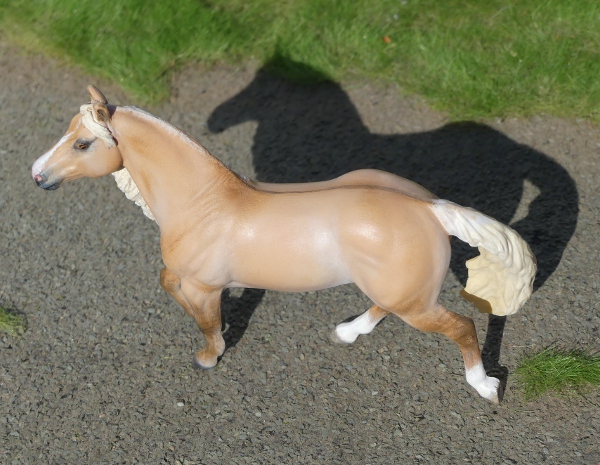

His dorsal stripe, which annoyingly isn't at all obvious from the side, yet it's one of the most important parts of the paintjob! I'm just glad to have ticked this colour off my list, it's fascinating how horse colours combine and vary depending on the various dilution factors, and dun plus cream was one I'd wanted to tackle for ages!

Next up, the results of hours reading and research - I wanted to know what other breeds the new Mini Connemara mould would be best suited for.
I've already painted one as the Connemara it was sculpted for, one as my own pony (Welsh x New Forest, looking more like this sculpt than anything else on the market!), and the Sable Island Pony Breyer once released it as themselves. 
But there's a lot of pony breeds out there in the world, and I'm especially fond of the native and feral types rather than the cross-bred showring types, so I sat with my books and referenced Wikipedia and various breed websites, and came up with a shortlist of ponies which matched both the breed type & conformation of the sculpt, and the free, feral attitude in the pose.

So which breed stood out as best suited, and one I'd most like to add to my collection?
The Pottok, from the Basque region of France and Spain.
These ponies are rather like the 'mountain and moorland' natives I'm so fond of in the UK - ancient ancestry, hardy, thrive on the roughest of land, can manage just fine as feral herds doing normal horse things in the wild, but can be brought in to a domestic environment and loved just as much as any other pony when tamed and trained.


They also come in lots of good colours to paint, with pinto being notably common, so my first Pottok is a seal brown pinto mare! Well over 50% of the reference photos I've seen have been flashy tobiano patched bays, chestnuts, browns, and blacks.


I hadn't realised how good this mould would look in a patchy coat, I think cos I'd only seen solid colours so far I'd not even considered it before, but it really does suit it - especially this slightly dirty unpolished coat, I gave her grubby heels and a bit of mud on the knees and hocks, like she's a proper outdoors pony and never gets bathed or shampooed!


Looking very happy frolicking in the spring field. I may well set aside another of the Connemara bodies to paint her a companion, it wouldn't be fair to have only one of the breed in my entire herd!


And the other side, because the markings are never symmetrical on a pinto, so each side will have different shapes.

The final custom of this whole March batch is a portrait of a very famous racehorse, Tiger Roll. He's so well-known in the UK and Ireland that many people who've never watched a horse race have heard of him, while anyone who does watch racing has ended up quite fond of his sweet little face, and admiring his big achievements. He's one who's attracted so many supporters and fans that he gets referred to as 'the People's Horse'.
There's a lot of biographical videos, compilations showing all his races, and even a couple of full documentaries about him, over on Youtube if you have the time, but here's a nice short summary telling his life story while visiting him at home.
When he finished his last ever race, and did his final lap of honour in front of a cheering crowd at the Cheltenham Festival, I just had to paint his miniature - I think I always knew I would, I just wanted to see him retire safe and sound first!


His colour is much redder than a lot of bay horses, here's a photo of the real one to compare - it's a very deep, bright bay with a lot of red tones rather than dark browns and blacks, so he looks quite different to the other racehorse portraits I've done.


The big star on his forehead - in later races he wore a black visor to help him concentrate his attention forward and you couldn't see this, but up to and including his Grand National win, it helped make him easy to identify in a crowded race. His only other marking is a little white patch on his shoulder, which I spotted in a video of him being tacked up - under his saddle pad you wouldn't know it was there.


I think the mould looks better from the other side, the eye is rounder and happier-looking when he's facing left, but his plaits show more on this side. I had to cut away the sculpted loose mane and replace it with Milliput in these little rolled-up braid blobs. I wish more of the famous horses I wanted to paint could run with loose manes, but so many of them seem to have needed plaiting! I also gave him bigger hooves, and a slightly different profile as the original face had too much of a dished nose.

All in all, I'm happy with my month's worth of customs, but already plotting what breeds and colours will be next!

Friday, 18 March 2022

A Whole Box

Look what arrived today!


Yes, a whole box of 70th anniversary Mystery Horses! 

I happened to be browsing online model horse shops and spotted Hot to Trot Model Horses selling these whole cases of blind bags for a new reduced price - the Mystery Horses/Unicorns usually retail at £3.99 to £5.99 per bag, depending on where you order from and how recent a series they are, but at £50 for a full box it works out at just over £2 a bag. So while it was a lot to pay out in one go, it's a bargain in the long run!


The small print mentions that Breyer don't guarantee one of every model in every box, so I couldn't confidently predict what was going to be in there, but really didn't mind - I already have one of each for my original finish collection, so these were all destined for repainting, and they're all nice recent moulds I haven't had too many of before!

Time to get opening, let's see what I've got...


I'm pleased I have some of each mould, and it's satisfied my curiosity to learn that they do seem to be packed in a certain format rather than being a random jumble, as all the duplicates were side by side in the box, so you'd have four of something then two of something else then four of the next, and so on.
So if you ever happen to get chance to choose in person rather than online, and you want a mixture, I'd advise picking from different parts of the box!


I don't know whether every box has the same proportion of each horse - maybe the next one along was packed with fours of the moulds I got twos of, and vice versa? It's a slight pity the Missouri Fox Trotter was a 'two' not a 'four' for me, as that's the only mould I haven't painted at all yet, whereas I'll be up to eight Connemaras and nine Vanner cobs by the time I've worked my way through all these - but never mind, two's better than none!

On the same order, I added in one of the mid-year 2021 Stablemates which have been so elusive in the UK. Hardly any even ever arrived here, and the two I wanted most sold out almost instantly as they were more coveted moulds (Mini Alborozo, and Django), but this Appaloosa Sporthorse hasn't been nearly so popular - strange, really, as he's also a very recent mould, and this is his first appearance as a regular run.


The mould was sculpted as an Irish Draft, so it's a little bit more chunky than the typical Appaloosa Sporthorse, which will usually look like a TB or hack but with spots - sport horses are usually quite a high proportion of Thoroughbred blood, 1/2 to 3/4, so they tend toward a finer build and longer frame than warmbloods.


Stablemates' spotted paintjobs vary in effectiveness, when it's just spatter spots on a white background they tend to look rather plasticky and poor, losing their eyes amongst the other dots, but this level of shading under the spotting gives him a much nicer look - he's a handsome chap with his dark face and black points.

Wednesday, 9 March 2022

WIA Vincenzo and some Southlands Replicas

A very exciting parcel arrived today from Modellpferdeversand! I don't usually buy internationally cos of the postage and import and handling fees, but Germany seems to be able to bypass the post-Brexit headache as I've had two parcels make it all the way here with nothing extra to pay, thank goodness!

So when there's irresistible models which can only be bought from overseas, I just have to go for it.

First, the two newly released models from WIA, named Vincenzo and made in two colour options. Well, I say 'options', as if we're supposed to choose between them, but just like every previous WIA release they're equally nice, so I just get myself one of each!

Take a bow, handsome boys!


Let's have a look at the grey first, I've named him Harecroft Fidalgo.


The mould really does look great in person, and these production models are every bit as good as the promotion pictures showed, so I think WIA genuinely do photograph a model from the main run, rather than using the artist's proof paintwork to flatter the models, the way some companies do. If you like what you see in their official images, the horses you'll unwrap are really that good!


Each WIA horse is a shrunk-down version of a Brigitte Eberl resins (see the big Vincenzo here on Equine Resins Directory), so you're getting something which was designed as an accurate and fully detailed large sculpture by one of the best in the business, for not much more than the price of a plastic toy horse from the likes of Schleich, CollectA, or Mojo.


Rather than being plain matte white, he has a nice subtle amount of colour to him, as well as the obvious darker shading on his nose; there's hints of grey, cream, and silver, throughout his colour. He's also got streaks in his hooves - where white markings catch the hoof it grows pale, and although the markings are invisible on a fully greyed-out grey horse, the stripes in the hooves remain growing through for life. A lovely touch in the paintwork design, which not many people would've considered adding!


His mane is really magnificent!
I'm impressed with the amount of overlapping detail WIA have moulded here, it can't be easy to design the moulds to include all that hanging hair and complex limb positioning, but they make the extra effort - and it's well worth it!


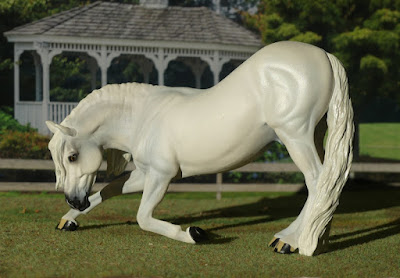
And here is the perlino, Harecroft Pérolo - I'm really not sure which of these two is the most gorgeous, they're both beautiful whether classic pale grey or glowing peachy perlino.


The deep kneeling bow position is very unusual in the model world - we've had a few artist resins, and customs repositioned to a bowing pose over the years, but never released as an original finish plastic model, so it's something very novel, and refreshing.
Allegedly it's quite easy to teach a horse to bow using a treat held slightly further and further out of reach until they kneel to get it, but I've never managed with mine - she just waits til I stand back up with the treat then says her 'please?' noise cos she can't understand that she could just bend down and take it!


They've done a lovely job of the perlino colour, it could easily get too pinkish but the tone here is a dusty faded pale orange, with nicely done darker shading in the mane (and look along the crest of the neck, the join between smooth body coat and mane hair is added in with a fine hand-painted zig-zag join). The eyes are also blue, as they should be for this double-dilute colour.

The WIA models are listed as 1:18 scale, this is roughly the same as CollectA and Mojo (both advertised as 1:20 for their horse models) though in reality I find WIA tend to fall a bit on the smaller side, when comparing breeds like-for-like - not enough of a difference that you couldn't use them in group set-ups for photoshoots or showing scenes, but enough to be worth mentioning in case anyone is super scale-conscious and wanting to work things out from measuring to the millimetre and referencing the real horses breed standards.


These models are just so photogenic, so you get a lot of pictures. They're also very steady on their feet, no need to worry about wobbling or tipping on the shelf. They were packed in individual little boxes with plastic inserts to make sure the slightly pliable legs don't get warped or squashed in transit.


The mane looks even better on the perlino than the grey, I think - the softness of the shading helps bring out the lovely detail and texture in the sculpt.

As well as the two Vincenzo models, I decided to get the brumbies by Southlands Replicas.

Founded in Australia, the company was focused on bringing figures of native wildlife and extinct creatures to the market. So many companies make the iconic species like kangaroos and koalas, but Southlands aimed to fill a lot of gaps and include animals which aren't so well known outside their home country. Unfortunately, due to the financial pressures of the last few years, they've now called it a day, and when the stock of current animals is gone, they'll be no more.

As part of their range, though not quite wildlife, in 2018 they made the only feral horse breed found in Australia. Sculpted by Anna Dobrowalska of Horse And Bird, the brumby moulds have now been given a life beyond the end of Southlands Replicas - Anna also sculpts horses for Mojo Fun, and the mare and stallion moulds are coming to join Mojo's 2022 range soon. 
While it's lovely they've been rescued in this way, and will carry on being available with their new brand, there's one thing which means I wouldn't have been quite so happy with the Mojo versions - the foal isn't coming with them. I'm sentimental enough about models that I want to keep the whole family together, and that meant adding the original Southlands releases to my order while the seller still had at least one of each left!


Here's the whole family!


I love the mare's grumpy face, so many model horses are happily alert or excitedly running along, not many get to lay back their ears and pull such a very mareish face!


She's very sweet, apart from that grouchy expression, with a nice mix between detail and slight fur texture, it makes her look naturally cute but not too toyish or cartoony.
Her colour's nicely shaded, paler on the lower legs and belly, and with some nicely added grey skin for the eyes and muzzle - hand painted I think, but softly so.


I wanted to give each brumby a name themed to their native local landscape and nature, so for this one I chose Harecroft Brindabella, the name of a mountain range in one area brumbies are found.


The stallion is much more glossy than the mare, I don't think this would be a design choice as in real life there's no difference in coat health or shine between the sexes, he just got a different paint application than she did. He also has plain black eyes, rather than the coloured irises added to both mare and foal, but the mould more than makes up for it in personality and drama, he's great anyway!


I've called him Harecroft Waratah, after a big spiky flower found in the mountains which gave the mare her name.
I think he's my favourite rearing model from the whole selection of toy-type plastic figures, a lot of brands have done these poses over the years but I really do like the way he's turning to one side, like a moment caught in freeze-frame motion, you can imagine how he'll twist and shift his weight and focus as he comes back down.


One thing I noticed about the difference between this Southlands release and the Mojo Fun edition - he's carried over his colour, but not his socks! So as well as gaining the baby to complete the family by buying them this way, but I also got white markings I wouldn't have had otherwise.


And here he is, the little one! Such a fragile, delicate little thing, balancing perfectly steady on his toes for the shelf, but looking like he's just about to kick and jump!


He also gets an Australian native flower name, from the home range of the real brumbies, and a fittingly cute-sounding one - a long-stemmed round yellow daisy known as Billy Buttons.

A very good parcel day indeed!

The Royal Canadian Mounted Police

I don't tend to buy as many Classics as Traditionals or Stablemates- they have some really nice moulds these days, but some I'm not as keen on, quite a lot are sold in expensive playsets where I don't want all the horses or any of the stuff, and a lot are let down by the paintwork (blurry edges to markings, pearly colours, paint spatter used instead of masking for spots, that kind of thing), and they're too big for me to comfortably repaint, so this is the smallest proportion of my Breyer collection by a long way.

But I've nothing against the scale for size purposes, so when I see one I really like, I'm perfectly happy to add it to my herd - especially when it's one of a limited edition of 1000, for just £10!


And here he is. He actually arrived a month ago, but I only just realised he got missed on the blog, oops!
An interesting release, done for Breyerfest in 2019, when the theme was Horse Heroes, he's representing the Royal Canadian Mounted Police, specifically their musical ride. His markings don't seem to be copied from any one individual horse, at least the info doesn't mention it if that's the case - I think they just went with a black horse cos they all are, and put some white on so it wasn't too boring!

The box is bilingual, but as he was only sold at Breyerfest (which is held in Kentucky), I don't think that's a practical choice - he wasn't intended for sale in shops in Canada, so it's just a nod to the horses' home country.


His tag's on elastic so it can be removed without damaging it, I took it off for pictures but will put it back on for display on my shelf, cos otherwise there's not much to point out he's anything to do with the Mounties, unless I wanted to store the box right behind him instead of flattened out and put away with my other informationy stuff.
It's kind of a shame they didn't make a set with tack, or at least a halter/bridle, so the horse was more distinct and recognisable once out of his box, but then, Breyer's tack can tend toward being very toyish and inaccurate so perhaps not!


I've named him Nimrod, picked at random because as I said he isn't based on any one individual. And the only Canadian police horse I ever met in person (because he was given to the Queen, so he lives over here with his cavalry mates now) was called George, and I don't fancy naming models after myself!


He's very handsome, some Breyer horses with black coats are given such a flat, semi-glossy coating of pure jet black that they don't look real, more like art sculptures given a sleek black coat of paint in the same way they could be coated pure white or fake bronze - an aesthetic choice rather than trying to copy a real horse colour. But he's one of the lucky ones, there's enough brown in his paint to give warm tones, a more lifelike black which is actually varied shades of very very dark brown.


I did some reading up on the real horses; early on the breeding was very varied, sounds like any light riding horse that could be sourced would do, from stock horses to hunters, later tending toward a more thoroughbred type. And they could be any colour, it was only decided that all-black would look better once they went to ceremonial duties (rather than being the main police transport).
Nowadays they're bred specially by the police for this job, rather than bought in from elsewhere and trained up, the way our military and police do here. They're still mostly-thoroughbred ancestry, with some recent Hanoverian stallions to give them a bit more bulk and substance.


The one indication, outside of the packaging, that he is Canadian - a maple leaf on each side. The horses are given these markings with a stencil and damp brush when they perform the musical ride, it's not permanent like a brand, and it's been added here with a neat clear gloss finish.

It's a bit confusing how to file this one on my website : although it's a great opportunity to have my first of the Canadian Horse breed thanks to his nationality and prominent maple-leaf mark, the mould is a Stock Horse Gelding, so maybe he belongs with the Quarter Horses? Or does he go on the partbred page as Thoroughbred x Hanoverian, like the real ones on the musical ride? For now, I've gone with the last option, just so he doesn't get missed out and forgotten cos I can't make my mind up!

Monday, 14 February 2022

Breyer 2020 Traditional - Winx

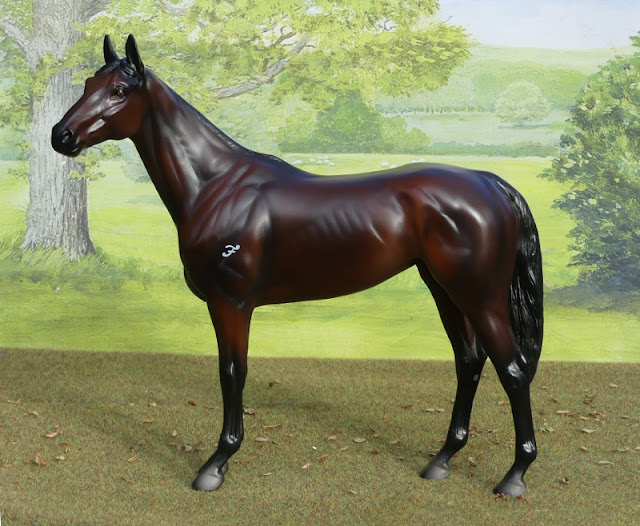
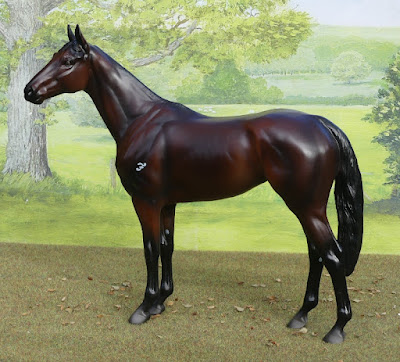
When Breyer first showed the photos of their portrait model for the famous racehorse Winx, I admit I was disappointed. Though I don't follow Australian racing, so I wasn't a particular fan of hers, I've seen photos of the real Winx, and she has beautiful colouring. See here - there's various shades of rich brown through her coat, and even some dappling if you see her here without her saddle. On the other hand, the model in the promotional photo looked a uniform mahogany red-brown, with shading only applied in the grooves of the muscles. I was disappointed enough that at the time I said I probably wouldn't ever buy her, unless at some point a cheap second hand one came up and they hadn't released the mould in a better colour by then.

But at various points through the year, I saw collectors' real photos of the Winx models, and they were much better than Breyer's original shot - more depth of shading, lighter patches on the flank, and a richness to the finish which made the colour look vibrant despite being dark. And I began to slowly change my mind, looking at the prices from various retailers I knew, checking out how many were in stock, perhaps I needed to hurry or regret it?

And yet I still held off, because perhaps they were varied, with different batches having the paint handled in a more subtle and skillful way than others, and I didn't want to make up my mind on the fact I'd seen good paintjobs, then get a flat dull one and be disappointed. I even bid for one on Ebay, but dropped out once the price got quite a bit higher than I knew I could order a brand new example!

Last week, I saw one more 'real' photo of an actual model, and gave in to temptation - I just had to risk it, and order myself a Winx : I'd regret it if she sold out once retailers concentrate on the 2022 models coming in, and I never did get chance to own one. The worst that could happen is owning a truly beautiful, elegant, and realistic sculpt, but in a bit of a boring colour, and that's no hardship or waste of money at all!

This morning, my parcel arrived, and while the cat 'helped' me with the box, I got to see her for the first time...

And she's lovely! Phew! 
I got one of the nicely painted ones, with a dark but deeply painted colour, almost black in places with really warm glowing highlights which show through in natural places. Sure, not quite so shaded and bright as the real horse, but as I said, I never followed her career from here anyway (we tend to see just UK and Ireland racing on free tv, and I don't have any of the subscription stuff for international sport), so although I can appreciate and admire her fantastic racing record (37 wins, the last 33 of which were in a row), I've no huge attachment to the real mare to need an accurate portrait.

Trying to catch a big enough bit of sun was tricky, this one's brighter but the shadows on her aren't so flattering.

I think the mould looks even more striking in this dark, sleek, shiny colour than it does in the pale matte buckskin I have already. It draws attention to the detail and contour in the sculpt, the way the light catches.

Breyer tend to do a lot more action-posed moulds these days, so it's a change to have a placid, relaxed-looking horse just standing there.

The other side looks just as handsome when you're handling the model, but with her head turned slightly away it's not so flattering for photos.

A really fine example of the lean, racing-fit Thoroughbred breed - how I'd love this to be the next mould they scale down to add to the Stablemates range, then I could paint more racehorse portraits of my own!

Because racing people just love a clever name bringing together something from each parent, I went through the Thoroughbreds page of my website and find some classy-sounding combination between two of my existing models.
I've got a very dark bay thoroughbred mare (Zenyatta) called Ravenswing, and a brighter bay stallion (Frankel) called King And Country, so Winx's show name will combine monarchy with the bird species and sound quite cool too : The Raven Queen


Hello! Look at those lovely long ears.