Sunday, 7 November 2021

More CollectA 2021s

I wouldn't normally have a second CollectA order so soon on the heels of the previous one, but with supply issues the way they are this year, I thought I might not get another chance at these releases til next year if I left it too long, and grabbed some of the very first batch to reach this country - by the time I did my daily check to see if they were in stock yet, it was already down to three of each left!


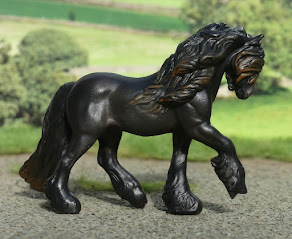
First, one of my favourites from the 2021s, the Chincoteague pony. A great little pose with spirit and attitude, and a well done colour with shading and crisp edges. I've named her Harecroft Summer Breeze.


As with all CollectA horses these days, there's the inevitable chunky legs, but on these small tough pony breeds it doesn't matter too much, as they still feel in proportion and not TOO thick. I love the look on her face, big eyes full of expression despite being painted plain gloss black, they catch a shiny sparkle from the natural light.


For a pony breed, it is quite a large model, and probably wouldn't work strictly to scale if you needed to have the right height difference between the Chincoteague and some other breed in your collection. She stands well above the older CollectA sculpts of pony breeds - I held her beside a Dartmoor and a Morgan from the same brand, cos I happened to have those two to hand, and she was only millimetres off matching the Morgan in height, but utterly dwarfing the Dartmoor pony which in real life would only measure an inch or two smaller at the withers!


This is their second adult domestic donkey, the older one was a very sullen-looking chunky creature which went out of production (or at least out of stock on model horsey websites) a while before I got into CollectA, so it's about time they brought out a replacement.


To be honest, I'm not entirely a fan of this sculpt; with how good the horse moulds are, particularly their lively, expressive and appealing faces, I think it's a missed opportunity for a really great donkey model, when instead we've just got an ok one.
I mean, it's not bad. If it was terrible, I just wouldn't have bought it, I'm not a completist collector who finds huge satisfaction in getting everything whether they like it or not, so the fact I even have one proves that I thought it was still worth the money, and that it's good enough for me to happily have it for my shelf, and to give my donkey foal a mum to stand next to.
But the sculpt just doesn't feel perfect to me : the anatomy of the head shape is off, and the feet are too big. And it wouldn't be fair to just pretend I love it and not point out the flaws, that's not what reviewing's about and I'm writing here to share my honest opinion.


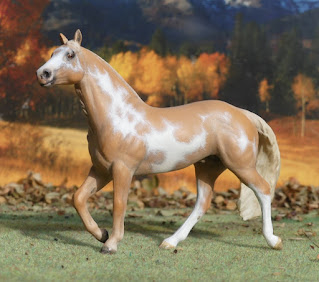
Here is the Paso Fino mare, who I've named Harecroft La Pluma. I think it's a slightly odd choice to go for dark palomino when the Peruvian Paso was done in a very pale chestnut, and as two breeds which people very often get mixed up or confused in their minds anyway, I'd have made an effort to make them look as different as possible!


Again, and perhaps most noticeable here out of all the figures I'm sharing today, the legs are huge and thick, which really does detract from the overall look of the horse. If you take a look at a real example of the breed, you can see the impression is of a chunky horse on very fine legs.
If you ignore the thickness of the legs, their pose is actually nicely done, capturing one of the distinctive gaits of the breed, which can best be described as a sort of running walk on fast forward, they move very quickly with tiny short steps.


The tail is also a distinctive trait of the breed, curling into a J shape naturally in many horses. Sadly some have it emphasised or created artificially with surgery by people value the look, and the prizes, over the welfare of the horse (you get a small percentage of awful unethical people involved with many showring breeds), but that's a minority and in general if you see a paso horse gaiting with a kinked out tail, it's because he holds it that way himself.


The other side, with the nice flowing mane on display. CollectA don't have quite the action and airy volume in the sculpting of the manes and tails these days, but they're still very smooth, elegant, and realistically done.


Finally, Konik ponies! I've been looking forward to this one since they were first announced, as a herd of semi-feral Konik ponies live on a conservation project near me, and I've been lucky enough to visit and photograph them a few times.


This brighter light shows the sculpt better, but washes her colour out a bit - the first shot is the better match for the paintwork. She reminds me a lot of CollectA's earlier Camargue pony sculpt, which makes sense as they're a similar type with a similar outdoors natural lifestyle, though the more primitive Konik is much heavier in the head and less well-built in the shoulder - which is correct conformation for their breeds, rather than an insult!


I love the way they've done her mane, instead of plain black there's streaks of brown in there too, and the windswept look suits her very much. And look at the fluff inside those ears!

I'd already received the Konik foal in my previous CollectA order, but saved him up til I'd got the mare as well, so now he gets to join the photoshoot.


His colour looks very watered down at first glance, but many of the real Konik babies are born very pale, and gradually come into their dark points as they shed their baby fur at the end of their first summer, so it's perfectly accurate that they gave the foal a much lighter colouration than his matching mum.


They make a really nice pair together; I've named them Wichura (gale) and Huragan (hurricane) because they arrived on the day of a really rough storm, all howling winds and rain whipping in sideways, and it suits their blue dun colouring, like dark grey stormy skies.

I'm not sure how CollectA decide which models get a foal and which don't, but I'm glad they decided to go for it this time. It isn't as simple as releasing babies if their adult example of the breed is a mare, because we have single stallions (Friesian, Fjord, Tennessee Walking Horse) who've had matching foals made, and plenty of mares (Akhal-Teke, Arabian, Missouri Fox Trotter, Russian Don, Belgian and Dutch drafters, British Spotted Pony, and Percheron) who haven't. Who knows!

Here's a couple more shots of them together to end with...

Saturday, 23 October 2021

Tales from the Body Box - A big batch of little horses

I've been painting a lot of Stablemates over the last few weeks, and haven't kept up with posting them, so I thought I'd make them share one big post rather than introduce them one or two at a time like usual - my apologies for the sheer amount of photo to scroll past here!


This is Harecroft Talisman, a fell pony. The miniaturised Fell mould was released in those anniversary blind bags, as a chestnut - a colour so rare in the breed that the books don't even bother to list it as a colour they come in, and I've only managed to find a picture of one single individual online.
I can only assume Breyer are saving the typical black colour for the first regular run release on a blister-pack card, but I wanted a black Fell Pony now rather than waiting however many years it takes for that to happen, hahah!


I think mine's a little bit different than the eventual Breyer paintwork will be, though, I've given him sun-fading on the ends of his mane and tail, and a hint of brown round the face, as most of the real Fells do have this, rather than being pure jet black from nose to tail tip.


Another angle with the bright sun bringing out his highlights, and the other side, with that lovely long mane! It's a lovely little mould, which as a rare breed we probably wouldn't have got if it hadn't existed as a Traditional mould first.


This is Johnny Cash, based on a lovely big gentle gelding who used to live in the field next door to my own horse. She's very picky about who she trusts and who she either hates or is afraid of, and this boy was on her 'perfectly safe to have around' list, they weren't quite friends but she wasn't stressed out by him, which is always nice!


He was another of the blind bag Mini moulds, this time the vintage Clydesdale Stallion. I never though the build of the large mould made a very true-to-type Clyde, and the tiny one was no better, so he had a makeover to be a chunky cob instead! I gave him a new full loose mane and tail, plus thicker hairy feathering on his legs.


His small mottled markings are copied from the real one, I even found a picture I took of him having a nap so I could get the pink and black speckles in the right place on his underneath!

Now, did anyone else here read the Silver Brumby books? I loved them as a teen, cos they were about horses but not riders - the feral horse herds in the south of Australia, living and behaving as wild horses would. Not 100% accurate in terms of what we know now about horse herd hierarchy and colour genetics, but pretty close, and a huge refreshing change from all those 'girl at posh yard with epic-backstory-horse wins things' horsey novels which flood the market. I could relate more to wild horses just being horses than I could to Horse Girls, hahah!


This is a portrait of Thowra, the main character in the first book and whose family we follow through others. From the story itself, we're told he's palomino (not a grey, as some of the book covers show him - publishing company misled by the 'silver' in the title, maybe!), but that it's a very very pale shade of palomino, a bit like the famous mustang Cloud, possibly even lighter.


I see there's more books than I ever read when I was getting them from the town library, but according to reviews the later ones are not well written, and have disappointingly poor or downright depressing plots, so if I do ever buy and re-read any more (I only own the first), I'll stop at the 4th book and count that as the end, just like I did years ago when I didn't know the series had carried on!


This is my first repaint on this mould, the Endurance Arabian. I tweaked the sculpting of the cheek and nose a bit, as it had such a shallow jaw and undefined muzzle before, but the rest is unaltered.
Usually for fleabitten greys, I rely on speckles flicked on with a toothbrush, but for this one I added a layer of hand-painted hair over the top of the speckling, it takes a very steady hand to keep the tiny strokes fairly short and fine, but looked effective enough in the end to be worth it!


I'll admit something - this isn't how she originally looked when I thought I'd finished her, and stood her on the mantelpiece. Her mane was pale grey with just a hint of darker shading at the roots, and the more I looked the more I couldn't ignore how much I hated it. It wasn't awful or badly painted, it just wasn't RIGHT on her, so I got up and fetched her back, and gave her the dark mane and tail you see here. I think it was the right decision, now she looks fine even though this isn't the colour I had in mind when planning her paintwork!


This little appaloosa was a paintjob I didn't set out to do, what I wanted to paint was the kind of appaloosa with a crisply defined white blanket pattern - sharp edges and no mottled roaning - but working white on top of colour is something I find hideously difficult, and I gave up halfway and rescued the mess by roaning him after all. So he's just another example of the kind of appaloosa I usually paint anyway, on a slightly different base coat colour, and I have to try again if I still want to get that blanket pattern after all!


He's fine for what he is, I'm not disappointed with how he actually looks, only frustrated that I keep painting the same kind of appaloosa almost every time I try a different one! I've named him Harecroft Galaxy Of Light.


Back to the blind bag horses, and the mini Smart Chic Olena mould - the same as I painted as a chestnut Quarter Horse last week, but equally good for a Paint Horse, I think. 
I usually do tobiano patterns, so I decided to go overo first for a change! His markings were made up, for the simple reason that inventing them is so, so much easier than trying to copy photos onto a 3D surface, and I only put myself through that difficulty if it's a portrait of a real horse I want to create - when it's a made up one just cos I fancy owning a certain colour pinto, then the pattern can be fictional!


I'm enjoying painting these new moulds, even though I really like a lot of older Stablemates it's a refreshing change and new challenge to have different sculpts in-hand and plot what to do with them, especially as I only have one or two of each, so there's a feeling of not wanting to 'waste' them on a colour which doesn't work well!


His colour inspiration was this horse I happened to see when browsing Spanish horses for sale (definitely not to buy, I have my native ponies and don't ride any more - but sales sites are wonderful for naming and painting ideas!) I thought that was such a stand-out colour with his unusual liver chestnut base coat and appaloosa detailing, he just had to become a model for my mini herd!


I'll be filing him as a Spanish Jennet on my website, a historical breed with evidence for spotted patterns in art from the era. I don't mind a bit having extinct breeds in my collection, most of them are horses I've copied from centuries-old paintings so he'll have plenty of company.
But there is a current breeding project aiming to recreate the Spanish Jennet, by crossing Peruvian Paso and Paso Fino horses with Appaloosas, to combine the gaits, the body type, and the spotting - so it's a bit of a matter of debate whether I ought to make them a page as an existing breed, or carry on putting them on my 'historical breeds' page?! Either way, I had fun painting him!


The sun in this final shot might make his colouring stand out a bit more, he's faintly roaned outside of his blanket markings, with a couple of stray white spots, too.

This next one was an experimental horse - I remembered reading ages ago that dappled patterns can be done using pencils, and while I think they meant artists' colouring pencils, I haven't got any of those, so I thought I'd try using a normal grey writing pencil, and see what happened...


Dapples happened!
I was surprised how effective it was, in very little time the pattern started to come up pretty clearly, and with each repeat covering of scribble they got darker and better defined. I finished her off with paint for the mane and tail cos I wouldn't have been able to get the pencil into all the little grooves of the hair texture, and for the shading and markings on the limbs and face.


She's really quite pretty, a colour I wouldn't have been able to get quite the same with painting, and something I'll definitely try again, maybe in combination with more paint shading over the top to get darker, or a more rose-grey effect.
I've included this picture of her laying down, cos I think you can see the scribble work a bit more clearly like this!

Then it was back to paint...


This was a colour idea I'd had in mind for this little chunky pony mould ever since I first saw it - a pony cob.
Quite a few traditional cob breeders in the UK are aiming to make a smaller type now, about 12-13hh instead of the usual 15-16hh traditional cob type, while keeping the true chunky type and heavy feathering on the legs. Before, if you wanted a pony sized cob either for driving or children to ride, it was usually a cross with a native welsh or partbred pony, so it'd be a lot lighter in build and more pony proportions, where these look just like scaled down large cobs.
There's no real breed name for them yet, they're locally known as 'pony cobs' but could be known by different terms elsewhere, just like the big ones are a cob to me and a vanner to an American and a tinker to a German, and so on!


Pony cob doesn't have a name yet, but I really like how he turned out - as usual he's got made up markings because copying from a picture stresses me out and rarely goes right, so I only make myself do it when it's for a portrait model of a horse I know. This one's just a general example of his type, who exists purely because I wanted to do the pretty colour on the cute sculpt!
It's a much smaller mould than most Breyer Stablemates, his head only reaches the shoulder of the Arabian posted up above him there - which makes it fun to paint, and gives a bit of variety when he's standing among mostly horse-sized breeds!

This will be my last batch of customs for a little while - I'm taking time off, injured!
At work last week I tweaked something in my lower arm while pruning a too-thick branch at a very funny angle - first my index finger went into cramp and wouldn't move, then after a few minutes it was twitching all on it's own, then eventually I got control and feeling back, and was able to carry on. 
But the following day it felt tingly, my arm was very strained and sore, and I'd lost all grip strength in that hand. It's gradually coming back and hurting less, day by day, but I can't hold models or paintbrushes to carry on with my repaints til it's properly healed. 
But with the amount I've been getting through lately, taking a break is probably a good thing!