Friday, 8 May 2020

Tales from the Body Box - four more

My painting spree continues without any sign of fizzling out just yet, this time there's four little Stablemates to share.

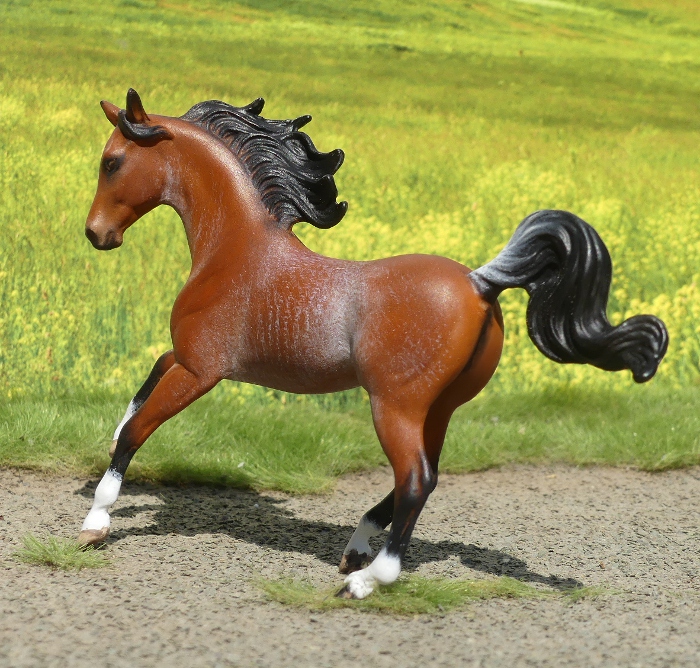
Last weekend I was just googling horse colours for the usual mixture of inspiration and entertainment, and it struck me that one of the commonest colours for the saddlebred breed is a solid liver chestnut, and I'd never painted one on the little G2 mould I have so many of, so it was off to the body box to get out one of my unpainted blanks and give her a coat of paint.


 I went for a flaxen chestnut cos the contrast of very pale mane would look so good against the dark coat colour, and I'm glad I did cos I really do like the way she turned out. I love the customising part of the model horse hobby for this reason, it's just so satisfying being able to have an idea then go off and create exactly the horse you want to own!
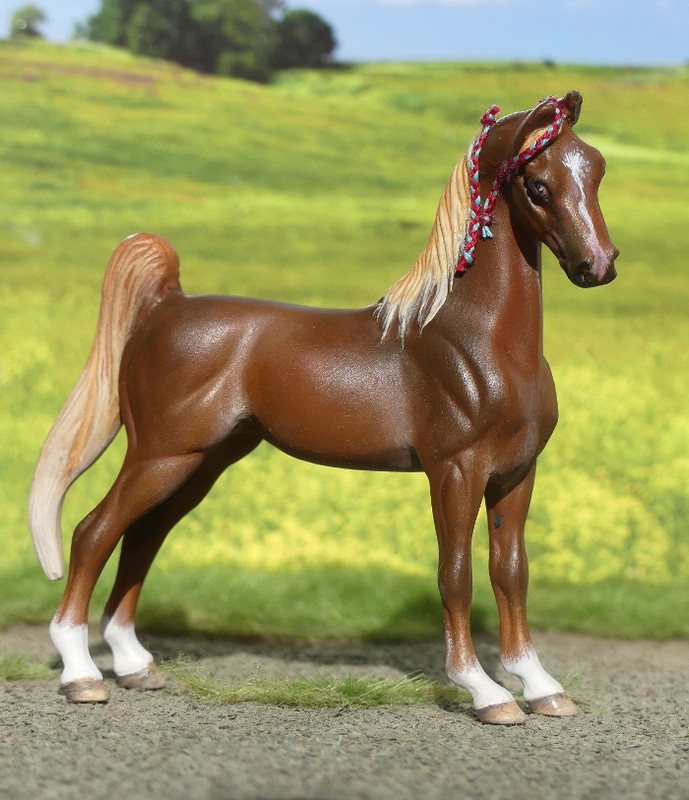

Despite not being as flashy as all her pinto sisters in my herd, a good solid colour makes a nice change and stands out in its own way, I think!


Her original moulded plastic braids I set upon with a scalpel to cut and carve them away, and gave her fine thread braids instead, I don't mind painting in the sculpted ones but I think the 3D effect of plaited thread really adds to the realism in photos, extra detail is always a good thing!

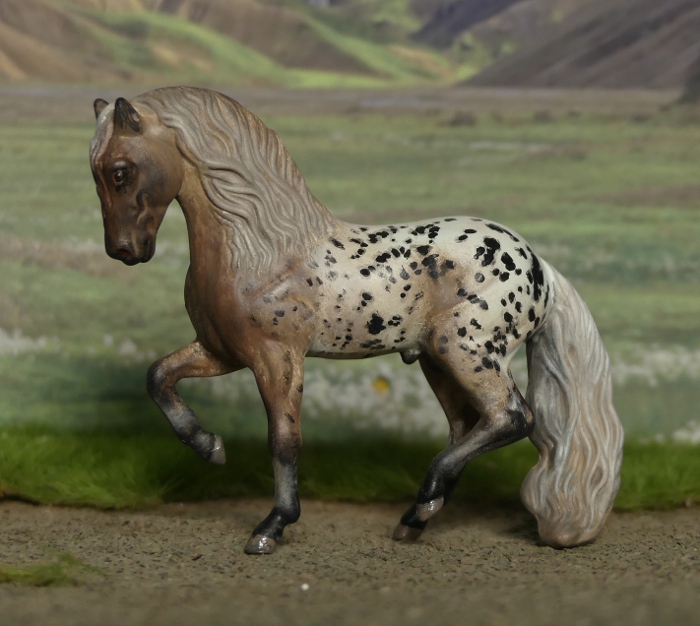
The next custom Stablemate was also a result of random colour googling for amusement one evening, the horse in the photo looked more like a riding pony type and didn't have any white on whatsoever, but I'd been waiting for inspiration for my final Django body and a bay roan pinto just clicked as yes, that'll suit him!


And having completed the paintjob, yes, I think it does - he looks just how I hoped he would! When the usual aim of applying paint with a brush is to get the colour as smooth and blended as possible, roans present a bit of a difficulty, especially the more mottled kind with patchier dark parts - it can be kind of hard to get your head round handling the brush in a way which will deliberatly leave a rougher shading, a suggestion of mixed white and brown hairs. This is why I paint so few of them, but I was determined this time it was the right colour for this horse to be.
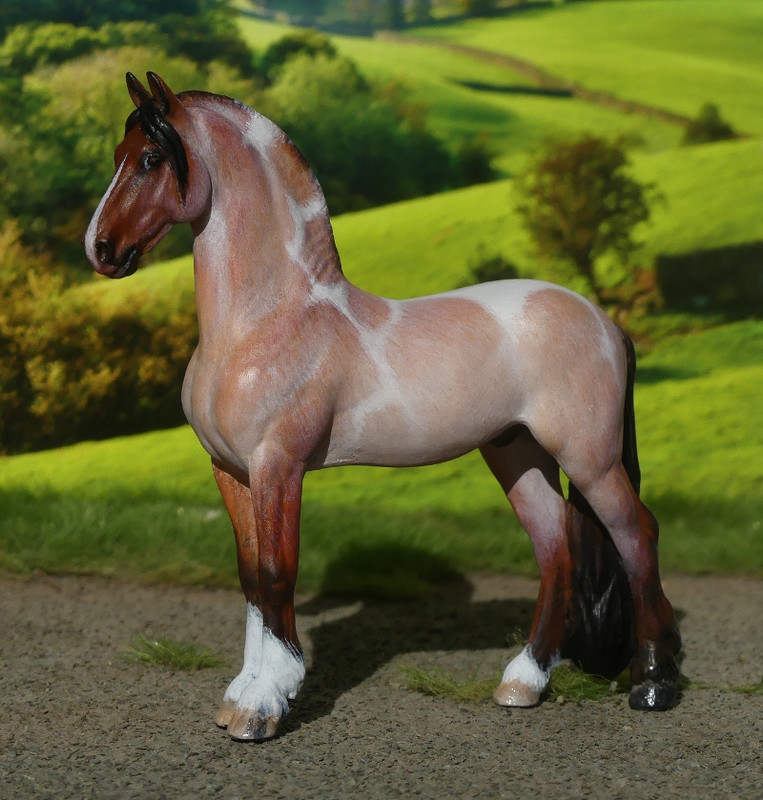

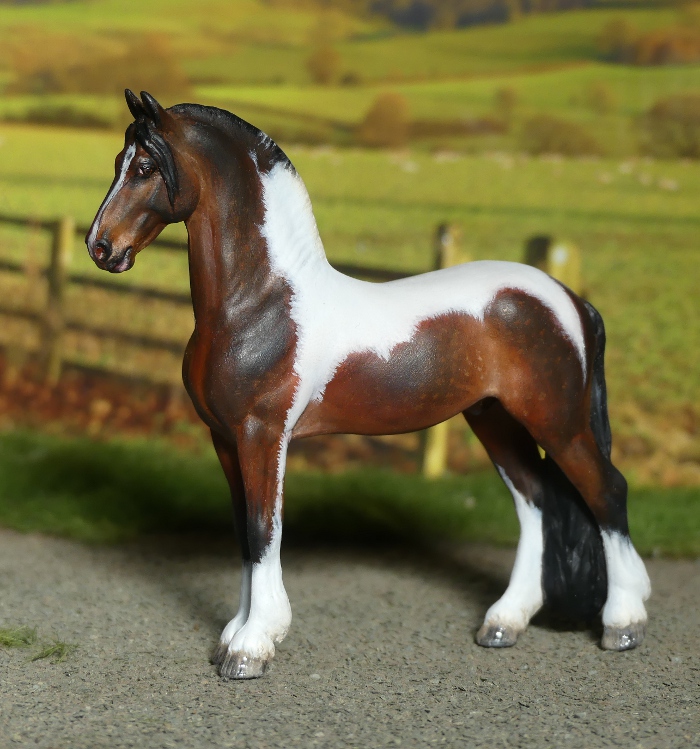
I remember a long, long time ago having a discussion with other model horse hobbyists about the rarity of tobiano pintos with a totally solid leg and dark hoof : so many of them automatically come with four socks or stockings, we notice (and maybe try to get a handy reference photo!) when we spot one with a dark leg and black foot. There was even a website at the time, where somebody had collected all the pictures of dark-legged skewbalds and piebalds they could find. So I thought I'd paint one! 
The only thing is, I'm now out of Djangos, and that makes me sad cos I've enjoyed making three patchy little cobs out of them, and would happily do three more!

The next two horses are the really, have I never painted that before? batch! 
I was messing about amusing myself by making one of those horse colour charts you so often see with small drawings or photos of real horses, some pretty basic and intended for riding school and horse-mad-kids' walls, others more in depth and explaining the genetics for particular colour enthusiasts, breeders, artists, and painters. 
I was fitting in pictures of my models for the various basic, variant, and dilute colours, and realised I was actually missing some pretty standard colours in my herd of customs. For a start, I'd never painted a cremello! I thought I had, but when I went to fetch the photo of the one I had in mind to represent the colour on my little chart, he was actually a perlino - oops!

So, another trip to the body box, and I chose a mould that would both be a breed likely to have cremellos, and equally importantly, look good as one!


Another saddlebred! I'd done a dark golden palomino one on this mould, and I've got a much paler palomino my friend painted, but cremello looks easily different enough to warrant picking the mould again, with the cream colour against pink skin, and blue eyes.


Rather than a stripe or blaze which'd reach her nose, I stuck with a forehead star, so there'd be no need to figure out how to handle a face marking on skin which is already pink! 
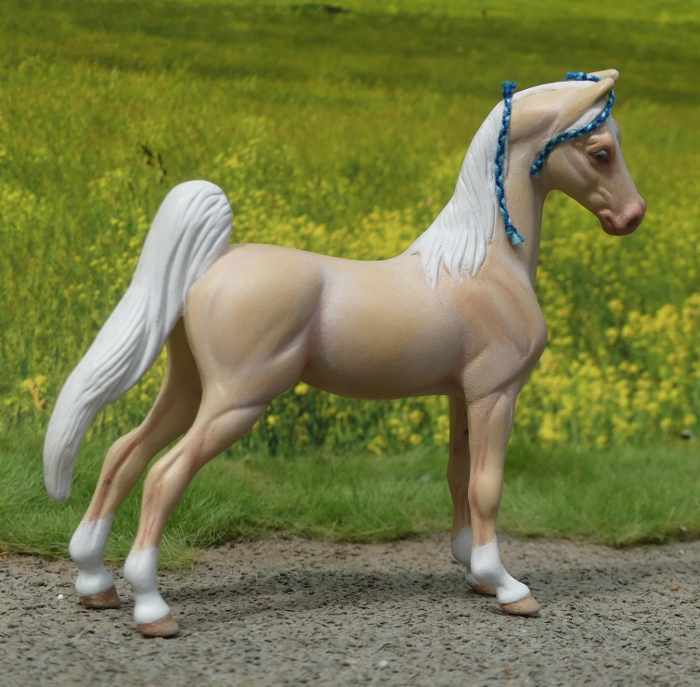

This one has blue braids, to match her eyes. I know the real ribbon colours are chosen to co-ordinate with the browband and rider's outfit (just like some showing classes here use those ribbon browbands which come with a buttonhole or hair bow so the person matches the pony), but for my mini ones I always go for something different picked out to compliment the horse's colouring.

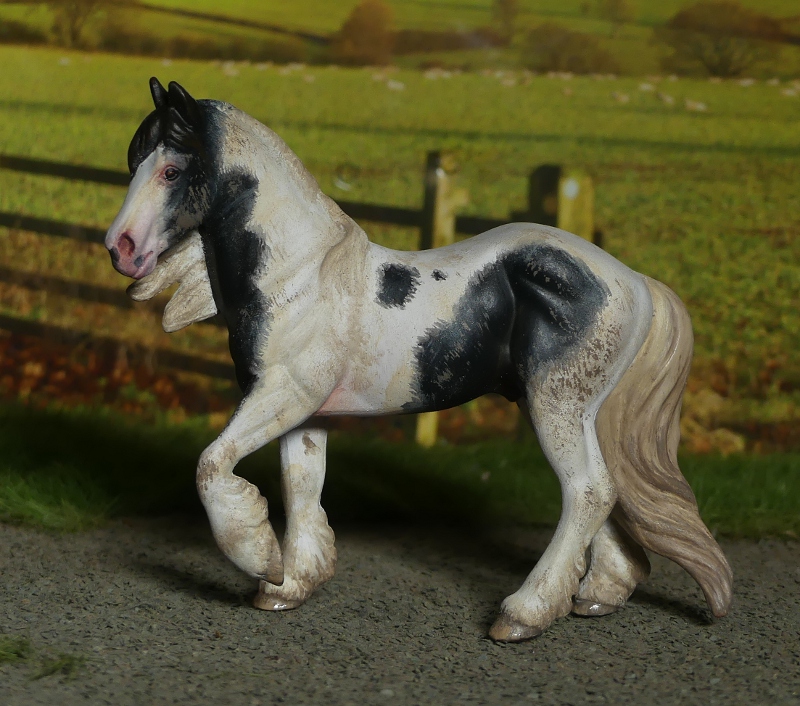
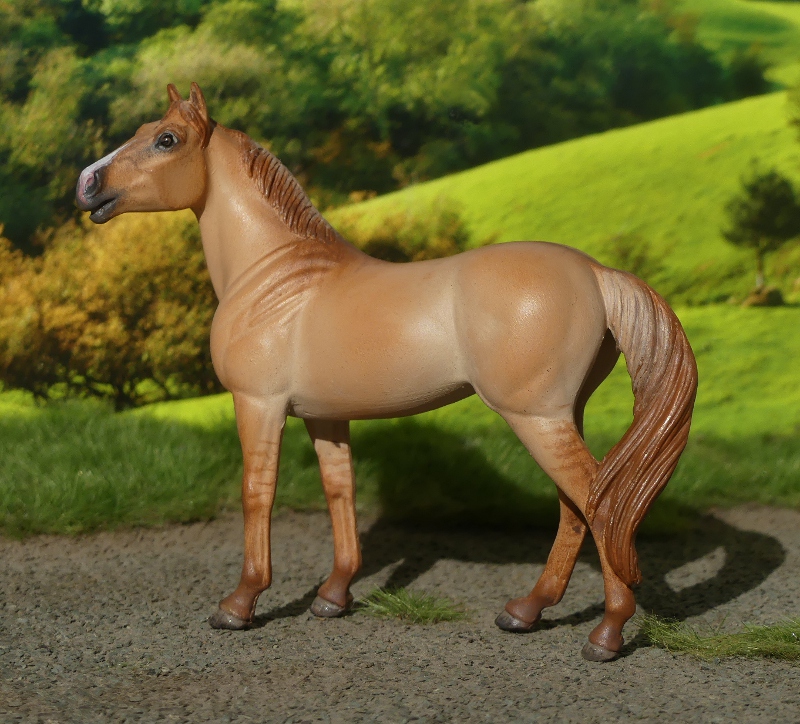
The next big glaring gap on my colour chart was a red dun. How?! Out of all the duns I've ever painted, not one!
So again, time to pick a relevant breed from the body box - this one was part of a batch of cheap Stablemates which I got on ebay, some perfect enough to fill OF gaps in my collection and others which had clearly been very played with, with a lot of scuffs and breaks, missing ears, and legs sellotaped to backs if they hadn't been lost entirely. A while ago I reattached the leg of this unlucky mare (or perhaps lucky, that she didn't just go in the child's bin!), and she's been waiting for a new colour ever since.
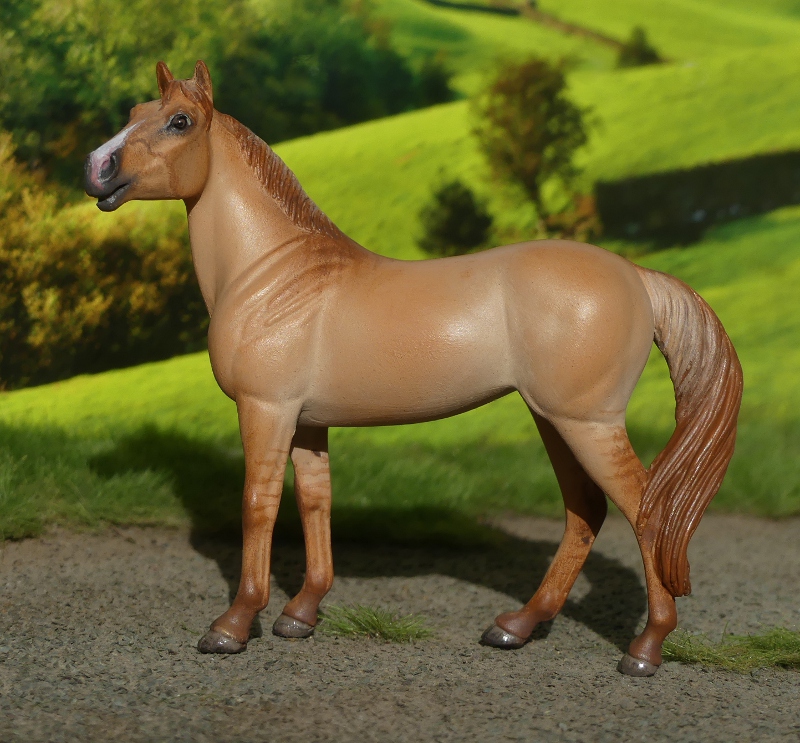

I think the colour suits her, it was a toss-up between a stock horse type and a highland when picking what breed body to go with, but I decided to start with this one and I can always do another for my dun highland conga next time. And look, she got the pink nose I avoided on the cremello!

I can tell which leg's been off, but hopefully the milliput join is strong enough that it won't happen again, and neat enough that it's not immediately obvious she had to be reassembled!


Because there was a danger of red dun looking like a bit of a wishy-washy attempt at a chestnut roan, I made sure to give her full-on dun markings, with a barred dorsal stripe, zebra striping to the legs, and frosting along the mane and at the top of her tail. As with the others, she got photographed before getting named, I haven't managed to think of anything to call any of this batch yet!

I need to have another look at my colour chart in progress to see if there's any more glaring omissions, quite how I painted for over a decade without reaching cremello or red dun is beyond me, so who knows what else got missed!

Monday, 4 May 2020

Breyer Sable Island Horse, or, An exercise in self control and forward planning

Yesterday I managed to have a parcel day despite not having a parcel arrive!

This year we've lost the entire calendar of British Eventing fixtures, understandably cancelled til further notice. Of course this lack of competition is mostly a shame for the competitors themselves, but as a spectator I'm really missing getting out to a nice cross country course on a sunny (or not-so-sunny!) spring day to watch and photograph the horses in action.
At some of the bigger events, there's also the treat of finding my favourite trade stand, which is naturally the one which stocks Breyers. It's usually my first chance to see each batch of new releases in person, getting a good look at new moulds or seeing how paintjobs have worked out in the actual production runs when the stock photo can be a bit misleading, and picking out a model to take home is a highlight of the day. This year, with no eventing, there'll be no trade stand visits either, but a little while ago I'd noticed the same company, Equestrian Bookfair, had started listing models on Ebay, and at the end of March, I came up with a plan.
To recreate the annual habit of buying a Breyer at their trade stand each time, I'd place a big order in advance, take the very quickest of glances just to make sure I'd received the right things in the parcel, then tuck the models away still in their boxes, and on the date which I'd have visited each competition, get one out to open and add to my collection. This way I get to spread them out through the year in a satisfying way - while one huge parcel day would be fun, there's more anticipation in looking forward to several little ones, and it's closer to recreating my usual experience of gaining Breyers gradually through the season.

This weekend would've been the first opportunity to buy from the stall, and so I got out one of my set-aside models, and this is who I picked :


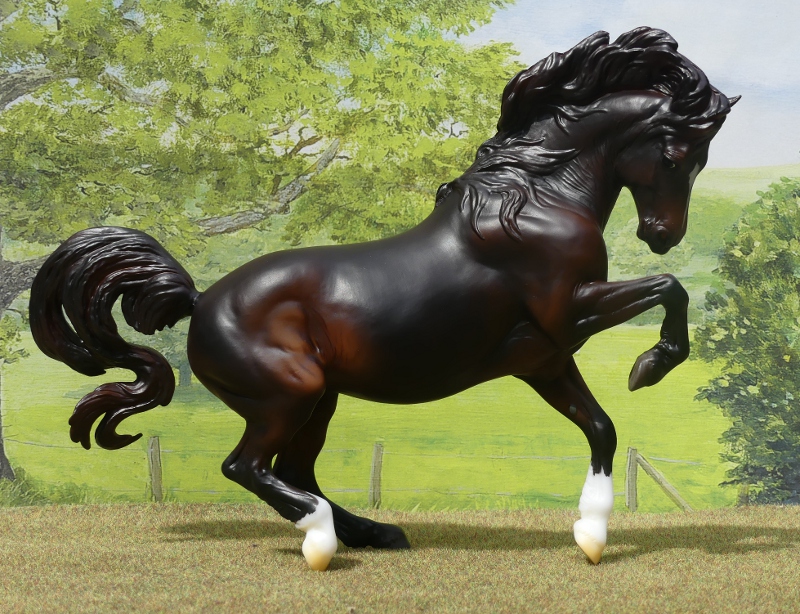
The gorgeous 2020 Sable Island Horse. A breed, and admittedly also a place, I didn't know about until the model was announced, but have read up on since (see, models are educational - I never would've known I didn't know unless Breyer had sparked the interest!). 


She's my first of this Connemara Mare mould, having avoided the pale grey one as overly plain and a little too translucent-plastic-looking, but the dark colouring on this one really highlights all the fine features in the sculpting, there's a level of added detail which we only used to see on artist resins, with creases in the skin, veining, whisker bumps, and even eyelashes! I may be late to this connemara appreciation party but count me as a big fan, now!
Here's a couple more shots showing off her dramatic pose from different angles...


And here's one of her laying flat (or she could be rolling, though exactly where you'd stand to get this view of a real pony having a roll, I don't know - drone photography?!), this captures the depth of her shading. In person you can really see the red tones in her mane and tail, so she's either a very dark chestnut or a bay but with sunbleaching, I'm not sure which Breyer intended - the box info just says they come in 'solid dark colours' - but whether they designed her as a black chestnut or a bleached bay she's a lovely addition to my herd!


Unlike most of the other recent releases, they haven't given her a name, simply listing and labelling her by breed instead. I decided something suiting that Sable Island background would be nice, so spent a while looking for names on it's map, people from it's history, any native flowers or birds, all yielding nothing useful, but then happened across a map of shipwrecks around the island, and from there found a list of all the ships' names to read through. One name jumped out as there'd been two different ships of the same name foundered on the sandbanks, Stella Maris. The words and meaning ('star of the sea') sounded pleasant and fitting, and looking it up a little further, Stella Maris was used by sailors since the medieval era, as a name for 'a female protector or guiding spirit at sea', which seems just perfect for a remote island herd's protective lead mare.

Sunday, 26 April 2020

Tales from the Body Box - another mixed batch

I suspect a lot of people, all over the world, are finding a hobby to be a great a help in these difficult and worrying times, with safety restrictions and cancellations limiting things we'd usually be out doing, and much more time at home to pass in a constructive way. Whether it's making tack or rugs (or even fully furnished stableyard buildings!), photo showing, or customising, many of us in the model horse hobby are finding it a welcome distraction and creative outlet.

I'm yet to be inspired to dig out the craft materials and make any tack, miniature props, or scenery, and I haven't sewn a rug for a very long time indeed!
I always say my creativity goes in phases, and I'm unable to do more than one thing at a time : if I'm writing, I won't be touching the paints. If I'm drawing, I won't be making any miniatures. If I'm painting, I forget I ever could draw, and all my ideas remain unwritten. But rather than seeing this as a useless disappointment, I just embrace whatever I do feel like I'm in the mood for, and my painting phase is carrying on far longer than they ever usually do, so this week I've got a few more customs to share.


Firstly, the horse I intended to paint last time I picked up this mould! I'm really not very good at painting what I had in mind when I set out (one of the many, many reasons I've never considered taking commissions!), some paintjobs just go off in a different direction part way through and I like the results too much to go and spoil it by insisting my original idea was better.
This one's called Bronzewing, and the markings are inspired by a skewbald I saw out competing cross country last year, I just liked the idea of the entirely white back view, as opposed to the flash down the sides of the quarters I more often see - and paint - on a more minimally marked tobiano.

One of my aims this year is to push a little more out of my coat colour comfort zone, or rather, extend that comfort zone so I feel competant tackling a wider range of colours. 


Overo pintos are one of those colours which feels very 'other' to me, totally outside my little world of UK horsey experience and knowledge. 
This, of course, goes for a lot of breeds - I don't travel the world, so I've never met a Lusitano, or an Icelandic, or a Peruvian paso, either. But their colours, and markings, aren't unfamiliar territory : the same bay I could paint on a TB would look at home on a Marwari. The greying I understand on a welsh pony, that works on an Andalusian, too. Dun for Norwegian fjords, well that's just the same as dun for Highlands but with a cooler haircut. Familar and well-understood white markings and patterns can, with a little research, be applied to lots of different breeds. 

But overo? Nope, that's crazy!
It doesn't do what my mind says markings do, when sabino and tobiano are the only white-marked coats I ever see, the patterns I've been painting for years. 
Tackling an overo meant hours spent googling through pictures, trying to 'learn' the likely shapes and spread of the white patches. My first one was fairly tame, with not a lot of pinto bits, so this time, I decided I had to be brave and go for a lot more white! 


I'm pleased with how he turned out, I think the colour was more or less a success (although it'd take someone who actually understands overo the way I'm at home with tobiano to truly judge whether I'd done a decent job or not!), and I do think it suits the mould quite well, the action pose calls for something eyecatching. I've called him Diamond Creek Dazzler.


I finally found a little pot of blue paint in an old craft kit, so now I can do blue eyes without having to resort to colouring pencil over a white eye!


Here's another colour I'm not used to painting, but this time I've actually known several of them in person, the much more familiar sunburnt black! Some look practically bay in their faded stage, and because I've already got the OF black in this mould I didn't want them to be too alike, so I went quite heavy on the reddish shading - some sunburnt blacks have a much more subtle tint, to the point where you only really notice it if they're near a non-fading jet black horse to compare!


This angle is better to show the mould and pose, but doesn't bring out the colour quite so well. He's now named Romario, I'm doing quite well keeping up with naming this batch promptly!


Having done a couple of new colours, I decided to go for something else I'd never tried before, though pretty popular for model painting - a rabicano roan. Most commonly found in arabians and quarter horses, I picked a G3 stock horse and gave her a simple dark bay base coat, then got to work adding the roaning. First some white flicked on each flank with my thumb over a chunky paintbrush, then I picked out a finer brush and added the rib barring, lines following the hair whorl from belly to hip, few flecks of white on the quarters, throat, and behind each elbow. I finished it off by blending in the hand-painted hairs and adding the white top to the tail with some careful dry-brushing, gentle dusting of a very soft dense brush with not a lot of paint touched on the very tips of the hairs, so it leaves a faint smudge of white which increases with every pass of the brush.


This head-up, mouth-open pose is a bit odd from the side, but does make good characterful pictures from the front, like a horse who poses for the camera!


The bum-emphasising angle so favoured by real-life stock horse people! I've named this mare Plum Velvet, cos her colour reminds me of the sheen and lustre on dark velvety fabric.


Having thoroughly enjoyed one rabicano, I rummaged through the body box to find another suitable breed, and came up with this Magnolia arabian, one of my duplicates from the second series of blind bag mystery horses. This time I picked a brighter shade of bay as the base coat, and added the roaning in the same way as the first mare - it's showing up a little less because there's not the dark and light contrast, but I think the colour really suits the mould and it's far more interesting than she looked in plain bay part way through!


My first Magnolia custom, this was one of the moulds I was a bit unenthused by when first released, but the process of painting one, handling it and seeing it from all different angles, has made me like it more somehow. I did file down a couple of extremely overlong toes, though, and shortened both the ears a little bit! I'd like to get more of the mould eventually - perhaps one day if any full cases of series 2 mystery bags come up for sale cheap like the series 1 boxes did! 


I've named her Lumina, a name which has been kicking about on my list for aaaages but I've painted a lot of geldings and stallions lately and was saving it up for a mare. 

My supply of Stablemate bodies is starting to look seriously depleted, now, with how many I've done over the last few months, though I'm far from running out entirely I know I've used up all I'd got of certain moulds : I really need to lay them all out together and take stock of what's left in there, what I paint next will depend on managing to match remaining breeds to my colour ideas and inspirations. We'll see! 

Sunday, 12 April 2020

Tales from the Body Box - seeing spots

Three little appaloosa patterned horses to introduce today, starting with one who was actually painted last year but I somehow forgot to ever get a picture of, so he's been delayed a bit!


He came about as a result of me thinking 'I have loads of this rearing mould, what could I do with it?', and also musing that I've hardly ever painted leopard appaloosas, most of mine have been blanket spotted, or roany semi-leopard. So it was a logical combination to put the appy paintjob on one of the rearing arabian bodies! He's buckskin, under his spotting pattern, so the spots on his body are a different colour to those on his legs.


Another colourful appaloosa, this time a flaxen chestnut with four long socks and a blaze, with my usual roany blanket type pattern. I'm getting much better at blonde manes and tails since I found the right creamy beige colour pre-mixed! 
I also found a really good method for getting the distinct sclera (eyewhites) that come with the appaloosa coat pattern : some very diluted pink paint touched against the eyeball while the horse is held on his side - the fluidity of the paint draws it right down into the crease between eye and lid all the way around, then once it's dried you can paint in the eye as usual.

And the final spotted horse is something of an oddity, being not quite an art portrait recreated with heavy resculpting of an existing mould (as I did for Whistlejacket and Cerbero), but inspired by an oil painting, anyway.


This is Landscape with Two Horses, by Nicolaes Berchem, dated to the second half of the 17th century. It's very often used as a perfect example of historic spotted Iberian horses, whether in the context of them existing in Europe (and oh, what a shame it is that they no longer do!) or as the source for the spotted genes which went to the Americas and carried on into new breeds developed there. Though there's several other good examples of spotted horses in artworks from that era, I've always had a fondness for the main horse in this painting, both for his lovely soft brown colour and detailed spots, and the way he turns just enough to look us in the eye, ears pricked and curious - he just leaps out at you as a real little character.
With no standing Iberian-type SM mould to work from, and being increasingly averse to major resculpting projects, I decided the only way I'd ever make a model version of him was to pick from what I'd got and go with it while I was in an enthusiastically painty mood, and so at last he's happened!


I'm extremely happy with how he turned out, roany smudgey mottled colours I find very stressful as there's so much opportunity to just make a blotchy mess when brush-painting by hand, it can go all wrong in one application of ever so slightly too much paint, or the wrong consistancy cos the air's drying it too much or you've tried to counteract that with a little too much licking of the brush...it's kind of scary, but super satisfying to relax when it's over. Maybe being glad it's over isn't really the same as enjoying painting and I'm in the wrong hobby, hahah.


Another angle, as well as attempting to get the spots in the same places I tried my hardest to get the shading just the same, with some more blended and some more speckled, and the deepest colour on the face, the front of the shoulders, and the legs.
I'm not entirely sure what to make of this colour, in technical specifics - my best guess is that his base colour is seal or sooty bay, or possibly a dark bay dun, with the leopard complex lightening and mottling it up, and also causing the pale mane and tail through roaning rather than any kind of additional silver gene on top. 
But the stand-out contradiction to this is that his spots are black, not bay/dun. Usually, an appaloosa's spots are whatever his solid base colour would've been. Sometimes they do look much darker, so you can see spots on the 'bay' front half of a bay blanket appaloosa, for example, but that's cos the appaloosa lightens the body colour with what can be subtle roaning of the coat even outside of the distinct white blanket area, and the true base colour is always what you're seeing in the spots. So really, this horse's spots should be painted in shades of brown, but to be true to the original oil painting, I stuck with black. 


This side is a mirror image of the other! Usually, if using a single photo reference for inspiration, I'd just make something up for the side I couldn't see, but this time it's complicated - I really wanted the clear side of his neck and shoulder to carry an exact copy of the pattern - his mane covers so much of this side I'd have lost the chance to recreate all that roaning and some of the spots, but of course the painting is of the left side, so if I invented some similar-but-different pattern, he wouldn't actually match the portrait when facing the same way. So he gets to be the only appaloosa in my herd who has the same spots on both sides!

Tuesday, 7 April 2020

Tales from the Body Box - Nereo

I've painted several racehorse portrait customs so far (Big Buck's, Sire De Grugy, Enable, and Sprinter Sacre), but a lot of my favourite famous horses are actually from the eventing world, not the racecourse.
Each season I go to about six or seven events, and over the years, I've got to watch the star horses as they rise through the ranks, from Novice and Intermediate through to Burghley, rated as one of the best competitions in the world.
One horse I followed all through his career was a particular chestnut, lanky and lean, with a quirky blaze and a pink nose, and roany markings. Why did I like him? He looked so much like one of my old favourite riding school horses, an aging partbred thoroughbred called Peter. My mum and I first referred to this big chestnut eventer as The Horse Who Looks Like Peter, but soon his success and reputation as a world-class horse meant we knew him by his real name - Nereo, ridden by Andrew Nicholson.

I'd always had an idea of wanting to paint him as a Stablemate model, but never did because there just wasn't the mould to suit - my options were the G2 or G3 Thoroughbreds, G2 or G3 warmbloods, or the jumping horse, none of which looked enough like his long, lean build with high withers and wiry muscles. And then the new Walking Thoroughbred mould was released, and ahhh, there was my mini Nereo.
Of course it hasn't been easy to get hold of one, they've not been a regular run single yet, so eventually I bought the Paint Your Own Unicorn set with the blank thoroughbred body in, and filed off the horn!


His colour was really nice to paint, a paler kind of chestnut, sandy rather than reddish, with slightly faded out legs, a chocolatey brown tail, and white roaning marks, notably on his elbow and hips. One random white 'scuff' on a horse and the most likely reason is an old scar which healed with white hairs, but Nereo has them on several parts of his body and most seem too spread out and mixed in with his chestnut hairs to be the result of an accident, so they must be some odd form of natural marking.


I carefully copied his white sock and striped hoof, but you can't really see it at either angle in his side-on photos!


The other side, showing just how race-fit and muscly the new mould is - a lot of eventers are the more compact, chunky end of the warmblood spectrum these days, but this suits the longer, lighter sporthorse or thoroughbred-type extremely well, and it'd be handy for racehorse or old-fashioned hunter portraits too. I could even see it as the makings of a nice akhal teke with a bit of reworking.


His face marking shows better at this angle, with a pink nose and lower lip spot, and again he's got roaning round the edges of his stripe. Unlike his roan hip marks which have always been there, this seems to be age-related greying (a horse approaching middle age will sometimes get white hairs, just like people do!), as his stripe looks much sharper in older photos than the recent shots when he won Badminton in 2017, or retired there the following year.

Sunday, 5 April 2020

Tales from the Body Box - the first 2020s

Here's my first batch of mini customs painted in 2020. I had a little lull for a few weeks at the start of the year, then picked up the paintbrushes again and it seems I'm back on a roll!


First up we have a brother for Billy Ruffian, the skewbald I painted last year. I always planned he'd be darker and with more white on, and that's exactly how he turned out - I don't like using reference photos for my little herd of tobiano cobs as it's so much harder to copy the white in place from a picture than to make it up as I go along, I feel like I know the pattern type well enough to invent something realistic.


The other side, showing his half-and-half mane and how the patches are never the same on both sides.


I've named this one The Artful Dodger, just because it goes so well with Billy Ruffian (which was a ship, not a character, but doesn't it sound like a Dickensian street urchin's nickname!), and I really am pleased with him - this mould is so nice to paint with so much detail and a real noble, proud look in his pose and attitude. I imagine he'd be a horse who does a bit of showing in the Coloured Horse and Pony classes and very often comes home with a rosette and some new admirers.


Whereas this looks like a cob which has never seen the show ring in his life! I'd had a little idea about how nice it would be to paint a scruffy, muddy custom, maybe a family pet pony, or a competition horse enjoying the field life in his winter off, and then I happened to rummage through my body box and picked up the cob mould, and it clicked : the kind of horse I see most often being all laid back and happily filthy is a hairy cob. 


While I wanted the horse to look muddy, I didn't want him to come across as neglected and unloved, so I painted him clean first, then added the dirt - he's been groomed, and brought in at night when the weather's worst, and has his mane and tail combed out regularly, he just also really loves a good roll and picks up mud.


As this one was painted in February, I did briefly consider using actual horse-field mud from my boots to get the dirt the right colour, but went with paint in the end because I didn't want it to rub off when it dried out!


And here they are together, to really contrast the difference in stature, character, and cleanliness!

Next after the cobs came a mustang in wild bay...


...just because I realised I'd only ever painted my own horse's colour on portait models of my horse! It was about time I used wild bay on something else, with the distinctive pale legs, lack of full black points, and ginger highlights to the tips of the mane and tail. I didn't like this mustang mould when we first saw it, thinking it looked too disjointed and awkward, but changed my mind as soon as I got one OF release, and now I enjoy painting them too. Not naming them, though, like Muddy Cob this one is still nameless.

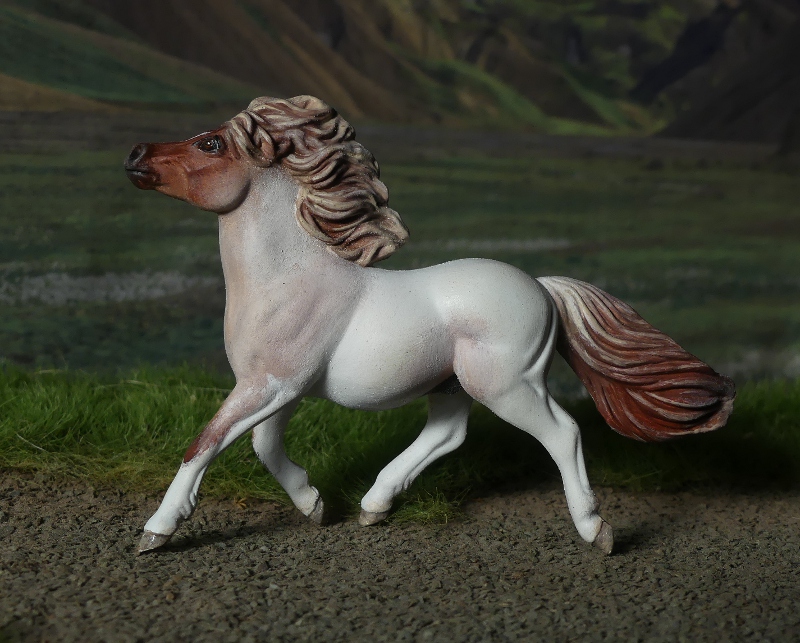
Having said how much I dislike copying reference photos for my piebald and skewbald cobs, I then promptly did exactly that for a different breed entirely!


This little shetland pony was inspired by a photo which cropped up in a news article about Storm Ciara! I did think I'd name it Ciara, then realised this is actually a stallion mould so gave that name away to an OF SM mare who arrived the same day as the storm hit here, so it fitted her just as well!


I think what I liked so much about this colour is the way the roaning fades the markings out, so you can barely see the patch on the flank, and the 'join' between the coloured shoulders and the white barrel is sort of softened. I haven't painted many roans, I think this is my first chestnut one, so it was interesting and a bit challenging working out how to make my paint do that without the usual hobby methods of airbrushing or pastels.


Last one for now, my first custom on the hanoverian dressage horse mould. I was going to paint a minimal tobiano when I set out my paints this day, but in typical fashion my plan changed along the way because I liked how he looked as a bay! Some big socks and some dappling stopped the bay being too plain, I really need to get better at resisting doing everything pinto so this was a good decision, actually. I've named this one Five Star.


I may not have painted quite what I originally planned, but I'm so pleased with the result anyway, and I'm getting more confident in my dappling now - I still don't think dapples and brush painted acrylics mix, but I'm way more horrified by the thought of pastels and sealant, or the technology and expense and waste of an airbrush, so I'm sticking firmly in the realm of tiny paint pots and trashing endless brushes!

There's a few more 2020 customs to come, but the most recent aren't photographed yet so they'll make the next post.